Ramsey interferometry
ID: ramsey-interferometry

Ramsey interferometry uses two coherent pulses with a free interval between them: the first creates a quantum superposition, the interval accumulates relative quantum phase, and the second converts that quantum phase into measurement probabilities. Its attraction is that an ordinary population readout can reveal the quantum coherence hidden from an energy measurement during the free interval.
Here is an ideal qubit model with an explicit pulse convention. Let , prepare , apply , evolve freely with , and apply the inverse pulse before a computational-basis measurement. The first pulse gives . Direct matrix multiplication givesThus the Born rule gives and . Before the second pulse, the same computational-basis measurement would give for both outcomes for every . At , the second pulse changes these probabilities to and . If the two pulses have the same sign instead, the output labels interchange: the pulse convention is part of the prediction.
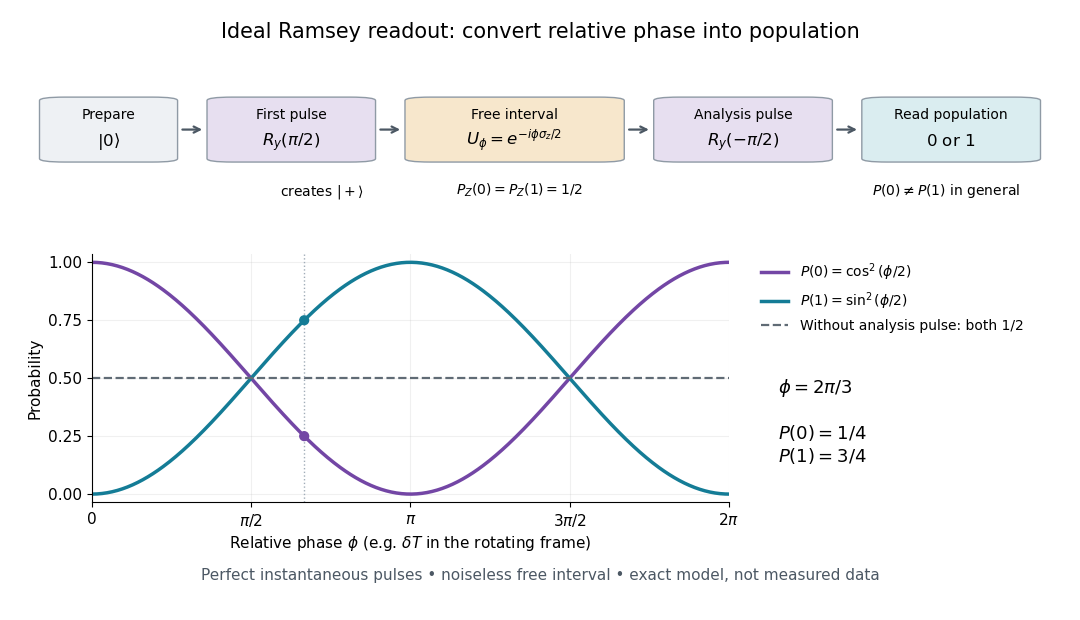

In a pulse experiment the phase is measured relative to the oscillator supplying the coherent pulses. In a rotating frame, write the free Hamiltonian operator as with signed angular frequency difference in the chosen labeling convention. A free interval then accumulates ; changing the second pulse's phase changes the analysis direction. This comparison makes Ramsey interferometry useful for measuring frequency differences and diagnosing loss of quantum coherence.
For example, suppose the first pulse has prepared a density matrix with equal populations and transverse Bloch vector length :The same inverse analysis pulse yields . The pure state case gives the full ideal fringe; the mixed state gives the flat result . This is a controlled mathematical comparison, not a fit to an experiment. Experimental contrast alone does not identify quantum decoherence: imperfect preparation, pulse errors and readout errors can also reduce it.
New to topics? Read the docs here!