Rayleigh scattering angular pattern
ID: rayleigh-scattering-angular-pattern

For incident unpolarized light and the isotropic electric dipole response of Rayleigh scattering by a small sphere, let be the angle between the incident beam's propagation direction and the outgoing direction. The differential scattering cross-section and its relative angular pattern arewhere is an element of solid angle. Averaging over the two transverse directions of incident polarization of an electromagnetic wave gives this pattern. Forward scattering at and backward scattering at are equally strong: . Sideways scattering at is weakest, but nonzero: . [ref]
https://farside.ph.utexas.edu/teaching/jk1/lectures/node107.html. Fitzpatrick, Thomson Scattering, equations 1283–1287: averaging the dipole angular pattern
.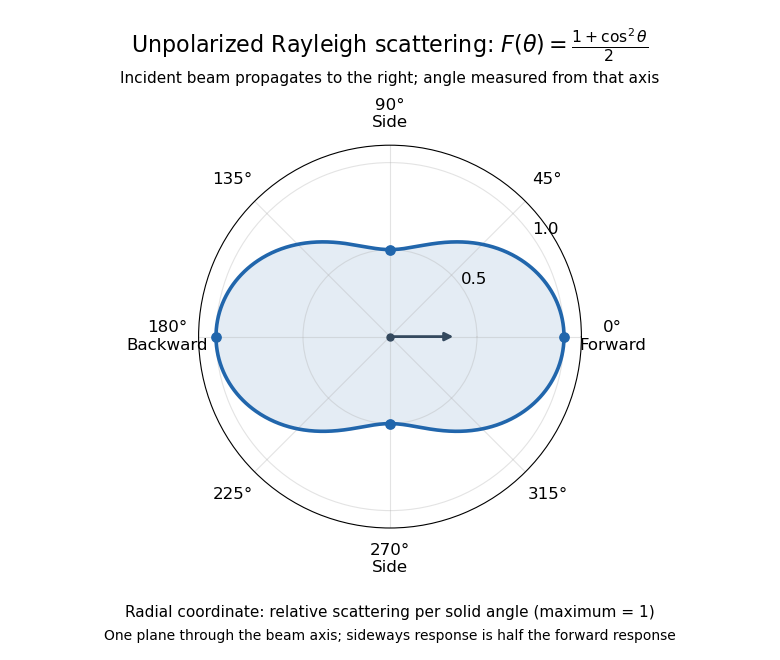
Rayleigh scattering angular pattern for incident unpolarized light, measured from the incident beam
. The plotted radial coordinate is , a relative differential scattering cross-section, rather than the distance travelled by light. The incident propagation axis points right: is forward, backward, and sideways. Rotating this plane about the incident axis gives the three-dimensional pattern. Details.
The normalization is consistent becauseThus integrating gives the total Rayleigh scattering cross-section . The plotted has maximum one; it is not itself normalized to unit solid angle integral.
For a single electric dipole driven by incident linear polarization, the angular distribution of electric dipole radiation instead has a factor, where is measured from the electric dipole moment direction, parallel to the incident electric field. That direction is perpendicular to the incident beam. Confusing with the beam angle would incorrectly predict zero forward scattering. Averaging the dipole patterns over incident unpolarized light yields the displayed .
New to topics? Read the docs here!