The electric dipole moment measures the first spatial moment of signed electric charge. For localized point charges at positions , or an integrable charge density with a finite first moment, define[ref].
The electric dipole moment is a vector with SI units : coulombs times length in metres. Opposite electric charges can cancel in while contributing in the same direction to . For a neutral pair with positive electric charge at and negative electric charge at ,Thus the electric dipole moment points from negative to positive electric charge, not along the attraction between the two point charges. [ref]
https://openstax.org/books/university-physics-volume-2/pages/5-7-electric-dipoles. Ling, Moebs and Sanny, University Physics 2, 5.7: charge-pair geometry and dipole moment
.Changing the coordinate origin changes the position vectors, not the physical electric charge distribution. If the new origin is at relative to the old origin, , so direct substitution givesConsequently charge neutrality makes the electric dipole moment independent of the origin. For a system with nonzero total electric charge, always specify the origin: a single point charge at the old origin has but . This is coordinate bookkeeping, not a newly created electric dipole. The full electric potential stays the same at the same physical point; the terms of its electric multipole expansion and the observation coordinates change together.
As a stipulated numerical example, put at and at . Their total electric charge is zero and . Translating the origin by leaves this electric dipole moment unchanged. Adding at the old origin instead gives and . Distinguishing these two cases prevents the mistaken claim that every electric dipole moment is independent of the origin.
The usefulness of the electric dipole moment is compression: many internal electric charges determine one vector governing the leading distant electric potential of a neutral localized object when . [ref]
https://www.feynmanlectures.caltech.edu/II_06.html#Ch6-S2. Feynman, Leighton and Sands, II.6.2: distant dipole fields
. A polar molecule need not literally contain two point charges; its atomic nuclei and electron density collectively give an electric dipole moment. For example, the chemical polarity of water reflects its bent molecular geometry, whereas the symmetric linear molecular geometry of carbon dioxide makes its permanent electric dipole moment vanish. [ref]https://openstax.org/books/chemistry-2e/pages/7-6-molecular-structure-and-polarity. Flowers, Theopold, Langley and Robinson, Chemistry 2e, 7.6: molecular geometry and polarity
. A collection of such electric dipole moments per unit volume gives electric polarization. [ref].Electric polarizability relates an induced electric dipole moment to an applied electric field. In a weak-field model with linearity, . A tensor response allows different electric field directions to induce electric dipole moments in different directions. A response that changes with molecular rotation enables rotational Raman spectroscopy.
A bound charge in a harmonic restoring potential has induced electric dipole moment . Completing the square proves this for every static field within the strictly harmonic model. First-order nondegenerate perturbation theory gives the same coefficient because the position operator connects the unperturbed ground state only to the first excited state. This exact response coefficient does not make its two-state wavefunction approximation exact.
The linear response relating an induced electric dipole moment to an applied electric field. In ordinary nonresonant Raman spectroscopy, changes in its symmetric components during a normal mode determine activity. These components transform like .
A slender high-permittivity particle responds mainly along its axis , giving . Far-field projection into an observation plane leaves one real polarization direction. Every nonzero output is therefore linearly polarized in this leading approximation, even for circular or unpolarized input.
The dynamic electric polarizability relates the induced electric dipole moment at a driving frequency to the applied electric field at that frequency in linear response theory. A complex coefficient can encode both a dispersive phase and absorption. For a charged one-dimensional quantum harmonic oscillator with charge magnitude , mass , and natural frequency , the undamped response isOne derivation uses the oscillator electric-dipole selection rule and first-order time-dependent perturbation theory. The same result follows from the classical Lorentz oscillator model: and imply . At exact resonance there is no bounded periodic response without damping; a finite switch-on produces secular growth rather than a finite steady-state value of the pole expression.
For a localized quantum harmonic oscillator along , let the transverse magnetic vector potential be for , with zero potential before the switch. The Coulomb gauge form of minimal coupling gives . The creation operator matrix element means that only is reached at first order from the ground state. Its interaction picture amplitude isIn particular , so resonant finite-time expressions are nonsingular. The induced electric dipole moment is . It contains a driven component with the dynamic electric polarizability and free-frequency transients required by the initial conditions. The discontinuity in gives an impulsive electric field and an initial mechanical velocity even though the initial canonical momentum has zero mean.
For a nondegenerate parity-symmetric ground state in an external electric field, write the perturbation as . The first-order state correction givesThe positive coefficient is the electric polarizability along the applied direction. Meanwhile second-order nondegenerate perturbation theory gives . Thus the induced electric dipole moment satisfies , not . The Hellmann–Feynman theorem independently gives .
A neutral isotropic atom with static electric polarizability in the field of a distant point charge has induced dipole and energy . Since ,The negative radial force is attractive for either sign of . Reversing reverses the induced dipole but not the energy or leading force. The factor accounts for the work of inducing the dipole; using the permanent-dipole energy without that work would double the answer. The approximation assumes weak fields, a slowly varying field across the atom and negligible electronic overlap.
For a localized charge and current distribution satisfying charge conservation from Maxwell equations,
A finite electric dipole consists of equal and opposite electric charges separated by a nonzero displacement. It has charge neutrality but a nonzero electric dipole moment . An ideal point electric dipole is the mathematical limit with fixed, so must increase as . Shrinking the separation while holding fixed instead makes the electric dipole moment vanish. The ideal electric dipole describes an exterior electric field; it does not reproduce the two near-charge singularities or the internal structure of a molecule. [ref]
https://farside.ph.utexas.edu/teaching/jk1/lectures/node20.html. Richard Fitzpatrick, Electric Dipoles: the fixed-moment point limit
.Place the pair's midpoint at the origin and write , where is vacuum permittivity. By superposition principle and Coulomb's law, its exact electric potential away from the two point charges isFor , retain the first nonzero term of a Taylor series. The electric potential and its negative gradient becomeHere and the products in parentheses are dot products. These are exact exterior formulas for the ideal electric dipole and distant approximations for a finite pair. The electric field on the outer axis points along with magnitude ; on the perpendicular bisector it points opposite with magnitude . This directional structure is what a scalar total electric charge misses. [ref]
https://www.feynmanlectures.caltech.edu/II_06.html#Ch6-S2. Feynman, Leighton and Sands, II.6.2: exact pair potential and dipole expansion
.In a prescribed uniform external electric field , a rigid pair has opposite forces . Its net force is zero, but summing their moments about the midpoint gives the torqueThe cross product makes the torque perpendicular to both the electric dipole moment and the external electric field. If is the angle from to in their plane, the signed turning torque is . It tends to reduce a small positive . [ref]
https://openstax.org/books/university-physics-volume-2/pages/5-7-electric-dipoles. Ling, Moebs and Sanny, University Physics 2, 5.7: forces and torque on a dipole
.The external interaction potential energy, with zero chosen at , isParallel alignment minimizes this potential energy; antiparallel alignment maximizes it even though the torque is zero in both positions. This omits the pair's constant internal binding potential energy and assumes a fixed permanent electric dipole moment. [ref].
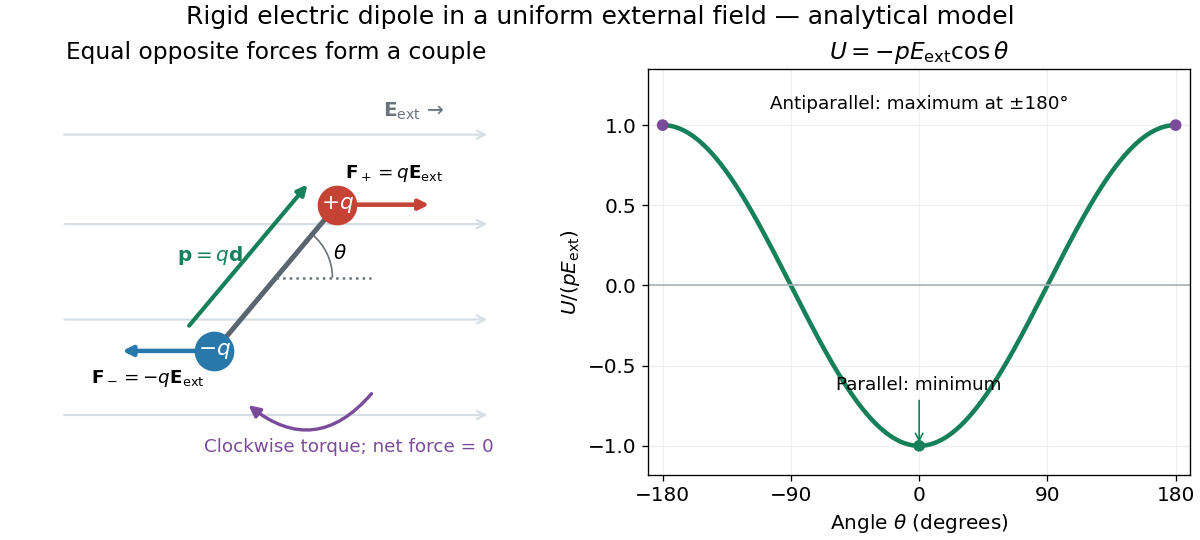
A nonuniform external electric field can exert a net force on a neutral electric dipole. Before taking the small-pair approximation, the exact external force is , where is the midpoint. A first-order Taylor series gives, for a fixed electric dipole moment and an external electric field varying slowly across ,in electrostatics. The last equality uses the vanishing curl of the external electric field, with held fixed while differentiating. Thus uniform external electric fields turn a misaligned electric dipole, whereas gradients can also move its midpoint. For example, the local source-free electric field gives , so reversing the electric dipole moment reverses the net force. This stipulated local model has zero divergence and zero curl.
A motivating experiment is Filsinger and colleagues' study of electrostatic deflection of polar molecules. Benzonitrile () in helium expanded from a pulsed valve into vacuum; two 1-mm skimmers narrowed the beam before a 15-cm deflector. A grounded trough and a high-voltage rod produced a vertical electric field gradient. Scanning a focused laser vertically downstream and recording benzonitrile ions from photoionization measured the beam's relative density. With voltage off, the profile spanned about 2 mm; applying voltage shifted and broadened it upwards. At 10 kV, many molecules lay outside the original profile. [ref]
https://pure.mpg.de/pubman/item/item_736019_2/component/file_736018/433451%28filsinger%29.pdf. Filsinger et al., Quantum state selection, alignment, and orientation of large molecules using static electric and laser fields, sections II and III A, figure 3
.Interpretation uses a quantum state's Stark effect energy : gives . States whose energy falls with increasing electric field seek stronger fields. The voltage-off profile controls the mechanical aperture. Inferring state populations needs calculated trajectories, speed distributions and a rotational temperature model; profile displacement alone does not measure a permanent electric dipole moment uniquely. This is an electric Stark effect experiment, with photoionization occurring after deflection. [ref]
https://pure.mpg.de/pubman/item/item_736019_2/component/file_736018/433451%28filsinger%29.pdf. Filsinger et al., section III A: Stark slopes, trajectory modelling and state selection
.For the symmetric finite pair, the first omitted electric multipole expansion term after the electric dipole is third order, so typical relative errors scale as . This stronger error estimate need not hold for an arbitrary neutral molecule with a nonzero electric quadrupole moment. A concrete check for a pair on the axis compares the exact and ideal electric fields at on the positive axis and at on the perpendicular bisector:Both perpendicular-bisector components are negative. At , the ratios are approximately and : errors of and relative to the ideal electric field. The condition concerns observing the pair's own electric field; the separate condition for its external force approximation concerns variation of the applied electric field across the pair.
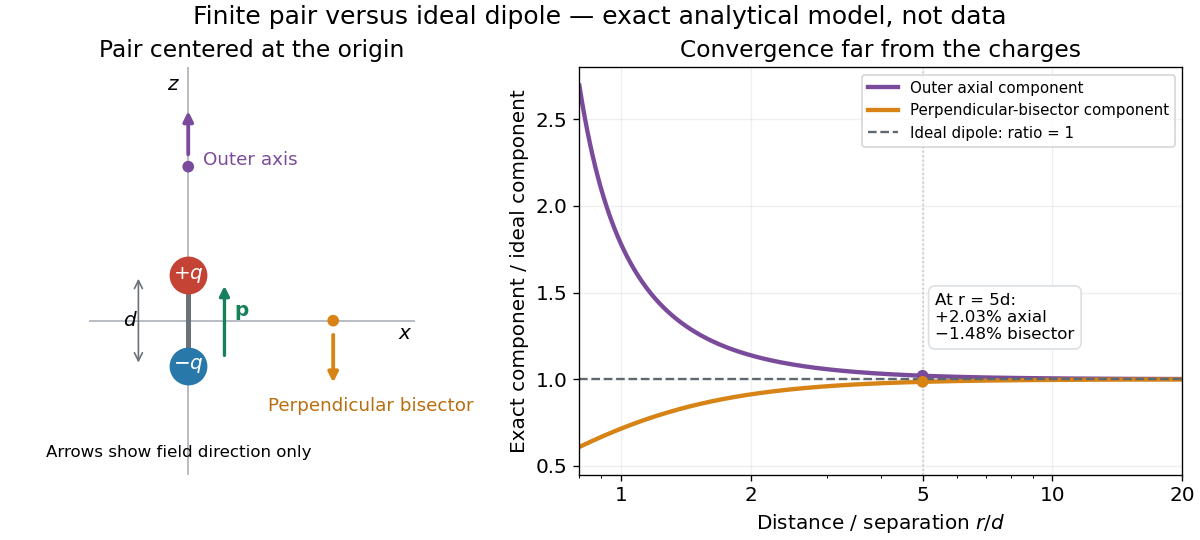
At distances large compared with the separation of a neutral charge pair, its electric field has the displayed leading form in terms of the electric dipole moment . Measure the polar angle from . The radial and angular components are and , giving . At fixed radius the polar field magnitude is twice the equatorial one. This leading neutral-pair field falls as , faster than the electric field of an isolated point charge.
For potential energy homogeneous of degree , Newton's second law gives . Indeed, Euler's identity implies , so the second derivative equals . Thus a trajectory with zero total energy and initially zero radial velocity remains on a sphere of constant radius. A positive electric charge released from rest on the equator of a fixed ideal electric dipole has these properties; in its meridional plane it oscillates on the semicircle on the negative-pole side. A finite two-charge electric dipole does not have exactly homogeneous potential energy and perturbs this result.
The formula combines the source electric dipole field with the second dipole's coupling to that field.
The point-dipole energy is . If the separation is perpendicular to the first dipole, the second term vanishes. Parallel dipoles then have positive energy , while mutually perpendicular dipoles give zero in this approximation. Real molecular interactions can include multipoles, induction and short-range contributions beyond this point-dipole term.
Reduction of an effective electric dipole moment by the opposing local field of neighboring dipoles.
Articles by others on the same topic



The electric dipole moment is a measure of the separation of positive and negative charges within a system. It is a vector quantity that indicates the strength and direction of an electric dipole.