
Rolle's theorem is the equal-endpoint case of the mean value theorem. Let and let the real-valued function be continuous on the closed interval and differentiable on the open interval . If , there exists with . Geometrically, a tangent line somewhere in the interior is horizontal, like the secant line joining the endpoints. [ref]
For the polynomial on , both endpoint values are zero and the derivative is . Thus , where , and the horizontal tangent line is . The horizontal secant line is : equal endpoint values do not force the interior tangent line to pass through those endpoints.
The absolute value function on exposes the importance of differentiability. It is continuous and , so the secant line has slope zero. However,and the derivative does not exist at zero because the one-sided derivatives disagree. Every existing derivative in the interior is nonzero. The corner fails a hypothesis of both Rolle's theorem and the mean value theorem, so neither conclusion is guaranteed.
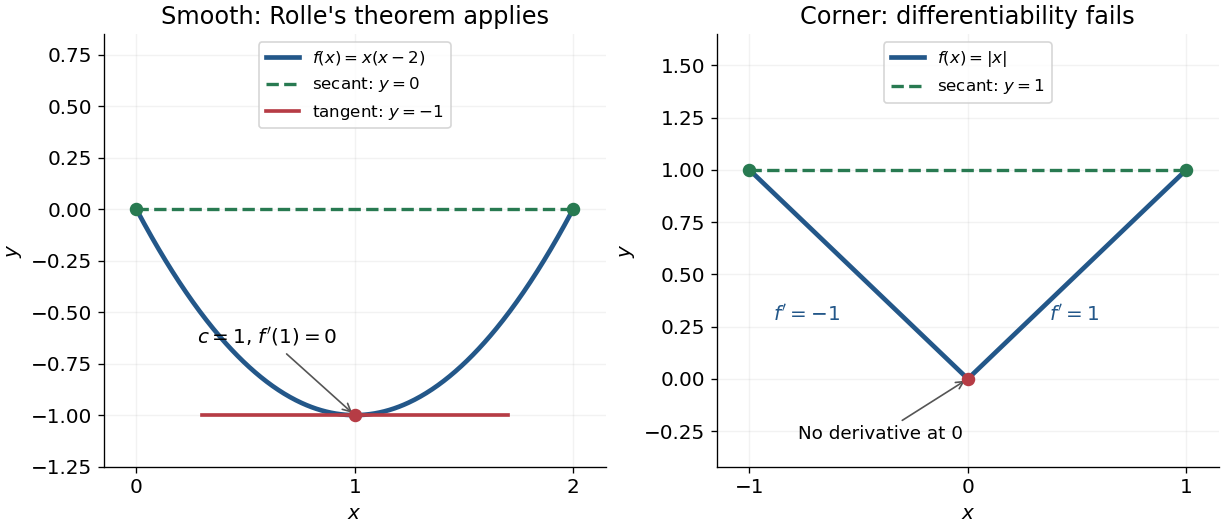
Rolle's theorem gives a horizontal tangent line for a polynomial, while a corner defeats differentiability
. Details. 
For a short proof, the extreme value theorem supplies a greatest and a least value on . If is a constant function, every interior point works. Otherwise at least one of these values differs from the common endpoint value, so it is attained at an interior extremum. At an interior local maximum or local minimum, differentiability forces the derivative to be zero: the difference quotients from the two sides have opposite weak signs and the same limit.
This turns repeated values into information about derivatives. Two distinct roots of a polynomial force a root of its derivative between them; iterating this idea gives the Rolle root count with multiplicities. More generally, a differentiable function with nonzero derivative throughout a real interval cannot repeat a value there, hence is injective. The beauty is that knowing only two equal values guarantees an exact local feature somewhere between them.
New to topics? Read the docs here!