Sheet elastocapillary energy ratio
ID: sheet-elastocapillary-energy-ratio

The sheet elastocapillary energy ratio compares capillary and bending energy scales for an elastic sheet:Here is a lateral size, is surface tension, is plate bending stiffness and is the elastocapillary length. The ratio is a dimensionless quantity: and both have units of energy.
The estimate assumes bending through an angle of order one over size . Then curvature scales as and integrating the bending energy density over area gives a scale . A comparable change in interfacial area gives a surface energy scale . The same balance underlies the capillary origami study's definition of elastocapillary length.[ref]
For an original calculation, take , and . Then . Doubling alone raises it to 10. Halving thickness at fixed , Young's modulus and Poisson's ratio divides by eight and raises to 20.
Changing all dimensions gives another trend. Write and keep material properties and surface tension fixed. At fixed thickness, ; at fixed aspect ratio , and . Thus halving alone gives one quarter of the initial ratio, while halving both and doubles it.
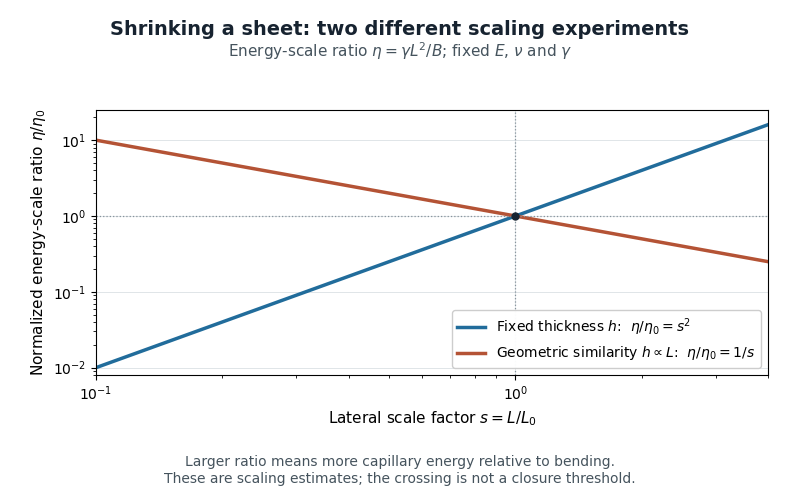
Two size-scaling paths for the sheet elastocapillary energy ratio
. Reuses the original normalized scaling plot: fixed thickness gives , while geometric similarity gives . The curves are dimensional estimates, not measured wrapping thresholds. Details.
A larger ratio makes capillary energy more competitive with bending, but does not establish complete closure. Actual wetting, contact angle, droplet volume, contact-line pinning and accessible deformation paths also matter. The ratio compares scales rather than computing the full change in energy along a folding path.
New to topics? Read the docs here!