Spatial sampling of a wave
ID: spatial-sampling-of-a-wave

In spatial sampling of a wave, a detector records a wave at positions separated by pitch . Angular wavenumbers differing by , with integers , give identical samples of a complex Fourier mode:This is spatial aliasing. To distinguish arbitrary sinusoids within a prescribed band, require , equivalently , the Nyquist spatial frequency. Thus for the shortest allowed wavelength. At equality a sine can vanish at every sample, so phase information can be lost. The Nyquist–Shannon sampling theorem states the precise reconstruction conditions for a bandlimited function; a finite scan introduces further limitations.
The synthetic two-tone snapshot iswhere both count cycles per metre. The component wavelengths are and . With , both lie below the Nyquist spatial frequency of cycles per metre. With , the -cycle component aliases to the -cycle component: at every , . The sampled sum is therefore indistinguishable from , although the continuous curves differ between samples. Drawing lines between sample points cannot resolve this ambiguity.
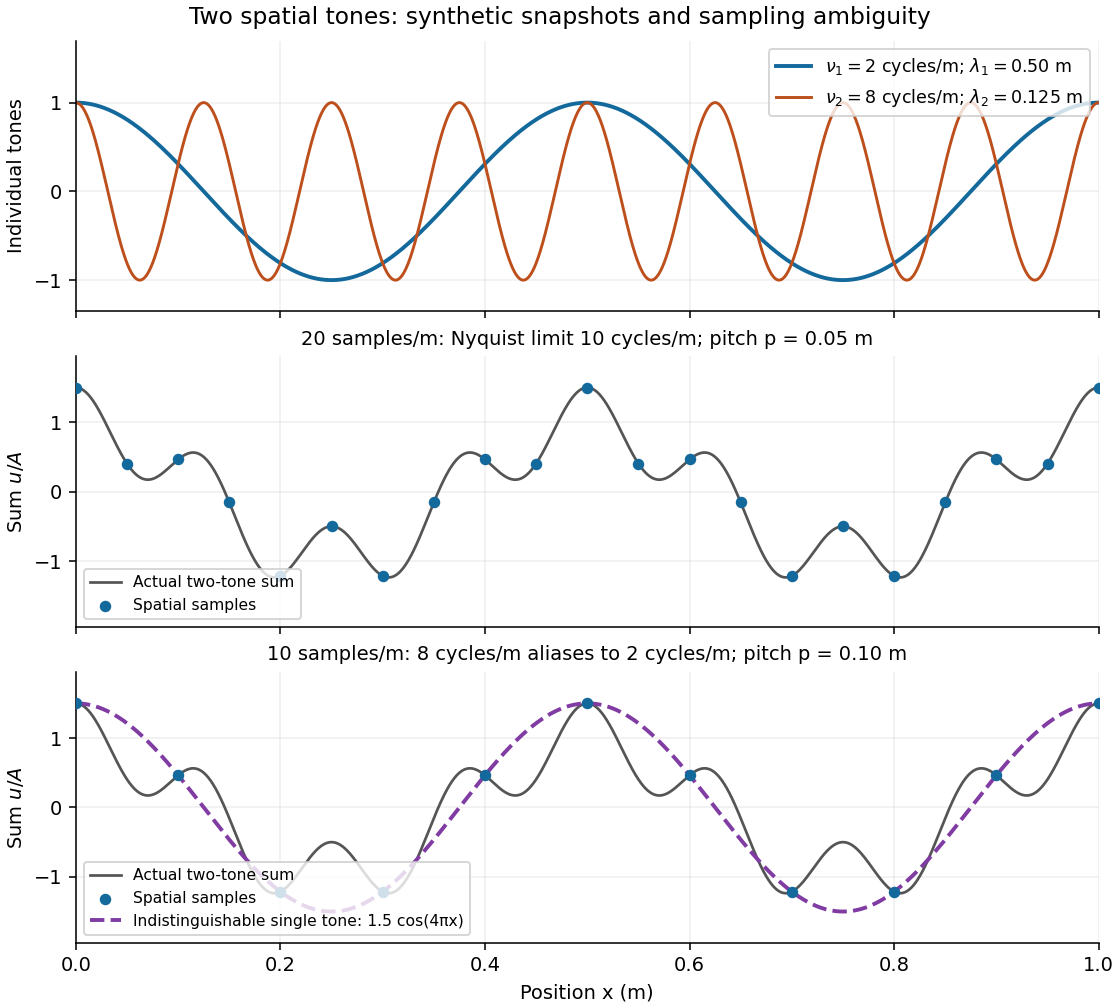
Synthetic two-tone spatial waveform: fine samples distinguish the components, coarse samples hide the shorter wavelength
. Details. 
New to topics? Read the docs here!