The Nyquist–Shannon sampling theorem says that a bandlimited function can be recovered exactly from equally spaced samples, provided the sampling rate is high enough. It is the bridge between a continuous waveform and a sequence of numbers: the missing values between samples are determined by the restriction on its frequencies.
Here is a precise finite-energy version. Let , meaning , and suppose its Fourier transform, defined through the Plancherel theorem, is zero outside . Thus is the largest allowed ordinary frequency, in cycles per second, rather than an angular frequency. Set , where is the number of samples per second. If , the continuous representative of is recovered byThe quotient is the normalized sinc function, with value one when its argument is zero. Each shifted sinc function is one at its own sampling time and zero at every other sampling time. Its coefficient is therefore exactly the required sample value. For this L2 space formulation, the reconstruction converges in the L2 space norm and uniformly in . The critical rate is allowed for this class; choosing leaves a gap between the occupied frequencies and the sampling boundary.
For a numerical example, a bandlimited function with no frequencies above cycles per second can be reconstructed from its samples every seconds: . Exact reconstruction uses the whole sequence indexed by . A finite recording and a finite sum of sinc functions introduce truncation error; joining adjacent samples by straight lines is generally a different reconstruction.
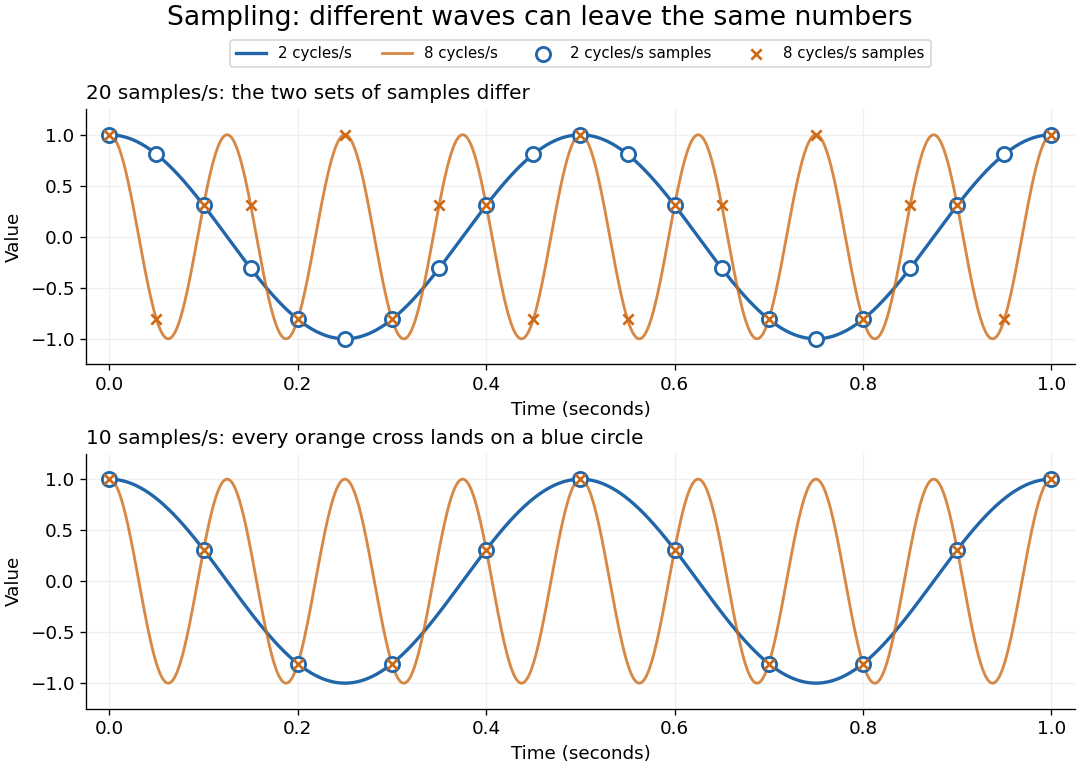
The obstruction is aliasing. At sampling rate , the two distinct waveformshave identical samples at , becauseThe samples alone cannot tell whether the waveform oscillates twice or eight times per second. If we know in advance that all frequencies are below , the -cycle waveform is excluded and the ambiguity disappears. These pure cosines are an illustrative aliasing example, rather than members of the finite-energy L2 space class in the stated theorem.
Exactly at a sampling boundary, the function class matters. At rate , the sine has zero values at every . It is a nonzero waveform indistinguishable from zero on that grid, but has infinite energy and is excluded by the finite-energy hypothesis above. This explains why a rule intended to cover arbitrary pure sinusoids should demand a strict inequality. For spatial data, replace seconds by distance: the Nyquist spatial frequency is for sample pitch .
The proof idea is short: the samples are Fourier coefficients of the Fourier transform restricted to a sampling-sized frequency interval. Because a bandlimited function has no contribution outside that interval, its Fourier series determines the whole Fourier transform; Fourier inversion then gives the sinc function expansion. See sampling expansion by periodic Fourier projection for this connection.
Claude E. Shannon's Communication in the Presence of Noise (1949), Section II, Theorem 1 and equation (7), gives the sampling statement and reconstruction using shifted sinc functions in a communication setting. Shannon explicitly notes earlier mathematical forms and credits Nyquist with emphasizing the sampling interval in telegraphy.[ref]
https://fab.cba.mit.edu/classes/S62.12/docs/Shannon_noise.pdf. Shannon 1949, Proceedings of the IRE 37(1), pp. 10–21; sampling theorem on pp. 11–12
For uniform samples at rate , the frequency is the Nyquist frequency. A real baseband signal confined below this boundary can avoid spectral overlap when an appropriate anti-aliasing filter is used.
Aliasing is the inability to distinguish different continuous frequencies from sampled values. The identity above says that frequencies separated by an integer multiple of the sampling rate give identical samples of a complex Fourier mode. For real cosines, changing the sign of a frequency also gives the same waveform, explaining the -versus- example at rate . The Nyquist–Shannon sampling theorem prevents this ambiguity within its specified class of bandlimited functions. Before sampling, unwanted higher frequencies must be suppressed if they would violate that assumption; once two waveforms give the same samples, those samples cannot identify which was present.
Ambiguity between spatial oscillations sampled on a grid. At positions , the factors and agree for every integer . Spatial wavenumbers outside therefore cannot be distinguished without additional assumptions. For a traveling event of temporal frequency and apparent speed , the associated criterion is , with a margin for filtering. Temporal oversampling does not remove this spatial ambiguity.
An anti-aliasing filter suppresses signal components outside the intended acquisition band before sampling. For voltage recording it is an analogue filter ahead of the analog-to-digital converter, with a transition band allowed below half the sampling rate. Once two frequencies have become indistinguishable through aliasing, a digital filter generally cannot recover the lost distinction. The Nyquist–Shannon sampling theorem concerns an already bandlimited function; a physical filter approximates that prerequisite.
For every , choose a nonzero smooth spectral bump supported in with , and let be its inverse Fourier transform. Then is a nonzero Schwartz function, vanishes on all integer samples, and its transform is the difference of bumps shifted to and . Its support lies strictly within . Thus even a small bandwidth increase destroys uniqueness from unit-spaced samples.
When the continuous Fourier transform of an integrable function vanishes outside , its periodic Fourier coefficients are the integer samples of the continuous representative of , with the sign of the index reversed. Projecting in and then applying the Fourier inversion theorem gives the displayed reconstruction using the normalized sinc function, with each quotient defined as one when . The Cauchy-Schwarz inequality controls the reconstruction error uniformly in . Bessel's inequality bounds the vector of shifted sinc functions, giving absolute uniform tails when the sample sequence belongs to .
Samples spaced by pitch can distinguish spatial frequencies strictly below cycles per unit length. Thus the shortest limiting wavelength is ; exactly at the limit a sinusoid's phase can make all samples vanish. A practical deformable mirror has additional limits from actuator influence functions and finite pupil geometry.
Articles by others on the same topic


The Nyquist-Shannon sampling theorem, also known as the Nyquist theorem, is a fundamental principle in the field of signal processing and information theory. It provides a criterion for how often an analog signal must be sampled to be accurately reconstructed from its samples without losing any information.