Stellar intensity interferometry
ID: stellar-intensity-interferometry

Stellar intensity interferometry measures a star's angular diameter by comparing fluctuations of detected light intensity at separated collectors. Each collector has its own photodetector; an analog multiplier or a digital correlator compares the electrical outputs. Changing the interferometric baseline changes the sampled spatial optical coherence. An unresolved star produces correlated fluctuations; a resolved extended source supplies different mixtures of emission directions, reducing their correlation.
This makes a useful telescope out of a surprising observable: the fluctuations discarded by an ordinary average-brightness measurement. Optical beams need not travel to a common combiner. A relative wave phase perturbation leaves unchanged, so pure phase errors do not directly change the local light intensity. Electronic delay alignment remains necessary; intensity changes from atmospheric scintillation, collection losses, and instrumental noise still require controls.
Let join the collectors and let be the unit line of sight toward the star. The relevant interferometric baseline is its projection onto the plane of the sky:The reference arrival-time difference has magnitude , with speed of light . Correct that delay, with a sign fixed by channel order, before averaging the residual correlation at . The physical collector separation equals only when it is perpendicular to ; tracking a star can change the projection even for fixed collectors.
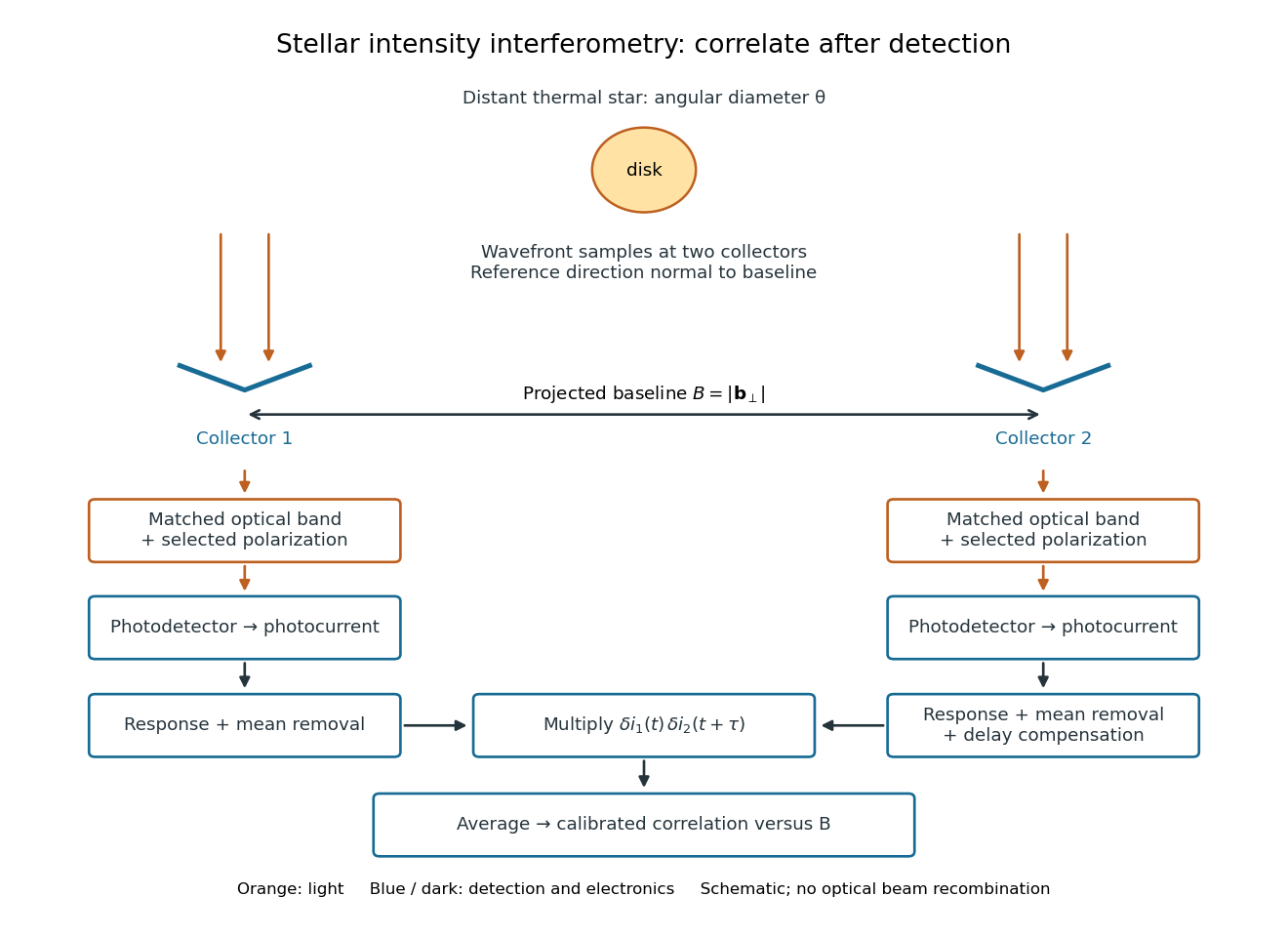
Functional geometry of stellar intensity interferometry: separate optical detection followed by electrical correlation
. Original schematic with the reference direction normal to the baseline. Matched optical selection feeds independent detectors; mean removal, response and delay alignment precede multiplication and averaging. This is not a scale drawing of the historical apparatus. Details.
New to topics? Read the docs here!