A photodetector capable of registering an individual absorbed photon as a distinguishable event. The detection record may include a click time and an output-channel label. Such a detector need not resolve the number of photons in a pulse: an ordinary single-pixel single-photon avalanche diode produces essentially the same saturated avalanche pulse when one or several photons trigger the same detection interval. Detector efficiency, dark counts and detector dead time affect the observed photon counting statistics.
A registered detector event occurring without an incident signal photon. For a single-photon avalanche diode, internally generated carriers can trigger the same avalanche as an absorbed photon. The dark-count rate is the mean number of these events per unit time under specified operating conditions. Such events can contaminate coincidence counting and increase the quantum bit error rate in quantum key distribution.
Noise-equivalent radiance is the incident radiance change producing signal-to-noise ratio one for a specified spectral and electrical bandwidth. A linear radiometer with voltage response and RMS voltage noise has . Its convention must distinguish per-sample noise from a noise amplitude per square-root bandwidth.
The ratio between a stated upper usable detector signal and a lower detectable or resolvable signal under specified measurement conditions. Exposure duration, read noise, saturation, digitization and the required linearity can all affect the quoted value. It is not determined by full well capacity alone.
The charge that an integrating detector well can hold within its stated operating specification before saturation or overflow compromises the response. It differs from the digitizer limit and from the largest signal that is accurately linear. In a charge-coupled device, excess charge can cause blooming into adjacent pixels.
Two or more photons detected within one unresolved spatial and temporal event cell can be registered as one event, have their energies combined, or be rejected by event grading. In an X-ray CCD, low mean occupancy per event island per frame is needed for reliable individual-photon spectroscopy. Reducing frame time or spreading the image can reduce this effect.
A photodetector in which light releases electrons from a cathode into a vacuum, and an anode collects them. A positive collecting-anode bias relative to the emitting cathode drives collection across the vacuum gap.
A bolometer detects absorbed electromagnetic radiation through the resulting change in temperature, often read as a change in electrical resistance. Its response depends on absorbed power, so interpreting an optical spectrum requires accounting for the incident wavelength band and detector calibration.
For a photodiode in its linear regime, spectral responsivity is the dark-subtracted electric current per incident radiant flux in a narrow band at wavelength , measured in . More generally a photodetector's readout can be electrical voltage or another quantity, with corresponding units. A broad-band readout weights the incoming optical spectrum by the detector's spectral responsivity; it is not the unweighted total incident power. [ref]
https://www.nist.gov/programs-projects/spectral-responsivity-measurements-and-spatial-spectral-power-responsivity. NIST, Spectral responsivity measurements: wavelength-dependent sensitivity and spatial characterization
.A photodetector bias frame is an exposure of effectively zero integration time used to estimate the electronic offset and read noise. For independent identical bias reads, the variance of their difference is twice the single-read variance; subtracting an estimated mean bias removes the offset but adds the uncertainty of that estimate.
Flat-field correction compensates stable multiplicative variations in photodetector response using calibrated illumination. Identically illuminated exposure ratios cancel the stable response in their mean, but their photon shot noise remains signal dependent.
An analogue-to-digital unit is a unit of a digitized photodetector output after electronic conversion. Its relation to collected electrons is set by the detector conversion gain; an additive electronic offset must be removed before interpreting a count as a light signal.
Detector conversion gain is the number of collected electrons per analogue-to-digital unit. With independent Poisson distribution photoelectron counts, the shot-noise variance in count units is the mean count divided by the gain. Detected-photon and electron conventions agree only when each detected photon contributes one electron.
Let independent exposure sums have mean ADU at each detector pixel, with pure Poisson distribution noise and fixed gain . The delta method gives , so and . For nonuniform detector pixel means , an unweighted spatial ratio variance is instead . This high-count approximation requires linear unsaturated data, bias subtraction and negligible read noise.
For stable positive detector pixel means and uniform detector conversion gain , high-count independent Poisson distribution noise gives . Thus substituting a global mean in the equal-signal formula yields , by the Jensen inequality. Equality holds for uniform means. The flat-field correction pattern cancels from the ratio mean but not from the signal-dependent noise. Local signal bins, or a variance fit after normalization of differences by the square root of their local mean, avoid this leading bias.
An optical photodetector detector pixel is a spatially sampled photosensitive element. Counts from distinct detector pixels have independent photon shot noise in the ideal model, but charge transfer, electrical coupling and resampling can produce covariance.
A photodiode is a semiconductor diode producing photocurrent from photon absorption. Exciting an electron across the band gap leaves an electron hole. The depletion region's electric field separates the charge carriers; others can arrive by diffusion before electron-hole recombination. Contacts complete the electrical circuit.[ref]
Si photodiodes by Hamamatsu Photonics K.K.. Si photodiodes, p. 2, §1-1 and Figs. 1-1–1-2: generation, separation and collection
The useful bridge is from light to a measurable electric current: spectral responsivity converts incident radiant flux into photocurrent, while quantum efficiency counts collected signal charge carriers per incident photon. These answer different questions: how much electric current one watt produces, and how many incident photons contribute to the signal. The worked calculation below makes their relationship explicit.
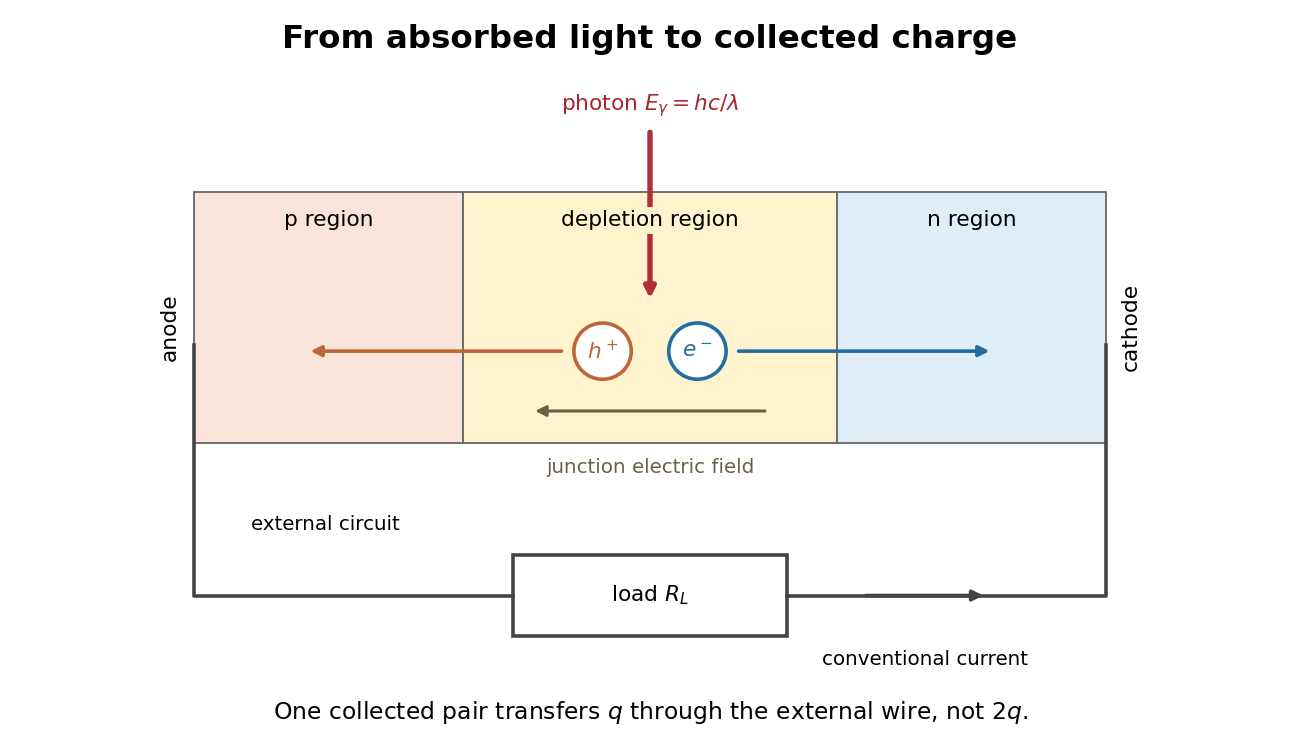
Photon absorption, junction separation and an external electric current
. Original qualitative p-n junction schematic with an external resistor. Collecting one electron–electron hole pair transfers one elementary charge through the external electrical circuit, rather than twice that amount. Dimensions and paths are schematic. Details.A photodiode with a strong internal electric field in which photogenerated charge carriers undergo impact ionization, amplifying the initial signal. Linear multiplication below breakdown and saturated single-event operation above breakdown are distinct operating regimes. A single-photon avalanche diode uses the latter.
A single-photon detector based on a reverse-biased photodiode operated above its breakdown voltage. A carrier generated by photon absorption can trigger a self-sustaining impact ionization avalanche. Quenching lowers the bias to stop that avalanche; recovery creates detector dead time. Random internally generated carriers can also trigger indistinguishable pulses, producing dark counts. Single-photon avalanche diodes ordinarily detect an event rather than resolve the incident photon number. [ref]
https://hub.hamamatsu.com/us/en/ask-an-engineer/detectors/sipm-mppc-spad-questions-and-answers.html. Hamamatsu Photonics, What is SPAD? and How does a SPAD work?: above-breakdown bias and quenching
Subtracting two photocurrents can suppress a shared classical intensity fluctuation when the optical responses and electronic gains are matched. Independent shot noise contributions do not cancel: their variances add in the difference. With equal charge and mean currents , the independent-arrival one-sided current power spectral density is . Correlated optical inputs require their covariance as well.
A photodiode divided into four independently read segments. Differences of opposite segment signals can encode a light distribution's displacement after measurement calibration.
Photocurrent is the electric current attributable to illumination. Here denotes its magnitude after background subtraction. For a photodiode without internal multiplication, let be incident radiant flux concentrated at wavelength , and let be external quantum efficiency, including losses before collection. An incident photon has energy , with Planck constant and speed of light . Dividing energy per second by energy per photon gives the incident photon rate . Multiplying by gives the mean collected pair rate ; multiplying by elementary charge givesThe factor is : each collected pair replenishes an electron at one contact and removes an electron at the other. A cross-section of the external wire therefore counts one transferred electron per completed pair, consistent with charge conservation. The electron and electron hole are two internal charge carriers, not two independent transfers through that wire.
Choose an illustrative photodiode model with , and . Using the exact SI values , and givesA mean fraction does not require each fourth photon to be lost in a repeating pattern. It specifies a mean conversion rate. Nor does mean : quantum efficiency is dimensionless, whereas spectral responsivity compares electric current with power.
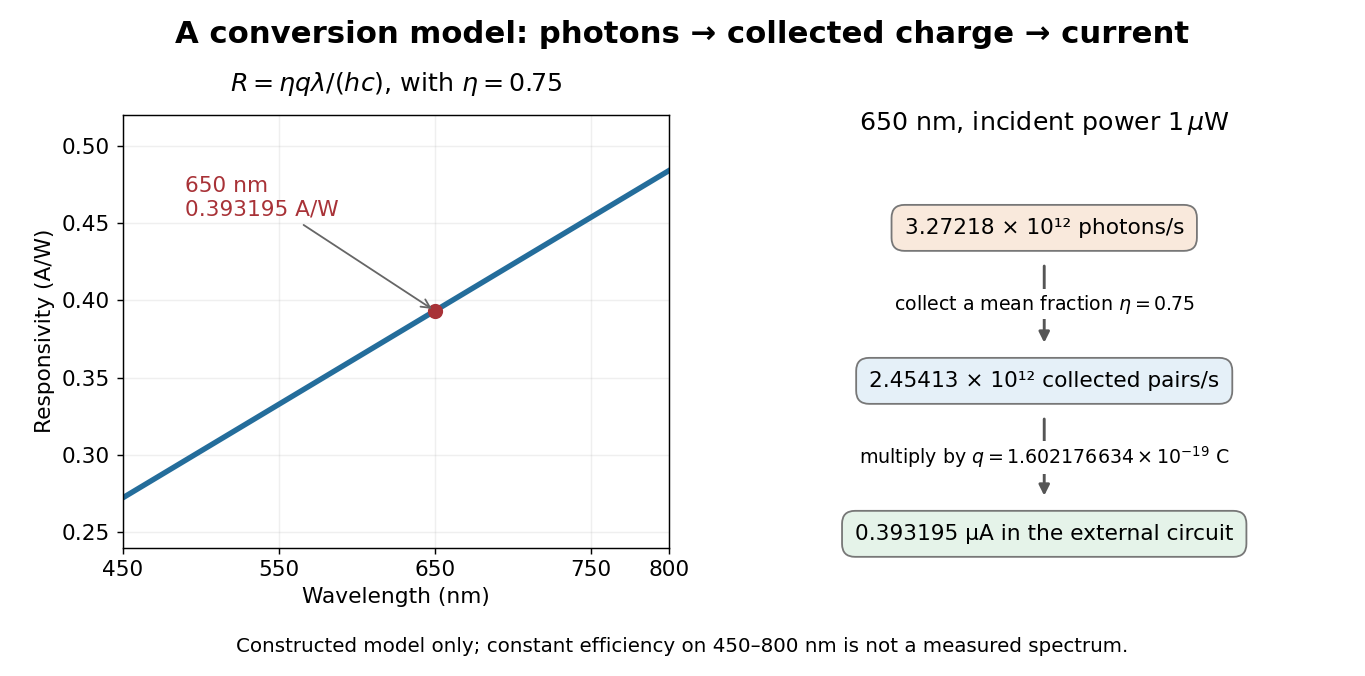
At fixed radiant flux, longer-wavelength photons have less energy, so more arrive per second. This explains the rising straight line when quantum efficiency is held constant. A real photodiode's quantum efficiency varies with wavelength; the plotted assumption cannot be extended past its band gap absorption cutoff. At fixed incident photon rate instead, has no additional factor of .
Photovoltaic mode uses no external reverse bias: a transimpedance amplifier can hold zero terminal electric potential difference, while an open electrical circuit develops a photovoltage. Photoconductive mode biases the diode cathode positive relative to the diode anode, generally reducing junction capacitance and increasing speed and dark current.[ref]
A simple calculation separates the readout from the conversion. If a linear transimpedance amplifier has feedback electrical resistance , the model above produces an output change of magnitude . The output sign depends on the connection. Increasing increases that electric potential difference, but does not create more collected charge carriers.
For a reverse-biased photodiode feeding an electrical load , Ohm's law gives a readout magnitude while the response remains linear. With negligible dark current and other series drops, the remaining reverse bias is , where is the supply magnitude. Thus the chosen electrical load can consume the available bias: a larger readout does not automatically reduce measurement uncertainty. For the same constructed example, and leave about ; this algebra alone does not establish a real device's linear range.
Thorlabs' silicon FDS100 experiment sends a collimated, fibre-coupled laser beam through a beam splitter to the photodiode and a reference optical power meter. Varying reverse bias and electrical load tests linearity. The measured readout approaches saturation when its electric potential difference consumes the bias.[ref]
Photodiodes by Thorlabs. Photodiodes, Lab Facts, Photodiode Saturation Limit and Noise Floor, opening experiment description and Figs. 1–3: reference power sensor, bias/load comparisons and saturation
A separate low-signal setup uses a laser, polarizers, an optical chopper, optical attenuators and a lock-in amplifier inside a light-tight enclosure. These are actual apparatus choices, not the parameters of the constructed example above.[ref]Photodiode Saturation and Noise Floor by Thorlabs. Photodiode Saturation and Noise Floor, p. 7 of 12, Experimental Design — Noise Floor: 637 nm source, polarizers, chopper, attenuation filters, lock-in readout and light-tight enclosure
For an independent dark current check, Thorlabs enclosed a photodiode in nested metal boxes to exclude light and suppress interference, used a Keithley 6487 ammeter supplying reverse bias, and monitored temperature. Only one specimen per type was tested; the nearby temperature sensor did not directly contact the semiconductor. Such a dark control measures the baseline but cannot certify spectral responsivity.[ref]
Photodiodes by Thorlabs. Photodiodes, Lab Facts, Dark Current as a Function of Temperature, Experimental Setup and Experimental Limitations: nested enclosure, ammeter and specimen/temperature limitations
To infer spectral responsivity at a selected wavelength, measure the radiant flux actually reaching the test photodiode, rather than just the reference arm. A reference-arm measurement calibration must include the beam splitter ratio and path losses. With signed readouts in one fixed orientation, subtract a beam-blocked baseline and usefor direct electric current readout or a calibrated linear transimpedance amplifier, respectively. Repeating at several incident powers tests whether this ratio is constant. Blocking only the source estimates ambient light plus electronic baseline; covering the detector excludes ambient light too. Their difference distinguishes optical background from dark current and readout offset. For a broad optical spectrum, the ratio is a spectrum-weighted response, not generally at one wavelength.
For independent Poisson distribution collection, the root mean square shot noise in a one-sided rectangular frequency band of signal bandwidth isHere is reverse dark current; thermal electrical noise and amplifier noise also contribute.[ref]
Si photodiodes by Hamamatsu Photonics K.K.. Si photodiodes, p. 6, §2-4, equations (2-4)–(2-7): independent thermal, dark-current and photocurrent noise terms
Subtracting a mean dark current removes its offset, not its fluctuations: subtracting a constant leaves the variance unchanged. Consequently makes dark current shot noise small relative to signal shot noise; it does not by itself establish high signal-to-noise ratio. With an independently measured baseline, the variance of that estimate must also be propagated. Increasing the measurement signal bandwidth raises the admitted noise. Calibration of wavelength, reference radiant flux, readout gain and collection geometry, together with drift and linearity, determines what measurement uncertainty can be claimed.
Dark current is charge produced in a detector without illumination, often by thermally excited carriers. Cooling reduces it, although cooling requirements also depend on the wavelength range and thermal background.
A hybrid infrared detector bonds a photosensitive semiconductor array to a separate silicon readout circuit. Each pixel has its own electrical connection; charge need not be transferred across the array as in a charge-coupled device.
A detector reference pixel has no illuminated photosensitive connection and samples readout offsets. Reference-pixel subtraction can suppress common electronic drifts but does not measure the sky background or all pixel-dependent errors.
A nondestructive read samples a pixel’s accumulated signal without resetting it. Repeated samples permit Fowler sampling and up-the-ramp sampling, and can help identify saturation and cosmic-ray charge steps.
Up-the-ramp sampling measures accumulated charge repeatedly through an exposure and estimates flux from its slope. Cosmic-ray steps, saturation and nonlinearity must be identified or modelled.
Fowler sampling averages several nondestructive reads near the start and end of an integration and differences the two averages. For independent equal read noise, averaging lowers the read-noise variance; correlated noise limits the improvement.
The HAWAII-2RG architecture has a grid with an 18-micrometre pitch. For infrared work its readout circuit is normally bonded to a mercury cadmium telluride absorber. Reference pixels track electronic offsets and an independently addressed guide window can be read alongside the science array.
Background subtraction estimates a source contribution by removing a sky or detector-background measurement. An independent background estimate adds photon shot noise; a mismatched background adds bias of an estimator.
If emitted power obeys with known constant , then small relative temperature uncertainty is one quarter of relative net-power uncertainty. For measured quantities with covariance , . A weak net signal obtained by subtracting a large background can therefore have poor relative precision even when both original powers are measured accurately. Correlated standard uncertainties and worst-case error bounds require different propagation rules.
Let and be independent. Then has source-estimation bias and variance . Its accuracy ratio tends to when , and grows. This uses mean squared error, not variance alone, and assumes a fixed uncorrected mismatch.
Read noise is uncertainty added by measuring detector charge or voltage. It is often expressed as an equivalent number of input electrons per pixel per read.
Independent photon arrivals have a Poisson distribution: a mean count has variance and standard deviation . Subtraction of independent counting measurements adds their variances.
For a known-background Poisson measurement with mean , the standard deviation is . A small added mean has approximate signal-to-noise ratio when background counting noise dominates. A fixed criterion therefore gives and fractional contrast . This is a stated observation model, not a universal human threshold or a two-alternative comparison formula.
Subtracting a reproducible sky, dark or bias mean removes its offset but does not undo random arrivals or electronic fluctuations already present in a science exposure. An independently estimated calibration adds its own uncertainty. Longer integration reduces relative independent counting noise; correlated backgrounds and systematic residuals need separate models and may set an accuracy floor.
Quantum efficiency is the mean fraction of incident photons producing collected signal carriers. Noise-equivalent quantum efficiency can be lower when amplification adds fluctuations; this does not imply a corresponding loss of actual photon absorption.
An image sensor with active circuitry at its optical detector pixels to buffer or amplify collected signals. CMOS implementations can select pixel signals without transporting every charge packet through the entire image.
A charge-coupled device stores photoelectrons in potential wells and transfers the charge through clocked stages to an output amplifier. The transfer differs from independently addressed pixels in a hybrid infrared detector.
In an imaging charge-coupled device, absorbed photons produce mobile charge carriers in a semiconductor; collection stores an electric charge packet associated with each optical detector pixel. Closely spaced MOS capacitors allow applied electric potential differences to move the packet from site to site. Willard Sterling Boyle and George Elwood Smith described storage, transfer and detection as distinct operations, including imaging as one application.[ref]
Charge Coupled Semiconductor Devices by Willard Sterling Boyle and George Elwood Smith. Charge Coupled Semiconductor Devices, April 1970, p. 587, abstract and opening device-concept paragraphs; scanned original hosted by VTDA
The useful architectural trick is that many optical detector pixels can send their electric charge to a shared output electronic amplifier. This makes repeatable conversion possible but makes fidelity depend on every transfer along the route. An active-pixel sensor made with CMOS technology instead uses circuitry at pixels to convert or buffer their signal and select it for readout; independent pixel addressing does not require transporting each packet through the whole image. This compares readout architectures, not whether either technology can use a photodiode.[ref]
CMOS Sensors Enable Phone Cameras, HD Video by National Aeronautics and Space Administration. NASA Spinoff, 2017, NASA Technology, pixel-to-pixel transfer and amplification at individual pixels
A photon of energy fully absorbed in silicon produces on average electron-hole pairs, with variance rather than necessarily a Poisson variance. Thus and Gaussian FWHM is . Representative silicon values eV and give about eV FWHM at keV. read noise in split-event pixels, trapping and gain errors broaden that limit; optical pixel size alone does not specify the energy resolution.[ref]
The ASCA Data Reduction Guide by NASA HEASARC. §4.7, non-uniform CTI and Fano-limited FWHM expression
For source electrons , sky electrons , dark-current rate , total exposure , reads and rms read noise , independent variances add to . calibration can remove reproducible means but cannot remove the science exposure's random photon or dark-current fluctuations. A finite background estimate and imperfect calibration add further uncertainty.
For total source electrons , aperture pixels, sky-plus-dark rate , time , reads with rms , and an independent mean-background estimate of variance per pixel, the aperture variance is before additional calibration terms. The last factor is because one uncertain background mean is subtracted from all aperture pixels. Pixel correlations require covariance terms.
For an electron packet, a sufficiently positive gate electric potential attracts electrons beneath the insulating layer of a MOS capacitor. The corresponding potential energy is , where is the magnitude of elementary charge: a larger electric potential gives a deeper potential well for electrons. A drawing of potential energy must therefore reverse the vertical sense of a drawing of electric potential.
A simplified three-phase transfer raises the adjacent gate's electric potential before lowering the old holding gate. This overlaps the accessible regions, then leaves the packet under the new gate. Repeat with the next gate to move it forward. Isolated wells with an intervening barrier would store the packet without transferring it.[ref]
Charge Coupled Semiconductor Devices by Willard Sterling Boyle and George Elwood Smith. Boyle and Smith, 1970, p. 587, neighboring capacitors and manipulated electrode potentials
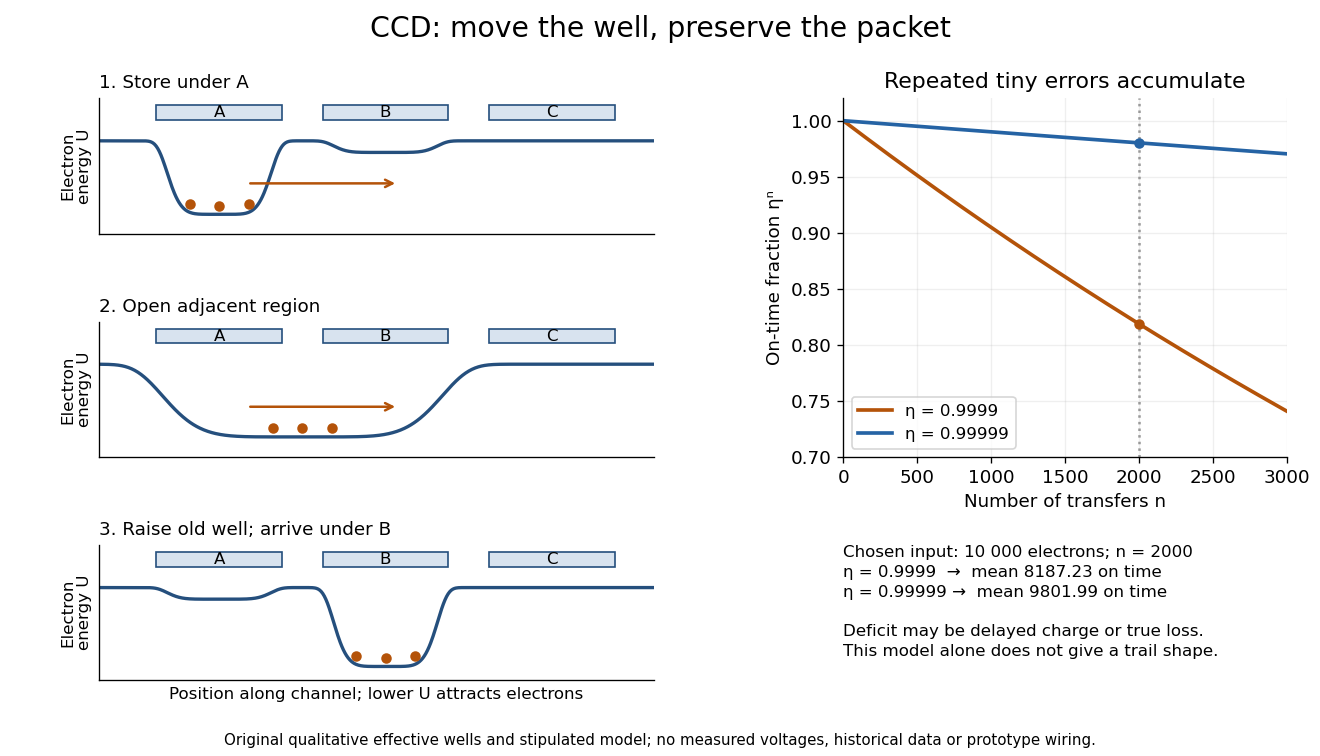
CCD clocked charge transfer and cumulative charge-transfer efficiency
. Original explanatory potential energy profiles show storage, overlap and arrival, with lower curves meaning more attractive regions for electrons. These are qualitative effective profiles, not measured voltages or prototype wiring. The right panel calculates the main-packet fraction for the stipulated constant-efficiency model; charge absent from that packet may be deferred or truly lost. Details.The charge-transfer efficiency is the fraction of a packet delivered into its intended next site or time slot in one transfer, under stated conditions. It is distinct from quantum efficiency, which concerns conversion of incident photons into collected charge carriers. Define the complementary inefficiency as .
In an original model with constant , let denote the mean number of original packet electrons still delivered on time after transfers. Assuming no reinjection into that packet,Repeated substitution proves the result; for different efficiencies the fraction is . For , a Taylor expansion of gives , while the simpler requires .
Choose and . For , the expected on-time output is electrons; for , it is . These are model means, so fractional electron counts do not describe an individual packet. Even a small per-transfer imperfection can imprint distance-dependent image errors.
If every original electron independently stays on time with probability , a fixed initial count gives a binomial distribution with variance . An initial Poisson distribution with mean instead gives an on-time Poisson distribution with mean and variance , by Poisson thinning. A deterministic attenuation formula alone does not specify noise. Real trapping can correlate packets and depends on timing, illumination and temperature; the independent constant-efficiency model then fails.
Deferred charge in CCD readout reaches later output samples than its originating packet. George Elwood Smith describes surface states at the silicon–silicon dioxide interface capturing electrons and releasing them later, smearing the image. A buried channel keeps the stored packet away from that interface.[ref]
Nobel Lecture: The invention and early history of the CCD by George Elwood Smith. pp. 2310–2311, Figs. 10–11, trapping
An original comparison separates two interpretations of the same main-packet deficit. If a single transfer defers fraction by exactly one sample and loses nothing, an isolated input packet produces samples followed by : summing both recovers . A truly lossy transfer yields only , with no later recovery. For and , both give in the intended sample, but only the deferred case gives a -electron trail. Such a trail redistributes position information even when total electric charge is conserved. Repeated delays require a time-response model; alone cannot predict trail shape. Electron-hole recombination, escape to another contact, or release beyond the recorded window can instead remove signal from the measured sum.
George Elwood Smith reports fabricating MOS capacitors, thermally generating the first packet, and clocking it to an output that pushed it into the substrate for electric current detection. A later integrated eight-bit device demonstrated imaging. Dark or reversed-clock control traces are not specified; feasibility alone does not calibrate charge-transfer efficiency.[ref]
Nobel Lecture: The invention and early history of the CCD by George Elwood Smith. pp. 2309–2310, Figs. 7–9, prototype and imager
A discriminating repeat would compare identical cycles with and without initial carrier injection, then suppress or reverse the transfer sequence while retaining output switching. An electric current transient synchronized with gate switching can include capacitor feedthrough; only the difference tied to initial electric charge and the expected transfer delay tests packet transport. These are proposed controls, not controls documented in the lecture. For an optical version, a blocked exposure estimates dark current and read noise; a spatially isolated illuminated optical detector pixel exposes any deferred charge in CCD readout trail. Photon shot noise persists even with ideal transfer.
An electron-multiplying CCD adds a high-field multiplication register before the output amplifier. Impact ionization generates a large mean gain, reducing input-referred read noise but adding multiplication excess noise.
Random multiplication increases the noise relative to deterministic gain. If the output from one input electron has mean and variance , a Poisson distribution of input electrons with mean produces output variance , by the law of total variance. The high-gain analog-mode excess-noise factor is .
An energetic charge carrier creates an additional electron–hole pair. In a multiplication register this is stochastic, so the output charge fluctuates even when the input electron number is fixed.
For a direct-gap semiconductor with equal parabolic conduction-electron effective masses, restrict the final valence hole to zero crystal momentum and consider a normal process. Momentum conservation gives , while energy conservation gives with . The Cauchy-Schwarz inequality gives , so and the threshold is . Equal final wavevectors attain the bound; opposite spins allow the two electrons to occupy that wavevector. This is the threshold under the stated hole constraint, not the general threshold when the final hole can carry momentum.
For source counts and independent background counts with Poisson distributions, the ideal counting standard deviation is , so the signal-to-noise ratio is . Detector noise and uncertainty in the estimated background add further variance. A larger sky aperture raises , while better throughput raises ; both affect the faintness limit of a spectrograph.
Subtracting an exactly known mean sky level leaves source-plus-sky variance of a Poisson distribution . If the sky per source pixel is estimated from equal-area, equally exposed independent sky pixels, its additional variance is , so before read and dark terms. The variance of removed background photons does not disappear with their mean.