Tombstone in open addressing
ID: tombstone-in-open-addressing

A deleted-slot marker in open addressing. Lookup continues past it because a hash collision may have displaced a match further along. Linear probing can reuse the slot for insertion after checking for an existing equal key. A genuinely empty slot can terminate lookup; this marker cannot.[ref]
5.2 LinearHashTable: Linear Probing. Open Data Structures: An Introduction by Pat Morin; section 5.2, find, add, remove, and correctness paragraph distinguishing del from nil
Delete hash table key from the original eight-slot example. Writing
E into array index makes lookup of inspect and incorrectly report absence, although its hash table record remains at . Writing D instead makes lookup pass and reach , returning after three hash table probes. The deleted slot must remember that the search route once continued through it.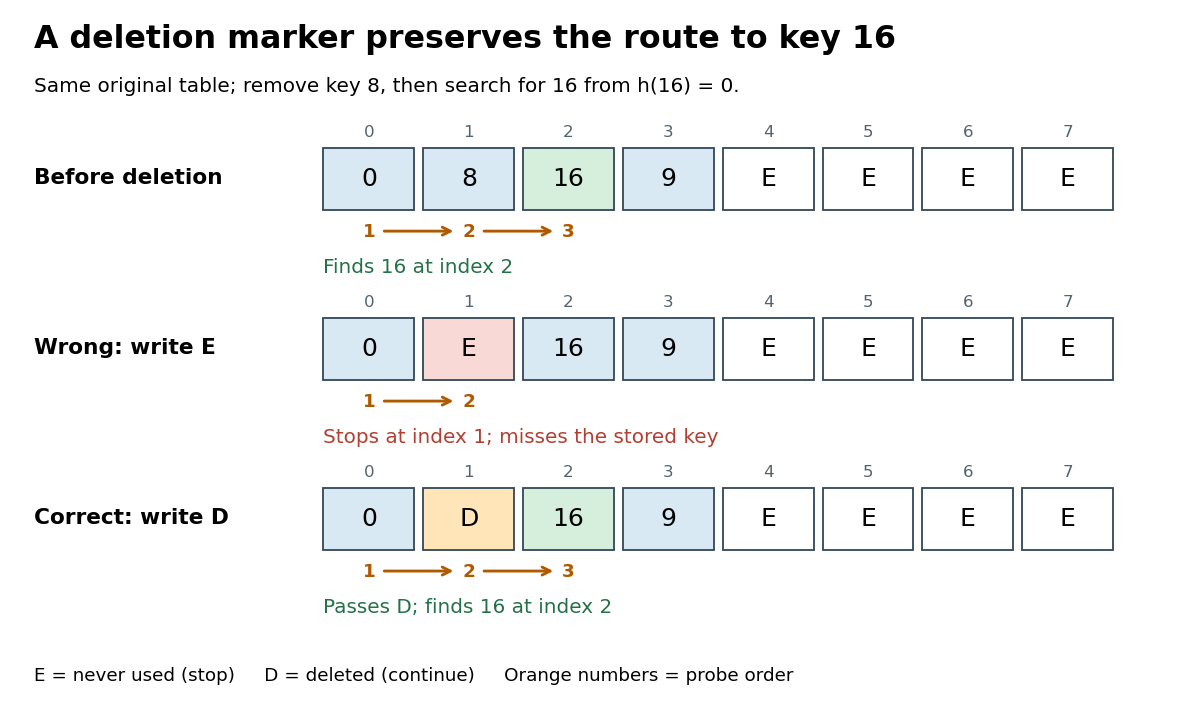
Deleting to an empty slot breaks lookup; a tombstone in open addressing preserves the search route
. Original deterministic comparison: the middle and lower rows are alternative deletions from the top row. E means never used and stops lookup; D means deleted and lets lookup continue. Orange numbers give the hash table probe order for hash table key . Details.
A short algorithm correctness proof uses this invariant: no never-used slot precedes a stored hash table key along its linear probing route. Initially the claim is vacuous. Insertion places a new hash table record no later than the first
E, possibly at an earlier D, and cannot create an E before another stored hash table record. Replacing a value leaves all slots occupied as before. Deletion to D also creates no E. By mathematical induction over operations, the invariant persists, so stopping lookup at E is sound. Deletion directly to E invalidates that argument, as the diagram shows.To implement the hash table map operation
put(k,v) in one bounded scan, remember the first D encountered, but keep checking occupied hash table keys. A later key equality match means replace that hash table record's value and stop. Only after reaching E, or completing hash table probes, is absence established. Then insert at the remembered D, if any; otherwise use the stopping E. If all slots are occupied and no match exists, report full or rebuild before trying again. Merely finding D is not permission to create a second equal hash table key.[ref]Continue from the correctly deleted example, with hash table keys at array indices and
D at . put(16,Z) examines and updates the value at , leaving deleted and retaining three live hash table records. Inserting immediately at would instead create two copies of . Now put(24,W) examines , proves absence at E, and places the new hash table record at the remembered array index . The hash table load factor rises from to ; reusing D avoids extending the linear probing cluster to .For a boundary case, fill all eight slots with hash table keys and then delete all eight to
D. The live hash table load factor is zero, but absent lookup of still needs eight hash table probes. put(16,C) also checks eight slots before reusing the first D, at array index . A loop that waits indefinitely for E would never finish in this state. Rebuilding from the live hash table records into a fresh array removes each tombstone in open addressing and restores never-used stopping slots.[ref]5.2 LinearHashTable: Linear Probing. Open Data Structures: An Introduction by Pat Morin; Section 5.2, resize: reinsert live elements and reset the non-nil count to the live count
New to topics? Read the docs here!