
The trailing edge is the rear region of an airfoil where the upper and lower surfaces approach or meet. The airfoil chord connects its chosen section reference to the airfoil leading edge. A mathematical profile may end at a sharp point, but a specified family can retain a small finite airfoil trailing-edge thickness.[ref]
For the symmetric thickness envelope of a NACA four-digit airfoil, let and let be the maximum thickness-to-chord ratio. One standard form isHere is half the thickness, so the full terminal thickness is . This polynomial leaves a finite rear gap.[ref]
Applied Computational Aerodynamics by W. H. Mason. Appendix A, pp. A-3–A-4, equation (A-4) and the finite-thickness observation
Substitution givesThus the original example , has . Replacing the final coefficient by makes the endpoint thickness zero. That is a different geometric specification, not a numerical rounding of the same profile.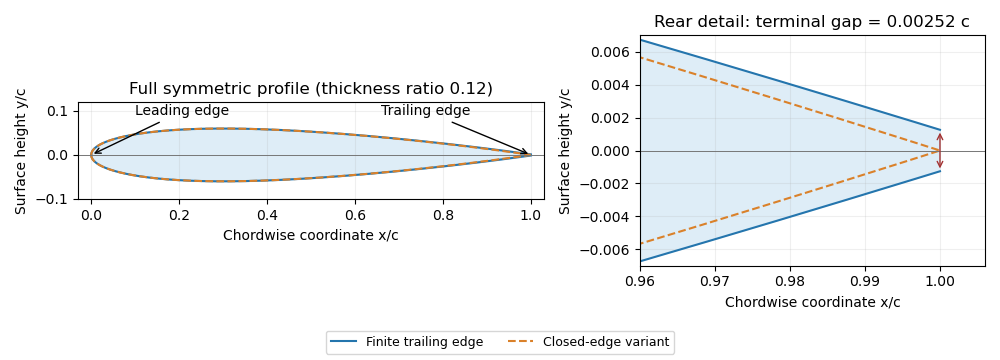
Symmetric four-digit airfoil geometry and the difference between finite and closed trailing edges. Original calculation from the stated thickness polynomial.
Details. 
For a sharp edge, the Kutta condition selects an attached-flow solution with smooth departure and finite rear-edge velocity, helping determine circulation and lift. It does not require fluid parcels passing above and below the airfoil to arrive simultaneously. For a finite-thickness edge, a model must also represent the rear region and its wake; simply imposing a sharp-edge condition does not remove that geometric difference.
New to topics? Read the docs here!