An airfoil chord is the straight segment joining an airfoil leading edge to its airfoil trailing edge; its length is conventionally . The airfoil chord is a geometric reference, not the curved distance along either surface or the curved mean camber line. The chord direction supplies the reference for angle of attack, while its length supplies a scale for reporting an airfoil's thickness and positions.[ref]
Wing Geometry by NASA Glenn Research Center. Airfoil Geometry: leading/trailing edges, chord and mean camber line
If the edge positions in one section plane are and , thenThe chordwise coordinate of a point is its projection . Thus a point a quarter of the way along the airfoil chord has , regardless of how the profile is rotated in a drawing. The aerodynamic center's approximate quarter-chord location refers to this straight geometric reference.
For an original tilted section, choose edge positions and in metres. ThenThe horizontal projection is , while the airfoil chord is slightly longer. Its quarter point is . Using a ruler along the page's horizontal axis rather than along the segment would measure a projection, not .
A finite wing generally has a local airfoil chord varying along its span. For a stipulated unswept trapezoidal planform of span , root chord and tip chord , integrating the linear chord distribution gives areaIts span-average chord is ; that average is not the chord at every section. The mean aerodynamic chord is a different wing reference and should be identified explicitly when used. NASA's definitions distinguish section geometry from this spanwise wing geometry.[ref]
For a scaled wind tunnel model, a specified pressure-tap position therefore remains a comparable geometric location as changes. Equal normalized geometry alone does not establish equal flow: comparisons must also consider Reynolds number, Mach number and the relevant boundary conditions.
The mean geometric chord, also called the standard mean chord, is the span-average airfoil chord of an aircraft wing:where is the wing area and the wingspan. The area is the projected wing planform, not the sum of the upper and lower skin areas.[ref]
A useful exact identity explains its difference from the mean aerodynamic chord. Represent uniform spanwise averaging by a coordinate with a continuous uniform distribution on , and put . This is a mathematical averaging device, not a claim that the wing geometry is random. With ,Thus the relative excess is the squared coefficient of variation of the local chords. The mean aerodynamic chord can also be interpreted as the expected value under the corresponding size-biased distribution, since larger chords receive proportionally larger weights.
For the original linear taper from to , uniform spanwise sampling makes uniform on . Its expected value is and variance is . Hence , a relative excess of . A constant-chord wing has zero variance, so its two averages coincide.
Equal does not determine how local chord varies or where the wing lies relative to a reference axis. Those additional data enter wing sweep and the mean aerodynamic chord reference position.
The mean aerodynamic chord is a reference length that weights each local airfoil chord by the area of its spanwise strip. For a symmetric aircraft wing with wingspan , local chord and wing area , its geometric definition isThe extra factor of distinguishes this from the mean geometric chord .[ref]
The weighting has a simple interpretation: a strip has area , so is an area-weighted mean. If a simplified section model has the same local pitching moment coefficient and dynamic pressure everywhere, its strip moment is . Integration then gives . This explains its use as a moment reference; an actual three-dimensional flow need not have a uniform section coefficient.
For the mean aerodynamic chord of a trapezoidal wing, take root chord , tip chord and a linear distribution . Integrating givesThe stipulated wing planform , , has , and . The wider strips receive more weight.
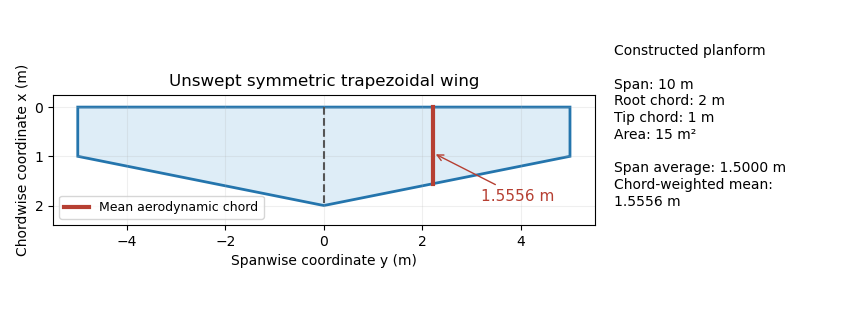
Trapezoidal wing planform with a mean aerodynamic chord of 1.5556 m, compared with the span-average chord of 1.5 m. Original geometry calculation.
Details. 
The Cauchy-Schwarz inequality gives a useful general check:Equality holds for a constant chord almost everywhere. A reported mean aerodynamic chord shorter than therefore contradicts this definition for the same span and area convention. Its length alone does not specify a location: the reference position of that chord and the aerodynamic center are additional geometric or aerodynamic data.
A mean aerodynamic chord reference position locates the reference segment whose length is the mean aerodynamic chord. Its chordwise origin and spanwise placement are additional geometric data. The length alone does not specify a point on a wing or determine its aerodynamic center.
For a symmetric wing planform, let be the local airfoil chord, its leading-edge coordinate and the wing area. A standard area-weighted half-wing placement isThe definition averages leading-edge positions themselves; it does not generally substitute the average station into a nonlinear leading-edge curve.[ref]
The quarter-chord reference of a mean aerodynamic chord then hasThe last identity follows directly from the definition of . It is a geometric area-weighted average of the local quarter-chord positions, without assuming a uniform aerodynamic loading.
For an original curved-leading-edge example, take constant chord , span and on the positive half-wing, with . Then , , andEvaluating the leading edge at the mean station would instead give , moving the quarter reference forward by . For a straight leading edge the two operations agree, as in mean aerodynamic chord of a trapezoidal wing.
The positive half-wing station is a placement convention; the whole symmetric planform's spanwise centroid remains zero. Reporting a chord-reference position should identify its coordinate origin, planform-area convention and the chosen fraction of the reference chord.
The quarter-chord reference of a mean aerodynamic chord is the geometric point one quarter of the reference-chord length aft of its specified leading-edge position:It supplies a reproducible location for reporting positions and pitching moments. The length of the mean aerodynamic chord alone does not locate this point; its reference origin is also required.
For a symmetric wing planform using the area-weighted placement in mean aerodynamic chord reference position,Adding one quarter of the first integral to the second givesIt is consequently an area-weighted average of local quarter-chord coordinates under this convention. No aerodynamic-load distribution was needed for that identity.[ref]
For an original trapezoidal example, let span m, root chord 3 m and tip chord 1 m. Then , m and the positive half-wing reference station is m. With straight leading edge , its reference leading edge is at 0.7 m. The quarter-chord point is therefore m aft of the stated origin. Changing sweep changes this coordinate even if all spanwise chord lengths remain fixed.
The aerodynamic center is defined through the response of pitching moment to incidence, rather than through a geometric averaging rule. In ideal two-dimensional thin airfoil theory, the quarter-chord moment is independent of angle of attack, which motivates that familiar reference. It does not prove that every finite wing's aerodynamic center lies at this geometric point.[ref]
F3 Lecture Notes: Thin-Airfoil Analysis Problem, continued by MIT OpenCourseWare. pp. 3–4, quarter-chord moment and aerodynamic-center conclusion within thin-airfoil analysis
Moment comparisons must also use the same reference. Moving the reference by a vector changes the moment by for the same resultant force. A location convention thus has a measurable mechanical consequence even though it is chosen geometrically.
For a symmetric trapezoidal wing planform, let root chord be , tip chord , and wingspan . The wing taper ratio describes the linear local chord on one half-wing. Direct integration givesA rectangular planform has and ; the triangular limit gives . These are lengths, not aerodynamic-center locations.
The mean aerodynamic chord reference position requires a placement convention. On the positive half-span, define the area-weighted stationFor a straight leading edge with , its corresponding chord reference starts at . A geometric quarter-chord reference is then . These are the standard planform integrals, not a guarantee about the aerodynamic center of every finite wing.[ref]
For the stipulated , , , the values are and . With and , the leading-edge reference is aft of the chosen origin, and the quarter-chord reference is . Changing the wing sweep moves these reference positions without changing when the same spanwise chords are retained.
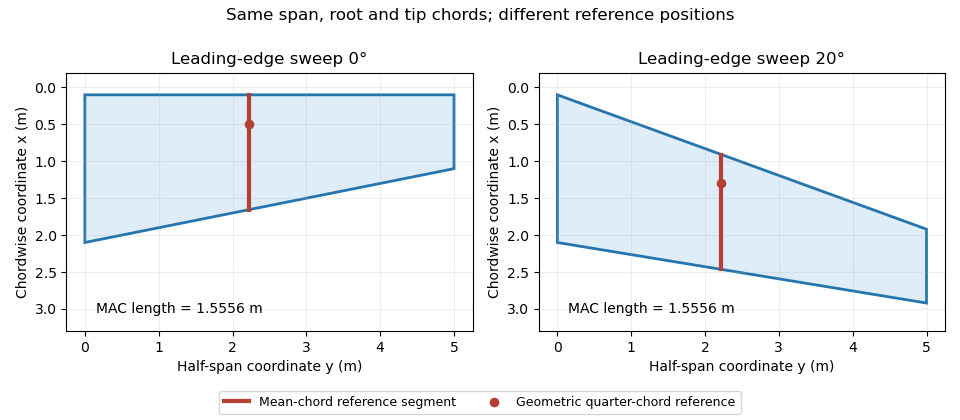
Identical trapezoidal chord distributions with different leading-edge sweep: the mean chord length stays fixed while its geometric reference position moves. Original calculation.
Details. 
Articles by others on the same topic
There are currently no matching articles.