Tunnel-diode load-line stability
ID: tunnel-diode-load-line-stability

A current-voltage characteristic determines possible steady operating points; it does not alone determine their linear stability. Consider an ideal voltage source feeding a tunnel diode through a resistor , with a positive constant capacitance across the junction. Assume a quasistatic device relation and neglect inductance, transit delays, noise and heating. Kirchhoff's current law gives the original one-state modelA steady operating point satisfies : the device curve intersects the descending supply line. This is the source-side counterpart of a resistive load line. A small perturbation obeysThus the equilibrium point is locally attracting if and unstable if the inequality reverses. Equality requires higher-order analysis. Even on a negative differential resistance segment, a sufficiently small supply electrical resistance can stabilize this model. The assumption about the electrical circuit matters: an inductive or delayed circuit has additional state variables and may behave differently.
Choose an original toy forward characteristic, with no fitted device parameters:where , and . For every , , so this entire forward curve absorbs positive total power. NeverthelessThe model therefore separates negative differential resistance from negative total . The corresponding peak and valley are at approximately and ; these voltages deliberately differ from the historical peak.
With and , the supply line is . The intersection equation factors exactly:The three operating points are , and . Their values of are respectively , and . The outer two attract nearby trajectories; the middle one repels them. This is bistability in the specified one-state electrical circuit.
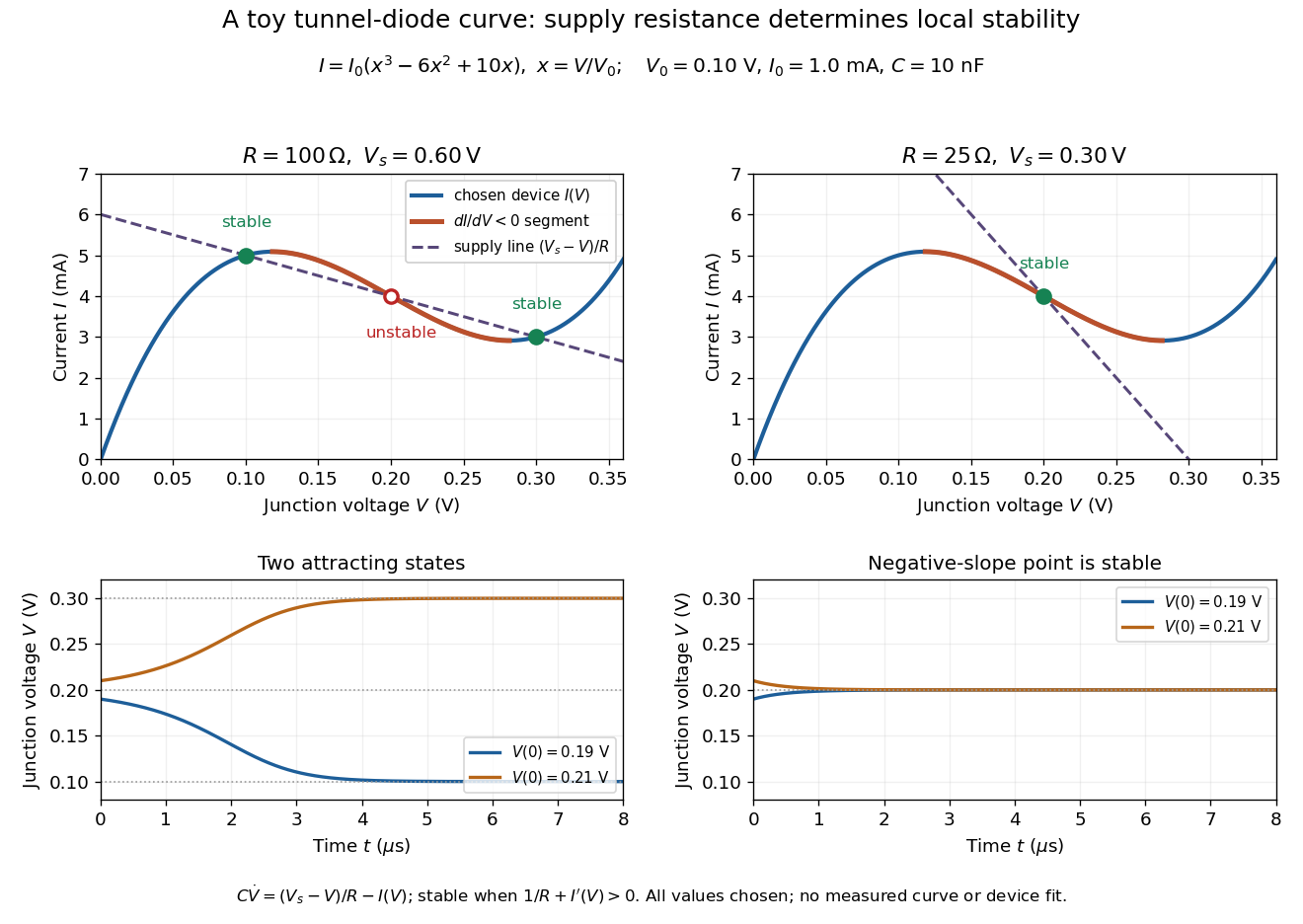

For the second panel, choose and . Now andThere is exactly one real operating point, again . Here , despite the device's own slope . With , the perturbation decays with time constant ; the unstable middle point of the first panel has growth time .
The one-state autonomous model supports switching between attracting operating points after a perturbation or parameter change; it cannot produce a nonconstant periodic orbit. A proposed oscillator needs additional dynamics. This limitation is useful: a load-line intersection establishes a possible steady reading, the slope test establishes local attraction in a specified model, and neither calculation alone predicts an oscillation frequency for a real tunnel diode.
New to topics? Read the docs here!