Twin paradox with finite acceleration
ID: twin-paradox-with-finite-acceleration

An instantaneous reversal is an idealization. A real traveller changes velocity over a finite time, follows a smooth world line, and has finite proper acceleration. Special relativity still calculates the elapsed proper time using the home inertial frame and the same integral; general relativity is not needed merely because the traveller accelerates in otherwise flat spacetime. The clock hypothesis identifies an ideal clock's reading with this geometric proper time.
One explicit smooth trip between the same and starts and ends at rest in the home inertial frame. ChooseIts velocity reverses continuously at , and its proper acceleration is bounded because and is finite. With and , numerical integration givesThis comparison fixes the reunion spacetime events and maximum speed, not the turnaround distance: the smooth trip reaches light-years, whereas the ideal trip reaches light-years. The smooth traveller spends less time at high speed and therefore accumulates more proper time than the ideal traveller, while still accumulating less than the home clock.
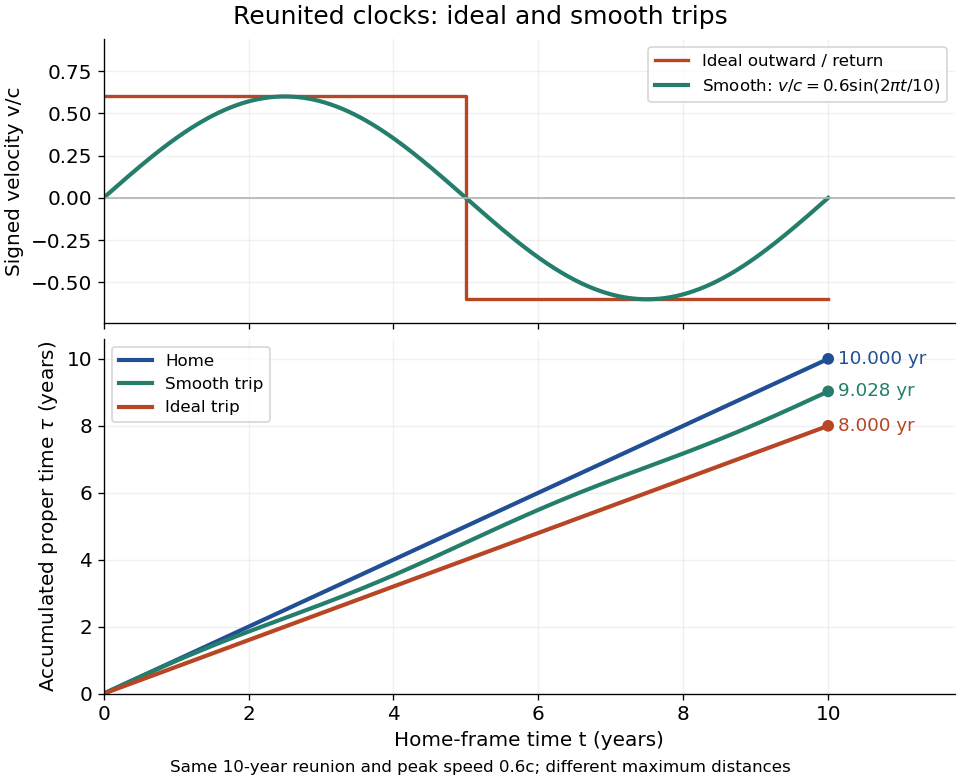
Signed velocity and accumulated proper time for ideal and smooth trips with the same ten-year reunion and maximum speed 0.6c; their turnaround distances differ
. Details. 
For a sufficiently short smooth reversal replacing the corner, the proper time approaches the piecewise inertial result. A reversal interval of home duration contributes between zero and to the clock reading; shrinking that interval cannot create a finite extra loss concentrated at the corner. The finite difference survives in the long coasting legs. Keeping the same reversal manoeuvre while lengthening those legs changes the age difference. Conversely, two travellers following mirrored paths with the same speed history accumulate equal proper times, even though both accelerate. Thus acceleration distinguishes paths and enables reunion here, but an amount of acceleration alone does not determine the age difference.
The changing simultaneity assignment also becomes continuous. At a traveller spacetime event with instantaneous velocity , the momentarily comoving inertial frame assigns home time . Differentiating givesDuring the reversal at positive , the last term advances the assigned home time rapidly. It describes the traveller's changing relativity of simultaneity, not a locally measured alteration of the home clock's ticking.
New to topics? Read the docs here!