Spatially separated simultaneous events in one inertial frame are generally not simultaneous in a relatively moving frame. The Lorentz transformation explicitly mixes position into time. This is essential when comparing distances between moving light pulses: one must compare their positions at the same time in the measuring frame.
At , the rod's simultaneous laboratory endpoint measurements in length contraction have and . They become and . In contrast, simultaneous rod-frame measurements at use and . The latter front-end event occurs later in the laboratory, after the front has moved. The sloping line in the figure is a set of simultaneous spacetime events, not a signal's trajectory. [ref].
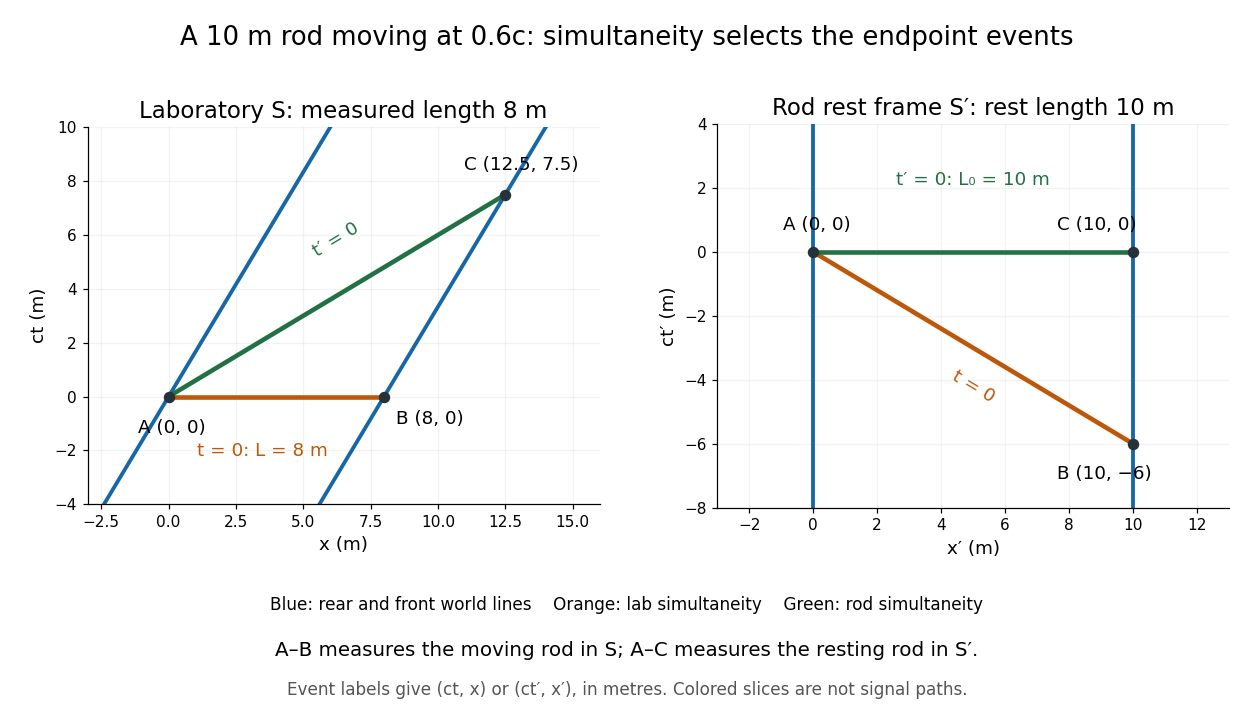
The same moving rod measured on laboratory and rod-frame simultaneity slices; length measurements use different endpoint events
. Details. The apparent conflict between fitting a moving rod inside a shorter stationary enclosure in one frame and observing an even shorter moving enclosure in the rod's frame. Length contraction compares endpoints simultaneous in the measuring frame, and relativity of simultaneity means the two frames do not compare the same pairs of events. Transforming the enclosure-entry and enclosure-exit events resolves the apparent contradiction.
A runner enters a stationary tunnel of length at the tunnel-frame instant a photon is emitted towards them from the far end. The interception fraction is , where . In the runner frame, with entry at the origin, emission is at and the entrance clock simultaneously reads . The entrance is then ahead by , so the photon travels , not the contracted tunnel length . Subtracting that initial entrance gap from the entrance's motion during the photon flight gives the same interception fraction. This is a concrete application of relativity of simultaneity, length contraction and the Lorentz transformation.
Two spacetime events are simultaneous in a specified inertial frame when their time coordinates are equal. The Lorentz transformation changes this condition for spatially separated events. A spacelike separation admits an inertial frame in which the two events are simultaneous; a nonzero null separation does not.
In Minkowski spacetime of metric signature , let be a constant future-directed four-velocity with . The time difference assigned to two spacetime events is . Thus the observer's simultaneous events form an affine hyperplane orthogonal to . This is an invariant relation of the three arguments ; the Minkowski metric alone does not single out one . For fixed , it defines an equivalence relation and the hyperplanes form a foliation. Changing changes this foliation.
In units , consider spacetime events , and , with coordinates ordered . A Lorentz boost of speed assigns , while the original inertial frame assigns . Nevertheless are timelike separated, so no inertial frame regards them as simultaneous. Hence the relation “simultaneous in at least one inertial frame” is not transitive. This does not contradict transitivity of Minkowski simultaneity relative to an inertial observer for one fixed observer.
A moving rod can have both ends inside a shorter shed on a single constant-time slice of the shed frame. Lorentz transformation sends the two simultaneous endpoint events to different times in the rod frame; it does not imply simultaneous containment there. Entrance and first collision can be spacelike separated and occur in reversed time order. After impact, length changes must propagate through the rod causally; a perfectly rigid instantaneous stopping model is not relativistically admissible.
For two photons emitted simultaneously a distance apart in one frame and moving in the same positive direction, the world-line intercept transforms to . Their equal-time separation in the boosted frame is therefore the displayed constant . It is different from length contraction of the emitters, because the emission events are not simultaneous after the boost.

