Two-point thermometer calibration example
ID: two-point-thermometer-calibration-example

Consider an original worked thermometer calibration, using the height of a liquid column responding through thermal expansion. Stipulate two equilibrated reference baths whose corrected thermometer readings are and , in degree Celsius units. Suppose the corresponding column heights are and . These are constructed inputs, not observed measurements. Assume the response is linear over this interval, with the same immersion and reading procedure throughout. Applying thermometer calibration givesFor , first subtract the zero-reference height, then divide by the full reference span: . Multiplying by the span gives , or in kelvin. Thus equal readings in separately equilibrated samples test equal temperatures, regardless of how much internal energy those samples contain. The Celsius offset and modern absolute-scale definition are described in degree Celsius and kelvin.
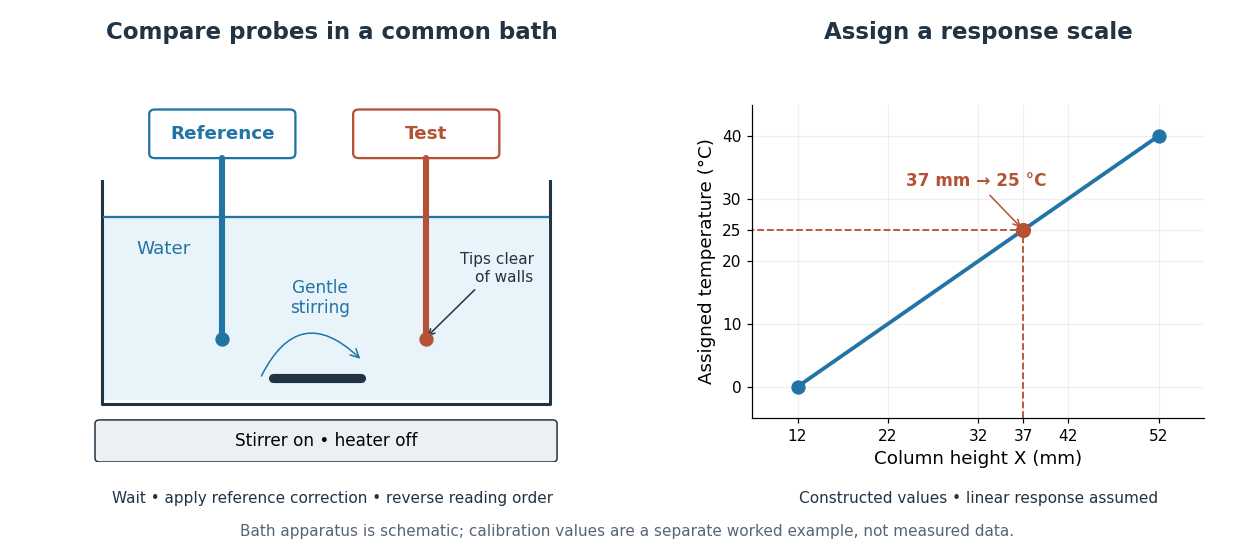

The two endpoints determine the assumed line, but do not establish linearity. An independent middle reference and a return to the initial bath can test curvature and drift. If the height has an error of while reference values and endpoints are held exact in this calculation, the inferred temperature error is ; that is only the height contribution, not a full measurement error budget. A boiling-water reference needs a measured atmospheric pressure correction, rather than an automatic assignment. The modern kelvin is not defined by either bath.
New to topics? Read the docs here!