Internal energy is the energy stored in the microscopic degrees of freedom of a thermodynamic system: random molecular kinetic energy, internal molecular excitations, and interaction potential energy. Its value requires a specified system and an energy reference. In thermodynamic equilibrium, internal energy is a state function; it records the present state, without remembering whether a previous change came from stirring, compression or heat transfer. This makes internal energy the common accounting quantity connecting mechanical experiments to thermal ones.[ref]
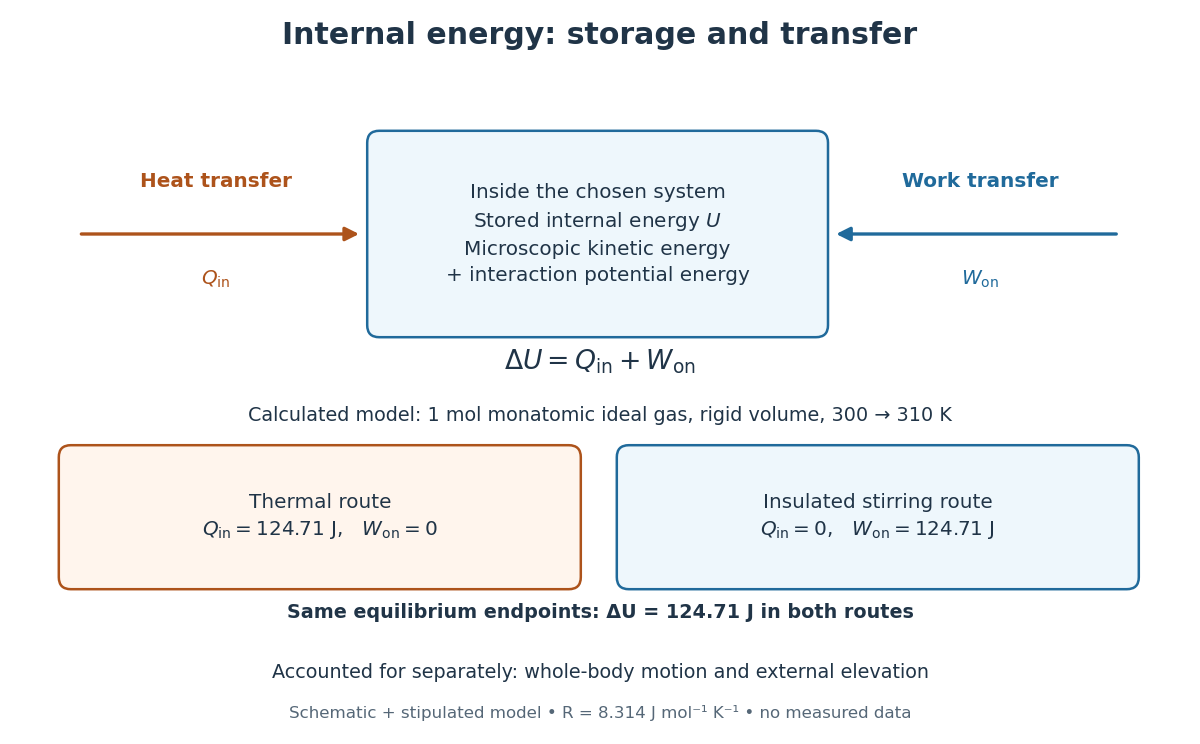
Heat and work describe energy crossing the system boundary during a process. They are not separately stored contents of the system. For a closed system whose bulk kinetic energy and external potential energy have unchanged endpoint values, the first law of thermodynamics givesHere is positive for incoming heat, and is positive for net work done on the system. Two routes between the same equilibrium states have the same , although their heat and work can differ. The infinitesimal notation distinguishes a state function change from path-dependent transfers.[ref]
For a calculated example, take one mole of a classical monatomic gas in the ideal gas regime, at fixed volume, from to . With stipulated molar gas constant , its internal energy change is . A purely thermal route supplies with . An ideal insulated stirring route supplies with , measured between equilibrium endpoints after the motion dies away. The same stored increment has two different transfer histories; neither history defines a separate kind of stored energy.
The familiar internal energy of an ideal gas is a useful special case. Neglect intermolecular interactions, hold the amount of substance and composition fixed, and suppose that independent quadratic terms per particle obey the classical equipartition theorem. Choosing the constant reference contribution as zero givesHere is absolute temperature, is the molar gas constant, and is the whole sample's heat capacity at constant volume. A monatomic gas has translational terms. A rigid diatomic molecule has when its two rotational terms are active and vibration is frozen; activating one harmonic oscillator vibration adds two terms, one kinetic energy and one potential energy, giving . The counting is of quadratic contributions, so a vibrational coordinate is not just one contribution.[ref]
This constant- formula applies only over a regime with those same active terms, classical translational statistics, nonrelativistic motion and unchanged composition. Quantum freezing, quantum degeneracy, chemical reactions or appreciable intermolecular interactions invalidate that simple counting. More generally, at fixed amount and composition an ideal gas can still have with varying heat capacity at constant volume, so use . A nonzero constant reference adds to without altering .
For a simple compressible system at fixed composition and particle number, the internal pressure is the partial derivative of internal energy with respect to volume at fixed temperature. From and the Maxwell relation , it has the measurable expression in the title. It is distinct from the mechanical pressure .
For an ideal gas, gives , so its internal energy depends only on temperature at fixed amount of gas. For the Dieterici equation , direct differentiation givesThus an equation of state determines this volume sensitivity even without determining the full caloric function .
For an ordinary stationary laboratory sample, a useful convention isThe bulk kinetic energy includes organized whole-body motion; for pure translation it is , with total mass and center of mass speed . The external potential energy includes elevation in an imposed gravitational field, approximately in a uniform field. Accelerating a sealed bottle or lifting it without otherwise changing its state changes these mechanical terms, rather than its internal energy. Molecular kinetic energy is measured relative to the chosen bulk motion.[ref]
3.2 Work, Heat, and Internal Energy. §3.2, “Internal Energy”: molecular speeds relative to the center of mass; moving-train and roof examples
State the convention rather than applying this separation blindly. If an experiment separately tracks a rotating apparatus or an organized flow, its mechanical kinetic energy must not also be counted in . In Joule's paddle-wheel experiment, waiting for the apparatus and fluid to come to rest removes such an endpoint ambiguity. Including the vessel and paddle changes whose internal energy is measured; including the falling weights additionally puts their changing gravitational potential energy inside the enlarged system's total energy balance.
Constant temperature does not generally mean constant internal energy. At fixed amount and composition, within one smooth thermodynamic phase of a simple compressible system, an equilibrium identity isThe bracket vanishes for the ideal gas law . It need not vanish for a real gas: changing the volume changes the average interaction potential energy, even when the random-motion contribution stays at the same temperature. The identity follows by writing and using a Maxwell relation; it does not require the actual process to be reversible. [ref]
For a Van der Waals equation model with volume per mole , gives . Thus an isothermal expansion from to , at fixed amount of substance , increases internal energy bySeparating attractive particles makes their interaction potential energy less negative. For stipulated , , , , and , the calculated increase for this one-mole sample is , despite . This dilute stable-branch model example is not a measurement of a named gas. [ref]
A phase transition gives another reason. During equilibrium vaporization of a pure substance at fixed pressure, the temperature can stay at its phase coexistence value while the phase fraction changes. Molecular separation changes interaction potential energy.[ref]
1.5 Phase Changes. §1.5, figure 1.18 and equations 1.7–1.8: molecular attractions and constant-temperature phase conversion
If the closed system does only pressure-volume work, its latent heat input obeysHere is enthalpy. A vaporization latent heat therefore is not automatically the internal energy increment: some input supplies expansion work. A fixed temperature reading alone cannot tell how much internal energy changed.Joule's paper On the Mechanical Equivalent of Heat (1850) describes a copper vessel holding water and a brass paddle with stationary vanes. Descending lead weights drove its shaft through strings and pulleys; the vanes opposed simple co-rotation. A boxwood shaft segment reduced thermal conduction. He measured fall distances and initial/final temperatures, repeating twenty descents per run and disconnecting the drive for rewinding. Calibrated thermometers read the water and room.[ref]
On the Mechanical Equivalent of Heat by James Prescott Joule. pp. 64–66 and Plate VII: thermometer calibration, water apparatus and operating sequence
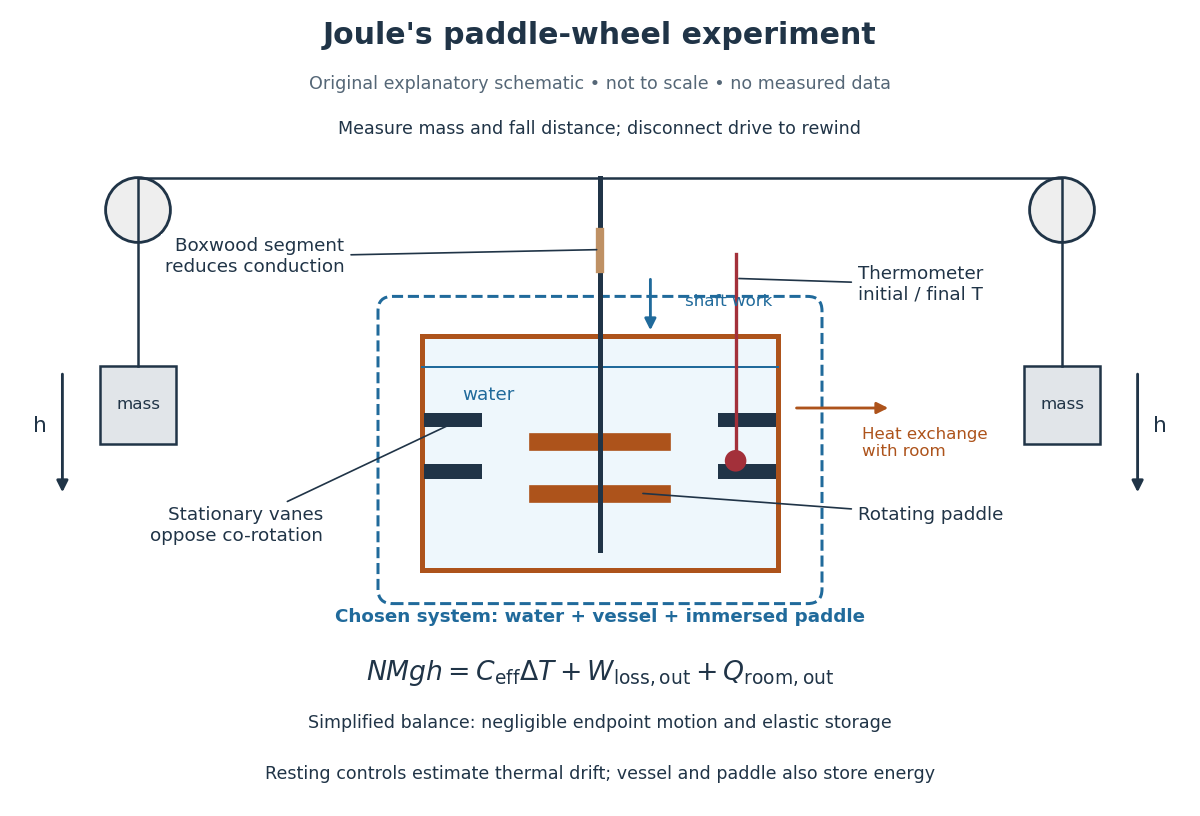
Joule's paddle-wheel experiment: mechanical input and thermal readout
. Original explanatory schematic, not a scale reconstruction or a plot of measurements. The outlined system includes water, vessel and immersed paddle, but excludes the weights and external drive. The symbolic balance separates mechanical losses outside this boundary from heat exchange with the room. Rewinding occurs with the drive disconnected. Details.His matched resting trials retained the water amount, duration, surroundings and reading procedure, omitting paddle motion to estimate environmental heat exchange. A screen reduced thermal radiation from his body. His calculation included the vessel and paddle heat capacities, external pulley/string losses, descent kinetic energy and string elasticity; it acknowledged residual vibration and sound.[ref]
On the Mechanical Equivalent of Heat by James Prescott Joule. pp. 66, 69–70 and 82: matched controls, apparatus water-equivalent capacity, mechanical corrections and residual losses
The measured observable is a corrected temperature rise, interpreted through the participating heat capacity; it is not a direct view of molecular motion. The experiment tests whether measured mechanical input accounts quantitatively for thermal storage. Frictional warming by itself would establish neither the conversion factor nor the absence of heat exchange. A modern authored demonstration at UCSB instead measures crank turns and a cylinder's temperature with an electrical thermometer: the apparatus differs, but again both mechanical input and thermal response must be measured. [ref]
Choose the water, vessel and immersed paddle as the closed system, with fixed outer volume and negligible endpoint changes in bulk mechanical energy. Between common equilibrium temperatures and ,The effective heat capacity includes every component that participates in the common temperature change. For nearly constant , the readout is . Heat transferred between water and paddle stays inside this boundary; it must not be added again as external input. The drive supplies shaft work even though the vessel has no expansion work.
For a simplified modern model, let be the total descending mass, let each of descents cover height , and let be energy diverted by the external drive. With negligible remaining drive kinetic energy and elastic storage,The signed may be negative if the room warms the assembly. This model omits the small endpoint and elastic corrections explicitly considered in the historical analysis. It does not equate all of the weights' lost gravitational potential energy with the water's gained internal energy.
As a proposed modern protocol, measure the falling masses and distances, calibrate the thermometer and independently, record room temperature and resting drift before and after each run, and wait for fluid motion to decay before the final equilibrium reading. Repeat with different fall budgets and run durations. A stable ratio of corrected input to corrected thermal storage supports the first law of thermodynamics over the tested range. Resting controls only estimate leakage if their thermal conditions represent the driven run; sensor lag, nonuniform temperature, unmeasured drive losses, evaporation or changing heat capacity can spoil the inference. Those are limits of the measurement, rather than evidence that heat was stored as a separate substance.
Specific internal energy is internal energy per unit mass. For a perfect gas with constant specific-heat ratio, . Its material balance is , where is heat supplied per unit volume per unit time.
Articles by others on the same topic



Internal energy is a thermodynamic property that represents the total energy contained within a system. It encompasses all forms of energy present at the microscopic level, including: 1. **Kinetic Energy**: This includes the energy associated with the motion of molecules and atoms within the system. As temperature increases, the kinetic energy of particles also increases. 2. **Potential Energy**: This is related to the positions and interactions of particles within the system.