U-tube differential manometer
ID: u-tube-differential-manometer

A U-tube differential manometer contains a connected column of liquid with one gas connection above each liquid meniscus. Write for the left and right pressures, and for the meniscus heights on an upward vertical coordinate. Assume constant mass density and downward gravitational acceleration of magnitude ; neglect the gas column's mass density and differences in capillary pressure. The signed vertical length difference then givesLarger left pressure means a lower left liquid meniscus: implies . Equal pressures give equal meniscus heights.
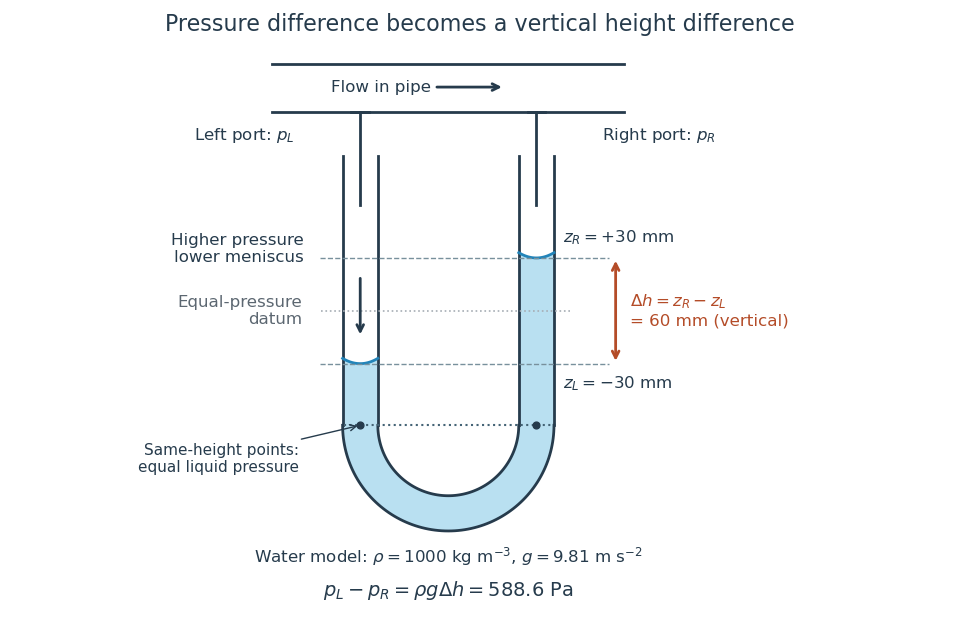

The balance follows directly from hydrostatic pressure. At a common height below both surfaces, the two points in the connected homogeneous liquid have equal pressure:Subtracting cancels the common bottom depth and leaves . The same-height rule follows from hydrostatic equilibrium, : a horizontal displacement changes no pressure, and for constant the quantity is constant throughout the connected liquid. Equal height alone is insufficient for unrelated vessels or for fluid flow with significant acceleration.
For an original constructed example, choose water of stipulated mass density , gravitational acceleration , and vertical length difference . ThenThe SI pressure unit is the pascal: the product has units . Swapping the two connections gives and reverses which liquid meniscus is lower. In equal-bore arms, volume conservation makes each surface move from its initial equal-height position; using only one surface's displacement would halve the inferred pressure. With unequal arm areas , a left fall and right rise instead obey , while the vertical length difference is still .
If the right port is open to the local atmosphere, is the left gauge pressure. Only with that reference and known atmospheric pressure can one obtain absolute pressure fromFor an explicitly stipulated atmospheric pressure of , the example gives absolute pressure. If the right port is connected to another vessel or a pressure tapping, the same reading is a differential pressure and supplies no absolute pressure without knowing that reference.[ref]
New to topics? Read the docs here!