A U-tube differential manometer contains a connected column of liquid with one gas connection above each liquid meniscus. Write for the left and right pressures, and for the meniscus heights on an upward vertical coordinate. Assume constant mass density and downward gravitational acceleration of magnitude ; neglect the gas column's mass density and differences in capillary pressure. The signed vertical length difference then givesLarger left pressure means a lower left liquid meniscus: implies . Equal pressures give equal meniscus heights.
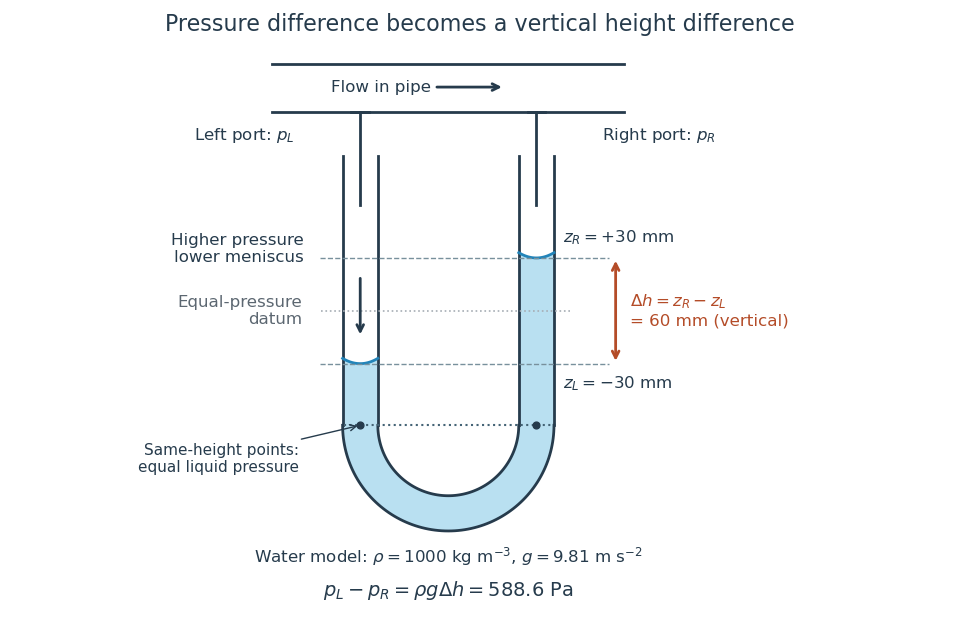

The balance follows directly from hydrostatic pressure. At a common height below both surfaces, the two points in the connected homogeneous liquid have equal pressure:Subtracting cancels the common bottom depth and leaves . The same-height rule follows from hydrostatic equilibrium, : a horizontal displacement changes no pressure, and for constant the quantity is constant throughout the connected liquid. Equal height alone is insufficient for unrelated vessels or for fluid flow with significant acceleration.
For an original constructed example, choose water of stipulated mass density , gravitational acceleration , and vertical length difference . ThenThe SI pressure unit is the pascal: the product has units . Swapping the two connections gives and reverses which liquid meniscus is lower. In equal-bore arms, volume conservation makes each surface move from its initial equal-height position; using only one surface's displacement would halve the inferred pressure. With unequal arm areas , a left fall and right rise instead obey , while the vertical length difference is still .
If the right port is open to the local atmosphere, is the left gauge pressure. Only with that reference and known atmospheric pressure can one obtain absolute pressure fromFor an explicitly stipulated atmospheric pressure of , the example gives absolute pressure. If the right port is connected to another vessel or a pressure tapping, the same reading is a differential pressure and supplies no absolute pressure without knowing that reference.[ref]
The ideal measurement calibration is a straight line through the equal-pressure zero. For the stipulated water mass density and gravitational acceleration above, its slope is per vertical millimetre. A lower liquid mass density gives a larger length change for the same pressure, improving the height-reading contribution to measurement resolution but requiring more vertical space for a given pressure range. The pressure scale depends on the actual mass density, which depends on temperature; here is a chosen model value, not an exact property of all water samples.
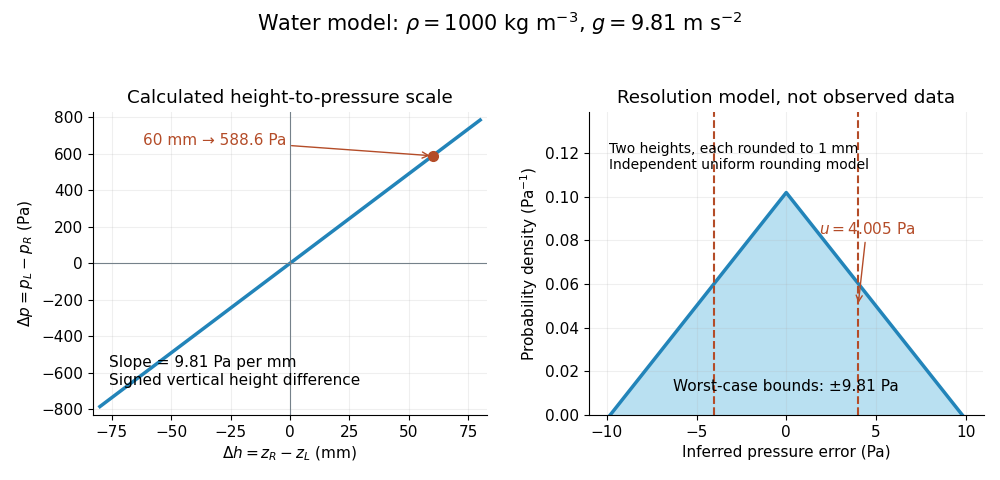

Suppose each liquid meniscus height is rounded to the nearest scale division . Each height measurement error lies within , so the error in their difference lies within . The resulting pressure error is bounded by . To quantify a standard uncertainty, make the additional model assumption that the two rounding errors are independent random variables, each having a continuous uniform distribution on . Each then has variance ; adding the two variances givesHere denotes standard uncertainty. The worst-case bound and standard uncertainty answer different questions. At they are respectively and of the reading. Shared reading bias or a different reading method can violate the assumed independence.
If the mass density, gravitational acceleration and height difference also have small independent standard uncertainties, a first-order estimate follows from the partial derivatives of :This displays why a finer scale does not remove uncertainty in mass density or gravitational acceleration. A pressure transducer compared against the column needs its own differential-pressure calibration to establish an electrical response.
NASA's Wind Tunnel Experiment Details, slide 27, describes a practical manometer measurement: partially fill a Tygon tube with water and connect its two ends to total pressure and static pressure ports in a wind tunnel. The total pressure connection pushes its liquid meniscus downward; the vertical length difference supplies the pressure difference. The slide predicts increasing separation as the tunnel speed increases. It supplies an apparatus and method, rather than a table of observed readings.[ref]
Wind Tunnel Experiment Details, slide 27 by NASA Glenn Research Center. Wind Tunnel Experiment Details, slide 27: water-filled Tygon tube, total/static pressure ports and height readout
A control for this practical is to expose both connections to the same atmospheric pressure before the run: settled liquid meniscus heights should agree in a symmetric column. Read each liquid meniscus at eye level, reconnect sealed tubing to the identified ports, and wait for settling. Recheck the equal-pressure zero afterwards; reverse connections to check the sign. These checks establish neither mass density nor ruler accuracy.[ref]
University Physics Volume 1 by William Moebs and others. §14.2, Manometers, Figure 14.12(a): both arms open to atmosphere
The inference is a differential pressure from hydrostatic pressure, with stagnation pressure on one side and static pressure on the other in NASA's practical. Converting that difference to a flow speed additionally needs the hypotheses discussed under dynamic pressure and Pitot-static tube. A changing pressure can leave the column oscillating; leaks, blocked pressure tappings or trapped liquid in a gas connection can alter or delay the readout. The column should be read after settling, and temperature should be recorded when choosing the measuring liquid's mass density.
Two corrections clarify the limits. If both gas ports are at the same height and carry the same gas of constant mass density , keeping its hydrostatic pressure gives . Different port heights require their separate gas column heights. Also, a curved liquid meniscus can sustain a capillary pressure jump through surface tension. Write for liquid pressure minus gas pressure at the two surfaces. Neglecting gas weight, the balance becomes . Identical meniscus shapes in matching clean bores cancel those jumps; unequal bores or different wetting conditions need not. Thus the useful simplicity of rests on identifiable physical conditions.
Articles by others on the same topic
There are currently no matching articles.