Uniform-sphere nuclear charge form factor
ID: uniform-sphere-nuclear-charge-form-factor

Consider an ideal nuclear charge distribution that is constant inside a ball of radius and zero outside:This is a deliberately sharp-edged model. Substitution into the spherical nuclear charge form factor gives, for ,At take the continuous limit . Direct radial integration gives , and the Taylor series provides an independent check:The first positive zero solves , equivalently , with . Consequently the first diffraction minimum moves toward smaller momentum transfer as increases.
For comparison, a smooth Gaussian function charge density with the same nuclear charge radius isThe Fourier transform of a Gaussian stays positive and has no zero. Both models have the same leading low- curvature, but they disagree at higher momentum transfer: at , the sphere gives and the Gaussian function gives . Measuring only a nuclear charge radius cannot distinguish these two nuclear charge distributions.
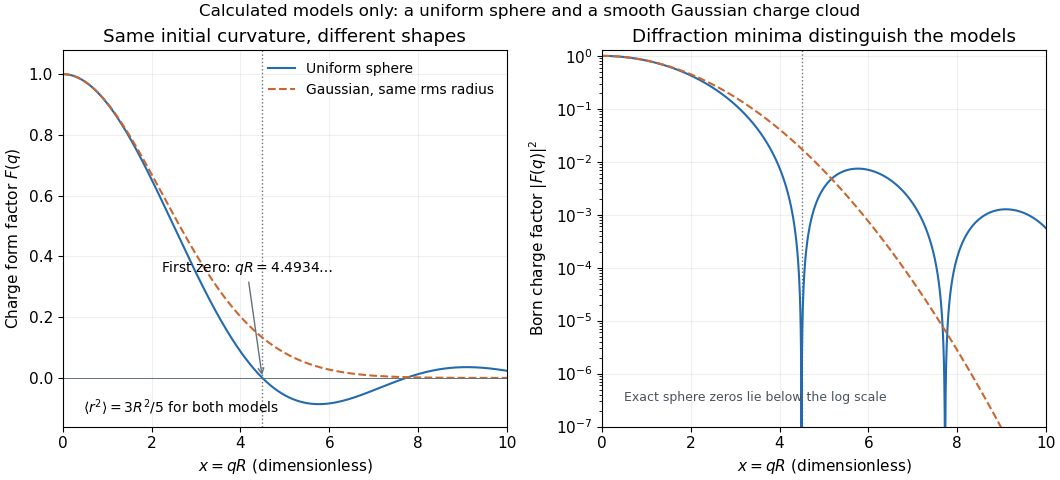

As a chosen scale illustration, take . The predicted first zero is , or using . With a ultrarelativistic Electron beam and negligible nuclear recoil, it occurs at . These are consequences of chosen model parameters, not measured properties of carbon or a claim that all atomic nuclei are uniform balls.
New to topics? Read the docs here!