
Vector calculus studies differentiation and integration of scalar fields and vector fields. Three operators answer different local questions: the gradient describes change of a scalar value, the divergence describes net outward flow, and the curl describes local circulation. Their associated integral theorems turn local derivatives into measurements along paths and across boundaries.
The difference between divergence and curl is especially visible in two smooth vector fields on three-dimensional Euclidean space:At each point they have the same Euclidean norm , but their directions differ. For , and . For , and . One expands radially in each horizontal plane; the other describes rigid rotation.
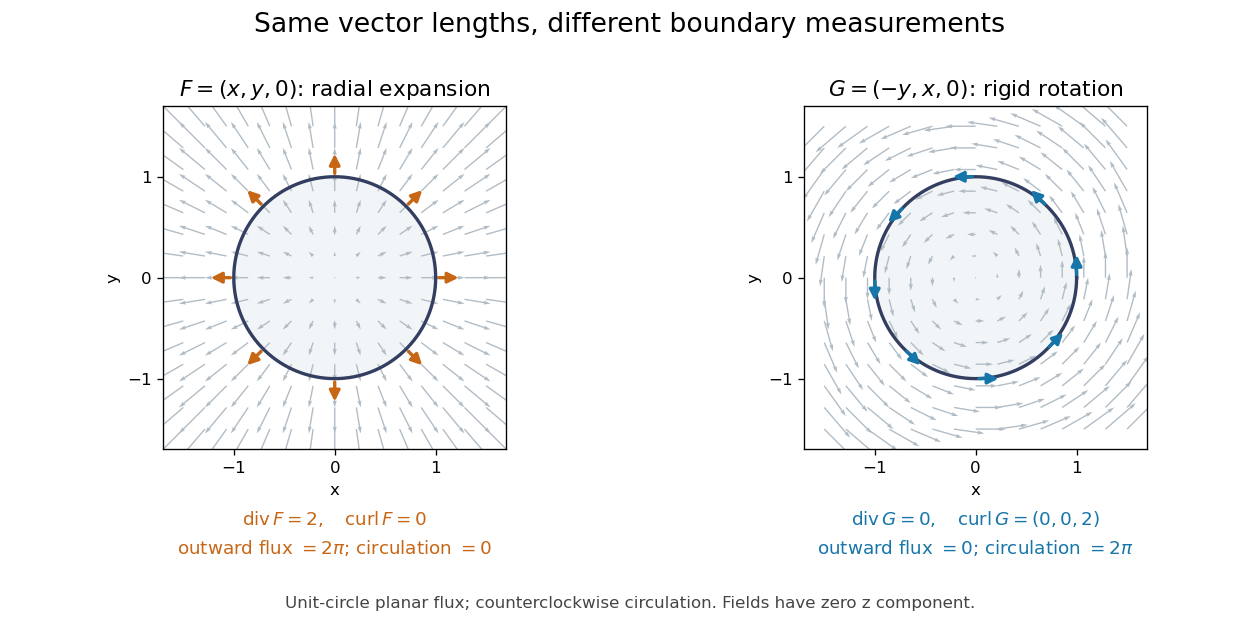
Equal-magnitude fields can have different divergence and curl: radial expansion gives outward flux, while rotation gives circulation
. Details. Around the counterclockwise unit circle in the plane , is normal to the boundary and has zero tangential component. Its outward planar flux integral is , while its line integral around the circle is zero. For the values are reversed: outward planar flux is zero, and circulation is . The divergence and curl predict exactly which boundary measurement survives.
Why is this useful? A velocity field can move material through a boundary or circulate it within a region. Conservation of mass connects its divergence with density changes through the continuity equation; its curl is vorticity. In electromagnetism, the Maxwell equations use the same operators to connect electric fields, magnetic fields, and their sources. The common mathematical language lets the same integral calculations work across different physical models. [ref]
https://openstax.org/books/calculus-volume-3/pages/6-5-divergence-and-curl. OpenStax: Divergence, curl, and their interpretations
.The geometric framework behind these operators is developed in differential forms. The Generalized Stokes theorem unifies the fundamental theorem for line integrals, Green theorem, Stokes theorem, and divergence theorem. In coordinates their formulas look different, but each relates accumulation over a region to a measurement on its boundary.
Wilson's Vector Analysis, published in 1901, was based on J. Willard Gibbs's lectures at Yale. Wilson's preface explains that examples from geometry, mechanics, and physics are interspersed with the mathematical development, so readers encounter applications as soon as they have the tools to understand them. That is a useful way to approach vector calculus: learn each operation through a measurement it makes possible. [ref]
https://archive.org/details/vectoranalysiste00gibbiala. Wilson: Vector Analysis, 1901, title page and general preface
.

Vector calculus is a branch of mathematics that deals with vector fields and the differentiation and integration of vector functions. It combines concepts from calculus, linear algebra, and mathematical analysis to study fields in multiple dimensions, focusing particularly on the behavior of vectors in space. Key concepts in vector calculus include: 1. **Vectors**: A vector is a quantity defined by both magnitude and direction.
New to topics? Read the docs here!