Waveguide cutoff frequency
ID: waveguide-cutoff-frequency

The waveguide cutoff frequency separates oscillatory axial propagation from exponential decay for a particular normal mode. For the vacuum-filled rectangular electromagnetic waveguide, the dispersion relation isFor a transverse electric mode of a rectangular waveguide, are nonnegative integers but not both zero. For a mode with and nonzero , both indices must be positive. The lowest cutoff for is consequently , or ordinary frequency .
A square cross-section instead gives equal and cutoffs. The absence of a transverse electromagnetic mode is specific to this hollow pipe, rather than all electromagnetic waveguides.[ref]
Rectangular Waveguide Modes. Haus and Melcher, Electromagnetic Fields and Energy, §13.4, equations (26)–(27) and Fig. 13.4.3: allowed indices, dominant mode and square-guide degeneracy
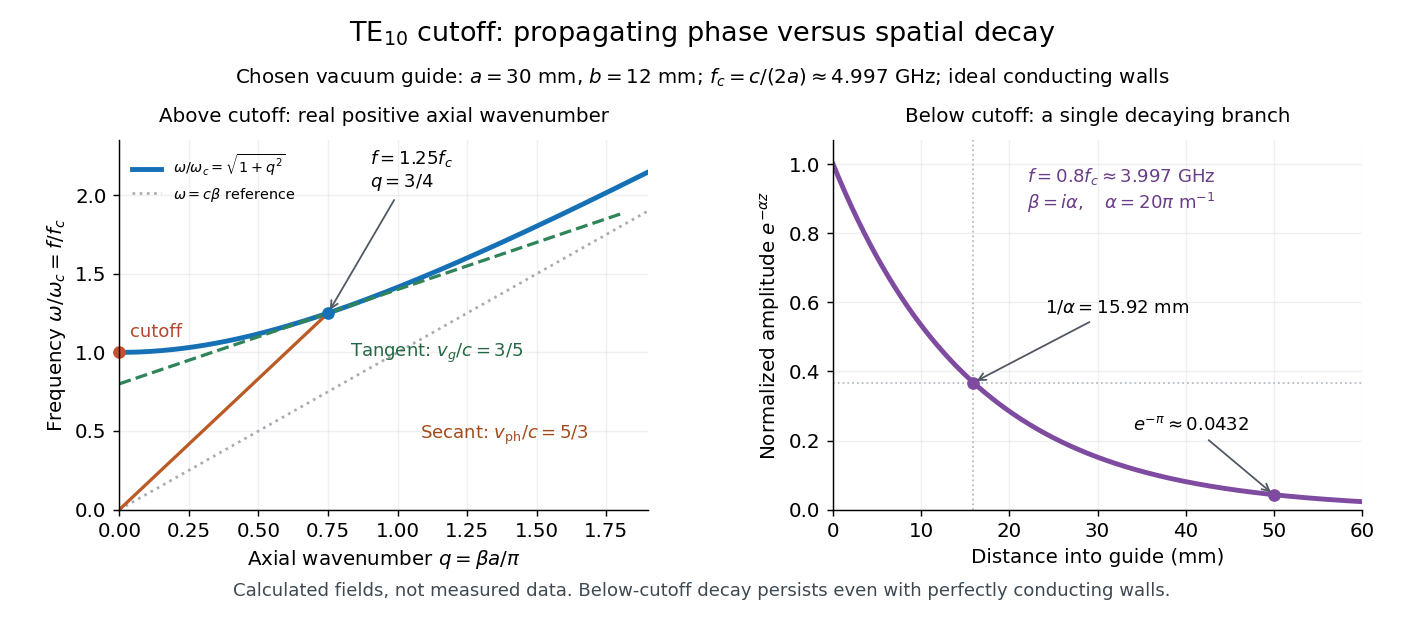
For , choose real for propagation toward . For , a field decaying into a semi-infinite guide hasA finite section can contain both growing and decaying axial solutions set by its two ends; the single decaying solution is not a complete finite-section transmission calculation. At exact cutoff , the two axial solutions become a constant and a linear function of : there is no finite axial wavelength for a traveling sinusoid.
In the chosen guide at , the branch has . Its amplitude decay length is ; after , its normalized wave amplitude is . This is geometric evanescence even with ideal walls, not Joule heating. A single decaying branch has zero cycle-averaged axial Poynting vector: substituting makes a quarter-cycle out of phase with . Coupling across a finite section requires the complete boundary-value solution.

New to topics? Read the docs here!