A Young tableau is a filling of a Young diagram with entries, typically positive integers. The shape is the partition of an integer giving its row lengths. We draw Young tableaux in the English convention of Young diagram, with left-aligned rows arranged from top to bottom. A filling need not obey increasing conditions unless these are specified: standard Young tableaux use each of exactly once and strictly increase along rows and down columns; Semistandard Young tableaux permit repetitions and require weakly increasing rows and strictly increasing columns.
In the constructions for a symmetric group involving Young symmetrizers, tabloids, and polytabloids, an unqualified numbered Young tableau means a bijective filling by , with no increasing condition imposed. This narrower convention is compatible with the broader use needed for Semistandard Young tableaux. Historically, Young's work connected these fillings to representation theory of the symmetric group; in particular, the equality between standard Young tableau counts and irreducible representation degrees over the complex numbers predates the modern hook-length formula. See Stanley's Algebraic Combinatorics, historical notes to Chapter 8.
For a Young tableau , let sum its row permutations and be the signed sum of its column permutations in the group algebra of the symmetric group. The product is a Young symmetrizer. The other order is another conventional realization. It satisfies , where is the hook product of a partition, so division by that scalar gives a primitive idempotent in characteristic zero. Acting on a tensor power constructs a Schur module.
If the rows of a Young tableau of shape have no repeated intersection with the columns of one of shape , then for every . If also in dictionary order on integer partitions, the shapes are equal. Saturation of the prefix bounds places one entry of each eligible row in each column, giving with and . A collision instead gives a transposition that makes row symmetrization followed by the relevant column antisymmetrization vanish.
Insert the successive letters of a permutation by row insertion to obtain an insertion tableau , recording the insertion times in the new boxes of . This is a bijection between permutations and pairs of standard Young tableaux of a common shape. Reverse insertion removes the box marked by the latest recording time. The first row of has length equal to the longest increasing subsequence.
List each pair with multiplicity , sorted first by and then by . Apply row insertion to the lower letters , and record the upper letters in the new cells. The row insertion comparison is strictly greater than the carried entry. The result is a pair of Semistandard Young tableaux of the same shape. Reverse insertion removes the rightmost cell containing the largest recording entry, then replaces the rightmost strictly smaller entry in each preceding row. It reconstructs the ordered list, proving the bijection. The insertion and recording contents are respectively the column sums and row sums of .
At one matrix entry , let be the shapes of the northwest, northeast, southwest and southeast matrix prefixes under the RSK correspondence. The displayed row-length recurrence expresses merged insertion paths: the new entry supplies the first-row carry, and the overlap of the two incoming row extensions beyond the northwest shape is bumped into the next row. Zero boundary shapes determine the whole diagram. Transposing the matrix exchanges , leaving the rule invariant.
For a symmetric nonnegative integer matrix, the two neighboring prefix shapes along the diagonal are equal. In the RSK growth-diagram local rule, set and take alternating sums of row lengths. The two occurrences of the alternating sum of cancel, leaving . Induction along the diagonal proves the formula. Each column contributes one to this alternating sum exactly when its length is odd.
For a finite - matrix, list its occupied pairs by increasing top entry and decreasing bottom entry within a top-entry tie. Perform ordinary semistandard row insertion on the bottom entries and record top entries in the new cells. The result is a bijection with same-shape tableaux for which and are Semistandard Young tableaux. The types of and are respectively the column-sum and row-sum vectors of the matrix.
Insert into the first row of a Young tableau by replacing its leftmost entry strictly greater than , and carry the displaced entry into the next row. If no entry is greater, append and stop. The procedure preserves a semistandard Young tableau; when all entries are distinct it preserves a near Young tableau. It underlies the Robinson–Schensted correspondence.
During row insertion into a near Young tableau, the successive carried entries strictly increase while the columns in which they are bumped weakly decrease. Every old cell keeps its entry or receives a smaller one. These facts follow from increasing rows and strictly increasing columns.
A near Young tableau fills a Young diagram with distinct entries from a totally ordered alphabet, increasing along rows and down columns. Its entries need not be the initial interval . It is the natural intermediate object for row insertion of a new entry.
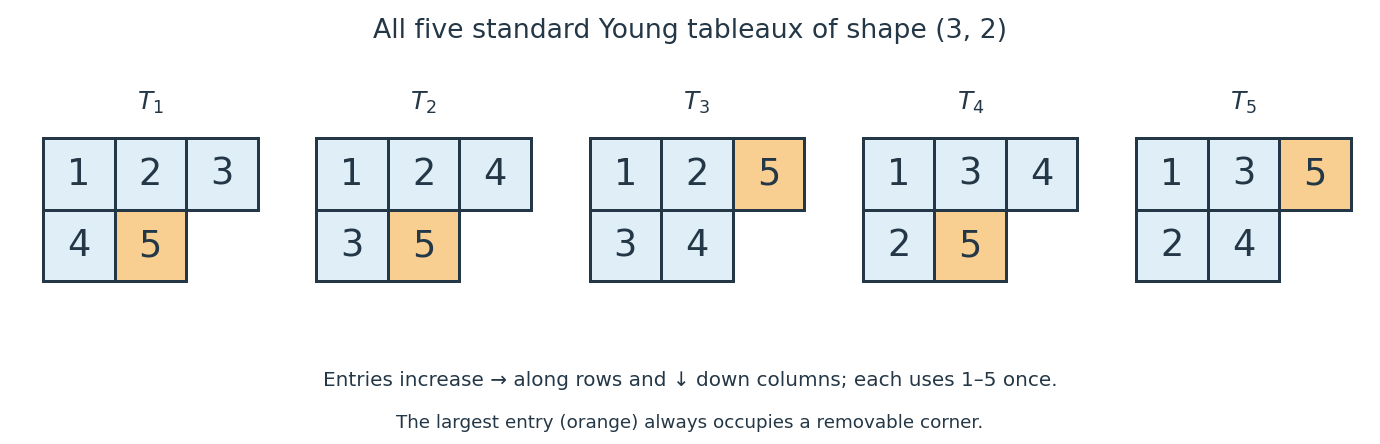
A standard Young tableau of shape is a Young tableau that uses exactly once and strictly increases left to right along every row and top to bottom down every column. Formally, a bijection is standard whenwhenever the indicated cells belong to the Young diagram. We write for the set of such fillings and for its cardinality.
For , the five standard Young tableaux are listed below, with each pair giving the top row followed by the bottom row:There are no others: the upper-left entry must be , and choosing the two bottom-row entries fixes both increasing row orders. Of the six choices of two entries from , only bottom row fails, because its would lie below . Hence by direct enumeration, independently of the hook-length formula.
The cells occupied by form a Young diagram: every cell above or to the left of an occupied cell has a smaller label. Consequently a standard Young tableau is equivalently a path from the empty shape to in the Young branching graph, adjoining one addable node of a Young diagram at each step. For , the successive shapes areConversely, number the cell added at step by to recover the standard Young tableau. This path interpretation also makes a standard Young tableau a linear extension of a partially ordered set defined by the row and column requirements; see Stanley's Algebraic Combinatorics, Chapter 8, on tableaux and paths in Young's lattice.
The usefulness goes beyond counting: the standard polytabloid basis of a Specht module over the complex numbers is indexed by , so . Each of the five pictured standard Young tableaux therefore labels one basis element of the irreducible representation of the symmetric group , whose dimension over the complex numbers is five. The filled diagrams index the basis; the actual vectors are polytabloids. The hook-length formula computes this dimension without listing all the standard Young tableaux.
Read each column from top to bottom, with columns ordered from left to right, and compare the resulting words lexicographically. With Young symmetrizer convention , this order gives triangular vanishing of Young-symmetrizer products. Changing the symmetrizer product convention requires a compatible order, rather than retaining a fixed vanishing direction automatically.
For standard tableaux of the same shape and , in column-reading order of standard Young tableaux implies . If there were no row-column collision, each column of would select one entry from each eligible row of . Its sorted first column is componentwise at least the row minima of ; equality fixes those selected entries and permits induction after deleting the column. Thus no collision implies . A collision gives .
Swapping consecutive labels preserves a standard Young tableau exactly when their cells are incomparable in the row-and-column order. Their contents then differ by more than one in absolute value. These admissible swaps connect all standard tableaux of any fixed shape, as adjacent swaps connect linear extensions of a partially ordered set.
The content vector of a standard Young tableau is , where is the Content of a Young-diagram cell containing . Such vectors are exactly the integer vectors satisfying: the first coordinate is zero; each subsequent coordinate has an earlier neighbor differing by one; between two occurrences of both and occur. To reconstruct the tableau, insert each entry in the next available cell on its prescribed diagonal. The neighbor conditions supply its required predecessors, so each insertion is an addable node of a Young diagram.
The axial distance from label to label in a standard Young tableau is the difference of their Young-diagram cell contents. This sign convention makes equal to for consecutive entries in a row and in a column. The reciprocal distance supplies the diagonal coefficient of Young orthogonal form.
A semistandard Young tableau fills a Young diagram with positive integers, permitting repeated entries, so that entries weakly increase along rows and strictly increase down columns. Its content records the number of occurrences of each entry. The Kostka number counts such fillings of shape and content .
For adjacent letters , pair entries in the same column and leave those pairs fixed. In each row, interchange the numbers of unpaired and entries, preserving their weak order. Strict columns are preserved: a letter that could obstruct a change from to , or conversely, would already have been paired. Applying the operation twice restores the tableau. The paired letters contribute equal amounts to the two contents, so the involution swaps their total multiplicities.
A word in positive integers is a lattice word if every initial segment has at least as many 's as 's for every . This is the reading-word condition in the Littlewood–Richardson rule. Under good-letter matching in a tableau word, every letter of a lattice word is good.
The row stabilizer permutes entries within each row, while the column stabilizer permutes entries within each column. Their intersection is trivial.
A tabloid is an equivalence class of tableaux under permutations within rows. The tabloids of shape form a transitive -set.
A tabloid is fixed by a permutation exactly when each of its cycles lies wholly within one row. Assigning the distinct length- cycles to rows gives the displayed coefficient. More explicitly, sum over nonnegative integers with and . Equal-length rows remain distinguished. Thus the character counts fixed ordered row sets, rather than unordered set partitions.
Over the complex numbers, the signed Young permutation module isThe isomorphism is the tensor identity for induced representations. The partition index is unchanged by this twist; conjugation instead changes the labels of its irreducible constituents. For the conjugate partition , the character inner product of and is one: Mackey restriction formula reduces it to the unique zero-one matrix with row margins and column margins .
Over the complex numbers,where the Kostka number counts semistandard tableaux of shape and content . It is nonzero only when dominates .
Let be the multiplicity of in the complex Young permutation module . For and ,Here means adding one cell, and zero parts are omitted. Equal row lengths contribute separately on the right. Restrict to and separate the tabloid orbits by the row containing to obtain the right side. Decompose into irreducibles and use the restriction branching rule for a symmetric group to obtain the left side. Equating multiplicities proves the formula.
For , over the complex numbers,By Young's rule, the multiplicity is the Kostka number for content . A semistandard Young tableau on just the entries has at most two rows. For shape , every lower entry is and every entry above it is ; the remaining top row is uniquely fixed by the content. Such a filling exists precisely for . Thus each displayed Specht module occurs once. A zero second part is omitted.
The Kostka number is the number of semistandard Young tableaux of shape and content : rows are weakly increasing and columns are strictly increasing.
For , identify with the permutation module on ordered pairs with . Let , , and . With and , one has a Specht filtrationwhose successive quotients areThe same construction for omits the zero factor.
The column antisymmetrizer of a Young tableau is the group algebra elementOn the Young permutation module it has one-dimensional image .
Let be a Young tableau of shape , and let be a Young tableau of shape , both on entries. If the Column antisymmetrizer of a Young tableau satisfies over any field, then dominates in the dominance order on partitions.
If two entries from one column of lie in the same row of , their transposition fixes the tabloid . Pairing terms of by this transposition gives , including in characteristic two. Otherwise the first rows of contain at most entries from column of . Thusfor every , proving dominance.
For tableaux of the same shape, exactly when no row of contains two entries from one column of . In that case a column permutation satisfies , and .
The Specht module is the span of the polytabloids of shape . It is cyclic, generated by any one polytabloid, and over it is irreducible.
The polytabloids indexed by standard Young tableaux of shape form a basis of over every field, and a basis of its integral lattice over . Column antisymmetry and Garnir relations straighten any polytabloid into this set. Ordering leading tabloids by the rows containing successive entries makes the corresponding coefficient matrix triangular with diagonal entries one, proving independence. In particular the dimension is the standard-tableau count in every characteristic.
Take two adjacent columns of a numbered Young tableau, with a bottom segment of the left column and a top segment of the right column such that exceeds the height of the left column. Alternating over permutations of , modulo permutations preserving and separately, gives a signed relation among polytabloids. The full alternation vanishes because each tabloid has two of these entries in one row. Solving for a nonstandard polytabloid replaces its offending row inversion by earlier column-standard tableaux. The relation is proved over the free integral tabloid lattice, where cancellation and division by nonzero integer factors are valid; reduction then makes it valid in every characteristic. Together with column antisymmetry these relations give the standard polytabloid basis.
A filling of shape and content defines a module homomorphism : given a numbered tableau, sum over distinct assignments obtained by permuting within its rows, and put each numbered entry into output row when its assigned label is . Restricting to gives . For Semistandard Young tableaux , these restrictions are linearly independent over every field. They form a basis of if the characteristic of a field is not two, or if is a two-regular partition of an integer. For two-singular shapes in characteristic two, they need not span. Column antisymmetrization and triangular leading tabloids establish independence; straightening the images of a cyclic polytabloid establishes spanning under the stated hypotheses.
For a partition of an integer , let sum all tabloids obtained by retaining elements of row and moving its other elements into row , leaving the other row sets unchanged. Here and replaces by ; Young permutation modules are defined for compositions too. Then over every field. Pairwise column cancellation gives inclusion of the Specht module in each kernel. The reverse inclusion follows by straightening the tabloid coefficients using these adjacent-row relations: the remaining free leading coefficients are exactly those of the standard polytabloid basis.
In positive characteristic , is nonzero exactly when for every adjacent pair, where is least with . The only invariant line in is generated by the sum of all tabloids. The map sends it to . Thus the kernel intersection theorem for Specht modules gives vanishing of modulo for . By Lucas's theorem, all these binomial coefficients vanish exactly when the last base- digits of are .
An ordinary Specht module of non-self-conjugate shape stays irreducible on the alternating group, and conjugate shapes give the same restriction. A self-conjugate shape splits into two irreducibles of equal degree, interchanged by an odd permutation. The index-two inner-product identity is , and Frobenius reciprocity proves exhaustion. The statement applies for ; is trivial.
For , the least non-linear ordinary degree is at and for . For no non-linear irreducible exists. The degree- representation is unique for , except where it does not exist and where two distinct degree-five irreducibles occur. The proof uses tableau branching to bound the degrees of nonstandard shapes and of the half-degree constituents of self-conjugate shapes, with the small cases checked by the hook-length formula.
For a row composition and a weakly decreasing marking with , mark the first cells of each row. Antisymmetrize within the marked columns and span the resulting polytabloids in the Young permutation module . This gives ; and for a proper partition . Its characteristic-independent Specht filtration is obtained by successively marking a cell or raising an unmarked row tail, with column-cancellation maps and the good-letter counting recursion.
The first component is a proper partition marking an initial segment of each row of the second component. The second component may be a composition rather than a decreasing partition. This convention specifies a generalized Specht module and differs from specifying a skew shape by two nested proper partitions.
Read a word of type from the left. Every is good; an is good when the number of previous good 's exceeds the number of previous good 's. The set contains words with at least good 's for each . Their matched chains yield independent marked-column polytabloids; column antisymmetrization and the add-or-raise recursion give over every field.
A Specht filtration is a finite chain of submodules whose successive quotients are Specht modules. In positive characteristic it need not split and is not a composition series, because its Specht factors may themselves be reducible. Dimensions and ordinary lifted characters can still be added along the filtration.
For induction of to the symmetric group on letters, the Specht filtration multiplicity of is the number of Semistandard Young tableaux of skew shape , content , and lattice word read from right to left in each row, taking rows from top to bottom. In characteristic zero these are irreducible constituents; in positive characteristic they remain Specht factors rather than simple constituents. Content gives the add-one-cell induction rule.
The nonnegative integer is the multiplicity of in in characteristic zero. The Littlewood–Richardson rule counts it by Semistandard Young tableaux of skew shape , content , and lattice word in right-to-left, top-to-bottom reading order. For example : the two new top cells must be ones, and the remaining reading letters can be . This coefficient also multiplies Schur functions in the induction ring of symmetric-group characters.
In the induction ring of ordinary symmetric-group characters, is the sum, with multiplicity one, of for which is a horizontal strip of cells. Here is the trivial representation of . In the Littlewood–Richardson rule, content means every skew entry is ; strict column increase is possible exactly when there is at most one new cell in every column. This proves the rule.
In the complex symmetric-group algebra, normalize a Young symmetrizer by . The row-column collision lemma proves , so is a primitive idempotent and is an irreducible left module. Different shapes are separated by the vanishing corner for . Counting conjugacy classes then proves that these modules exhaust the simple modules.
Let be a submodule of the Young permutation module over any field. Then eitherfor the tabloid bilinear form. The key identity is : if one pairing is nonzero, the cyclic generator and hence the whole Specht module lies in .
Over a field of characteristic zero,The map from sending the tabloid of to is a surjection whose kernel is .
Over the complex numbers, restriction from to is multiplicity-free:Equivalently, one removes one Removable node of a Young diagram in every possible distinct way.
For with ,Indeed, adjoining the trivial character to the standard character gives the point-permutation character, and Frobenius reciprocity turns its multiplicity in the self-product into the norm of the multiplicity-free restriction.
Order tabloids lexicographically by the row containing , then the row containing , and so on. For a standard tableau , the tabloid occurs with coefficient one in and precedes every other tabloid occurring in it. Distinct standard tableaux have distinct leading tabloids, so their polytabloids are linearly independent.
For any partition of an integer , the number of standard Young tableaux of shape isThe numerator is a factorial, and the denominator is the hook product of a partition, using every cell's hook length once. The empty shape has one empty standard Young tableau, and the formula still holds with and an empty product equal to one. By the standard polytabloid basis, is also the dimension of the Specht module over the complex numbers, or equivalently the degree of its irreducible character. For a teaching derivation of this dimension formula, see Etingof et al., Introduction to Representation Theory, §5.17, Theorem 5.17.1.
In the Young diagram of , the hook length array givesThis agrees with the five explicit fillings in standard Young tableau. Its conjugate partition has the same hook lengths after transposition, hence also gives dimension five. At the extremes, for , a single row and a single column each have hook product and exactly one standard Young tableau; their Specht modules over the complex numbers are the trivial representation and sign representation, respectively.
Why the formula is beautiful: global compatibility of all the row and column inequalities reduces to a product of local hook lengths. It is useful when enumeration is already expensive: computing one hook length per cell replaces testing up to numbered Young tableaux. For , the proportion of the bijective fillings that are standard Young tableaux is , the reciprocal of the hook product. This product does not justify treating overlapping hook conditions as independent; Grinberg explains that tempting but invalid argument in §1.3 of his teaching slides.
Historically, the modern hook-product statement was published by J. S. Frame, G. de B. Robinson and R. M. Thrall in 1954: [ref]
https://doi.org/10.4153/CJM-1954-030-1. The Hook Graphs of the Symmetric Group, Canadian Journal of Mathematics 6, 316–324, Theorem 1
. Their manuscript was received on 1 September 1953, and their proof reorganizes an earlier irreducible character degree formula into the product of the hook lengths. The theorem unifies the counting and representation viewpoints developed earlier by Young. For proof routes within this wiki, see trace computation of Specht module dimension, determinant formula for Specht module dimension, and Greene–Nijenhuis–Wilf hook walk.For , the least ordinary irreducible dimension exceeding one is , except at , where has dimension two. The dimension- shapes are and its conjugate partition, with the additional shapes and at . For there is no non-linear irreducible. A proof uses the restriction branching rule for a symmetric group: a nonstandard shape with at least two corners has two non-linear predecessors, and a rectangular shape has one predecessor which in turn has two non-linear predecessors. This bounds its degree strictly above once ; the smaller cases follow directly from the hook-length formula.
Right multiplication by on the group algebra is an idempotent with image . Every diagonal entry in the permutation basis is the coefficient of the identity in , namely . Thus its rank equals its trace, giving . Triangular standard-tableau ideals and the Robinson–Schensted correspondence identify this dimension with the standard-tableau count.
For a partition with positive parts, the number of standard Young tableaux, and hence the dimension of its complex Specht module, is . Negative factorial arguments give zero entries. Setting turns the determinant into by the Vandermonde determinant, matching the hook-length formula.
At a noncorner cell of a Young diagram, this random walk chooses uniformly one of the other cells in its hook of a Young diagram. It stops at a corner. Every step moves right or down, so it terminates. Its corner probabilities provide a probabilistic proof of the hook-length formula.
For a target corner in the Greene–Nijenhuis–Wilf hook walk, put and . The probability of terminating there from factors as , where , for , and for . It is zero when the start is outside the target's northwest rectangle. The factorization uses and the first-step recurrence.
If a permutation has a -cycle and remaining cycle type , thenwhere the sum is over removable rim hooks of length .
Multiplication of an alternant by is the sum of alternants obtained by raising one row exponent by . Equal exponents give zero. Otherwise sort the shifted beta number of a partition back into decreasing order. The resulting partition adds a size- rim hook; the number of crossed exponents is its height and supplies the determinant sign. This proves the formula through the bialternant formula. Iteration counts signed border-strip tableaux.
With beta numbers, the staircase has set . Lowering a bead by a positive even number either hits an occupied bead or a negative position, so no even-size rim hook can be removed. The adjoint of multiplication by under the Hall inner product of symmetric functions is . The power-sum border-strip multiplication formula therefore gives zero derivative with respect to every even power sum. Since the rational symmetric-function algebra is freely generated by the power sums, the stated conclusion follows.
Let be the core of a partition at prime modulus , with quotient component sizes and total weight . Complete -hook removal sequences number . Their signs agree because abacus bead-crossing parities telescope to the permutation taking the initial labeled beads to the packed core order. Repeated Murnaghan–Nakayama rule gives the displayed formula for any permutation on the remaining letters.
The parity of the sum of the leg lengths in any sequence that removes all -hooks from is independent of the sequence. Its sign is therefore well defined and supplies the common sign in repeated applications of the Murnaghan–Nakayama rule.
For even , the virtual charactervanishes on every permutation having an odd cycle. Under the Frobenius characteristic map, the Jacobi–Trudi identity identifies its characteristic with the degree- part of , which contains only products of even-indexed power sums.
At a permutation whose cycle lengths are the principal hook lengths of , the Murnaghan–Nakayama rule has a unique complete removal sequence. Consequently has value or there.
For a partition , the irreducible character vanishes on every cycle type containing an even part exactly when is a staircase . A staircase has only odd hook lengths. Conversely, vanishing first forces to be self-conjugate; applying the Murnaghan–Nakayama rule at the largest even hooks then forces consecutive row lengths.
For the alternating expression indexed by an integer composition, swapping two adjacent entries of negates . If two entries coincide the expression vanishes; otherwise sorting produces, up to sign, the irreducible character indexed by the resulting partition.
The tabloid bilinear form makes the tabloid basis orthonormal and restricts to an invariant bilinear form on each Specht module. In positive characteristic of a field, its radical controls the corresponding simple quotient.
Write , . The regular partition labelling the sign representation in characteristic is , with zero parts removed. Its conjugate partition is , which satisfies the invariant vector criterion for a Specht module. The sign-twisted duality of Specht modules turns this invariant line into a sign quotient of , necessarily its unique simple head. Conversely, regularity says consecutive column heights differ by less than ; combining this with the invariant congruences forces these heights to be except possibly the last. For , the label is because sign equals the trivial representation.
For a -regular partition,is nonzero and absolutely irreducible. Distinct -regular partitions label nonisomorphic simple modules.
The James submodule theorem follows from . A nonzero restricted form therefore gives a simple radical quotient. If counts equal-length rows, all integral polytabloid pairings are divisible by , while pairing with row reversal gives . Thus the form is nonzero modulo exactly for regular partitions. The construction and the proof commute with every field extension, so the quotient is absolutely irreducible, including over the prime field.
If is -regular, thenFor a tableau and its row reversal ,which is nonzero in characteristic . Applying a column antisymmetrizer to an endomorphism at therefore forces its value on the cyclic generator to be scalar.

