
A standard Young tableau of shape is a Young tableau that uses exactly once and strictly increases left to right along every row and top to bottom down every column. Formally, a bijection is standard whenwhenever the indicated cells belong to the Young diagram. We write for the set of such fillings and for its cardinality.
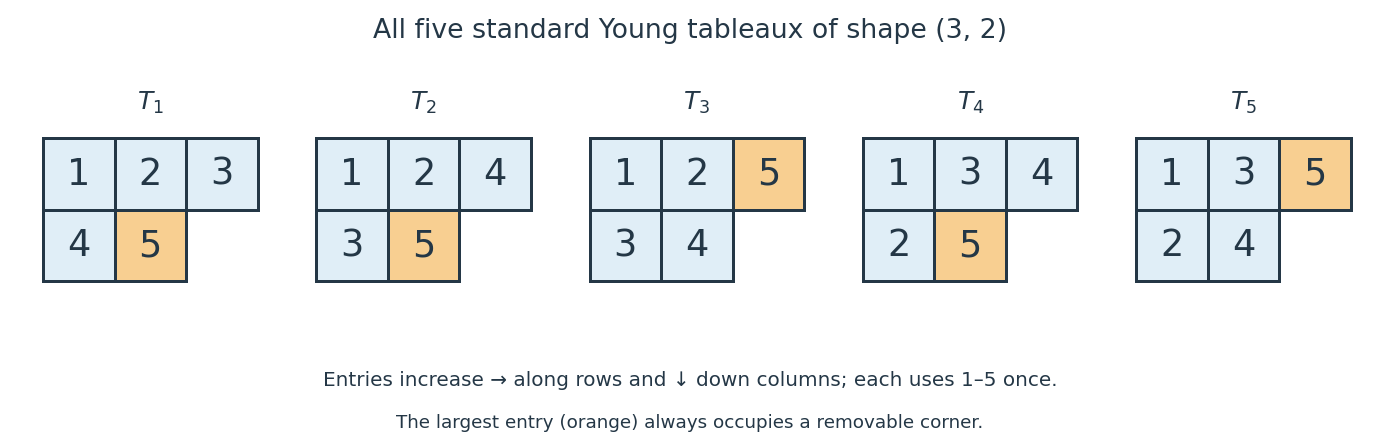
For , the five standard Young tableaux are listed below, with each pair giving the top row followed by the bottom row:There are no others: the upper-left entry must be , and choosing the two bottom-row entries fixes both increasing row orders. Of the six choices of two entries from , only bottom row fails, because its would lie below . Hence by direct enumeration, independently of the hook-length formula.
The cells occupied by form a Young diagram: every cell above or to the left of an occupied cell has a smaller label. Consequently a standard Young tableau is equivalently a path from the empty shape to in the Young branching graph, adjoining one addable node of a Young diagram at each step. For , the successive shapes areConversely, number the cell added at step by to recover the standard Young tableau. This path interpretation also makes a standard Young tableau a linear extension of a partially ordered set defined by the row and column requirements; see Stanley's Algebraic Combinatorics, Chapter 8, on tableaux and paths in Young's lattice.
The usefulness goes beyond counting: the standard polytabloid basis of a Specht module over the complex numbers is indexed by , so . Each of the five pictured standard Young tableaux therefore labels one basis element of the irreducible representation of the symmetric group , whose dimension over the complex numbers is five. The filled diagrams index the basis; the actual vectors are polytabloids. The hook-length formula computes this dimension without listing all the standard Young tableaux.
Read each column from top to bottom, with columns ordered from left to right, and compare the resulting words lexicographically. With Young symmetrizer convention , this order gives triangular vanishing of Young-symmetrizer products. Changing the symmetrizer product convention requires a compatible order, rather than retaining a fixed vanishing direction automatically.
For standard tableaux of the same shape and , in column-reading order of standard Young tableaux implies . If there were no row-column collision, each column of would select one entry from each eligible row of . Its sorted first column is componentwise at least the row minima of ; equality fixes those selected entries and permits induction after deleting the column. Thus no collision implies . A collision gives .
Swapping consecutive labels preserves a standard Young tableau exactly when their cells are incomparable in the row-and-column order. Their contents then differ by more than one in absolute value. These admissible swaps connect all standard tableaux of any fixed shape, as adjacent swaps connect linear extensions of a partially ordered set.
The content vector of a standard Young tableau is , where is the Content of a Young-diagram cell containing . Such vectors are exactly the integer vectors satisfying: the first coordinate is zero; each subsequent coordinate has an earlier neighbor differing by one; between two occurrences of both and occur. To reconstruct the tableau, insert each entry in the next available cell on its prescribed diagonal. The neighbor conditions supply its required predecessors, so each insertion is an addable node of a Young diagram.
The axial distance from label to label in a standard Young tableau is the difference of their Young-diagram cell contents. This sign convention makes equal to for consecutive entries in a row and in a column. The reciprocal distance supplies the diagonal coefficient of Young orthogonal form.
Articles by others on the same topic
There are currently no matching articles.