Articles by others on the same topic

An adjacency list represents a graph by keeping, for each vertex , a collection of the vertices reached by its outgoing edges. An array indexed by vertex identifiers can locate each collection; the collection itself may use a linked list or an array. In an undirected graph, each nonloop edge supplies an entry at both endpoints.[ref]
Graph.java. Graph.java, class documentation and fields: vertex-indexed adjacency collections; addEdge: entries at both endpoints
For a worked example, take the simple graphwhere denotes the unordered pair . Its adjacency lists, displayed in label order, areThus has three neighbours, although the graph has six vertices. Its list contains exactly the destinations available for a single step from ; no slots are reserved there for . The fourteen neighbour entries represent seven edges, with appearing as in 's list and as in 's list. The label order makes the example easy to read; an adjacency list need not be sorted.
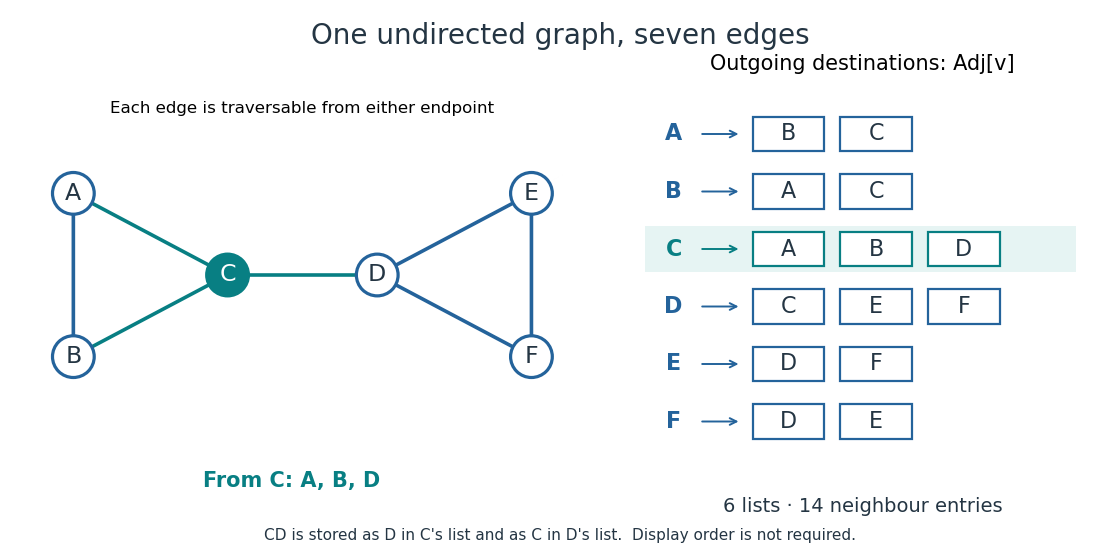
Seven undirected edges and their fourteen adjacency list entries
. Details. 
The useful idea is to store existing connections explicitly. Neighbour enumeration can then follow exactly the possible next steps, which is what breadth-first search and depth-first search need. In a sparse graph, most pairs of vertices have no edge; adjacency lists avoid reserving a separate adjacency matrix entry for every such absence. Whether this saves work depends on the question: neighbour enumeration and testing one proposed edge have different costs.