Articles by others on the same topic

Magnetic flux measures the signed amount of magnetic field crossing an oriented surface . Choose a unit normal and use the oriented surface element . The defining surface integral isFor a uniform magnetic field across a flat surface of area , the dot product reduces this towhere is the angle between the magnetic field and the chosen unit normal, rather than the plane of the surface. The SI unit is the weber, . [ref].
For a stipulated magnetic field and area , the magnetic flux is at , at , and zero at . In the last case the magnetic field lies in the plane of the surface, so it does not cross it. Reversing the chosen unit normal reverses the sign of magnetic flux without changing the physical magnetic field; at the same example gives .
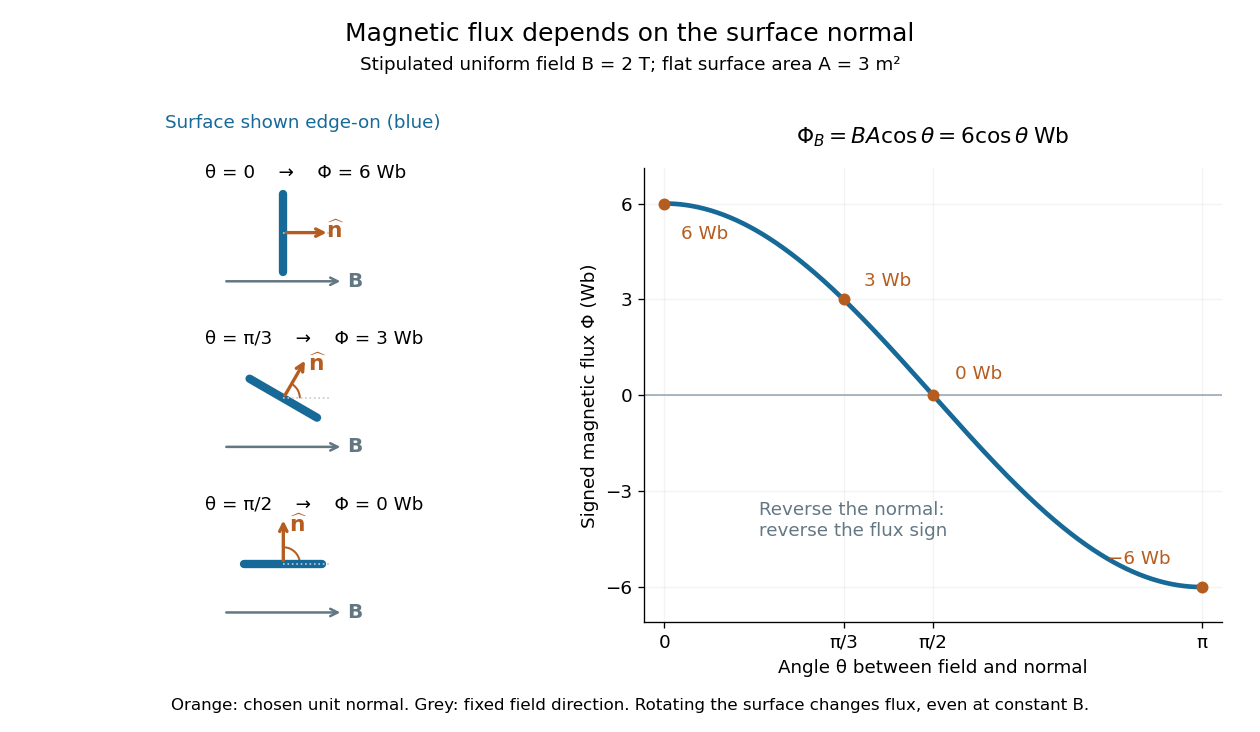
The geometric idea is projected area: tilting a flat surface reduces the area seen perpendicular to the magnetic field by the factor . This explains how rotation alone can change magnetic flux even when the magnetic field is constant; Faraday's law of induction turns such changes into an electromotive force. [ref]
https://openstax.org/books/university-physics-volume-2/pages/13-1-faradays-law. OpenStax, induction from changing magnetic flux
.

Magnetic flux is a measure of the quantity of magnetic field lines passing through a given surface area. It is a key concept in electromagnetism and is denoted by the Greek letter Φ (phi). Mathematically, magnetic flux (Φ) through a surface is defined by the equation: \[ \Phi_B = \int \mathbf{B} \cdot d\mathbf{A} \] where: - \(\Phi_B\) is the magnetic flux.