One of the best ways to think about it is the transversal time dilation thought experiment.
Light watch transverse to direction of motion. This case is interesting because it separates length contraction from time dilation completely.
Of course, as usual in special relativity, calling something "time dilation" leads us to mind boggling ideas of "symmetry breaking": if both frames have a light watch, how can both possibly observe the other to be time dilated?
And the answer to this, is the usual: in special relativity time and space are interwoven in a fucked up way, everything is just a spacetime event.
In this case, there are three spacetime events of interest: both clocks start at same position, your beam hits up at x=0, moving frame hits up at x>0.
Those two mentioned events are spacelike-separated events, and therefore even though they seem simultaneous to you, they are not going to be simultaneous to the moving observer!
If little clock one meter away from you tells you that at the time of some event (your light beam hit up) the moving light watch was only 50% up, this is just a number given by your one meter away watch!
Articles by others on the same topic

If one clock measures a proper time interval while moving at constant speed in an inertial frame, that frame measures , where is the Lorentz factor. The two spacetime events must lie on that clock's world line.
Suppose a clock moving at advances by between two ticks. Set at the first tick. The laboratory's synchronized clocks assign . During that interval the clock travels , approximately . The Minkowski interval checks the result:Both frames therefore recover the same of proper time. This calculation is useful whenever a process is timed on a moving apparatus but described using laboratory clocks.
A light clock makes the mechanism visible. Two mirrors separated by perpendicular to the motion exchange a pulse; define one tick as its complete return to the lower mirror. In the clock's rest frame the tick takes . In the laboratory each half-tick lasts and the light traverses a diagonal, so the Pythagorean theorem givesFor and , each leg covers while the mirrors move . The return tick lasts instead of : the light has the same speed of light in both accounts. [ref].
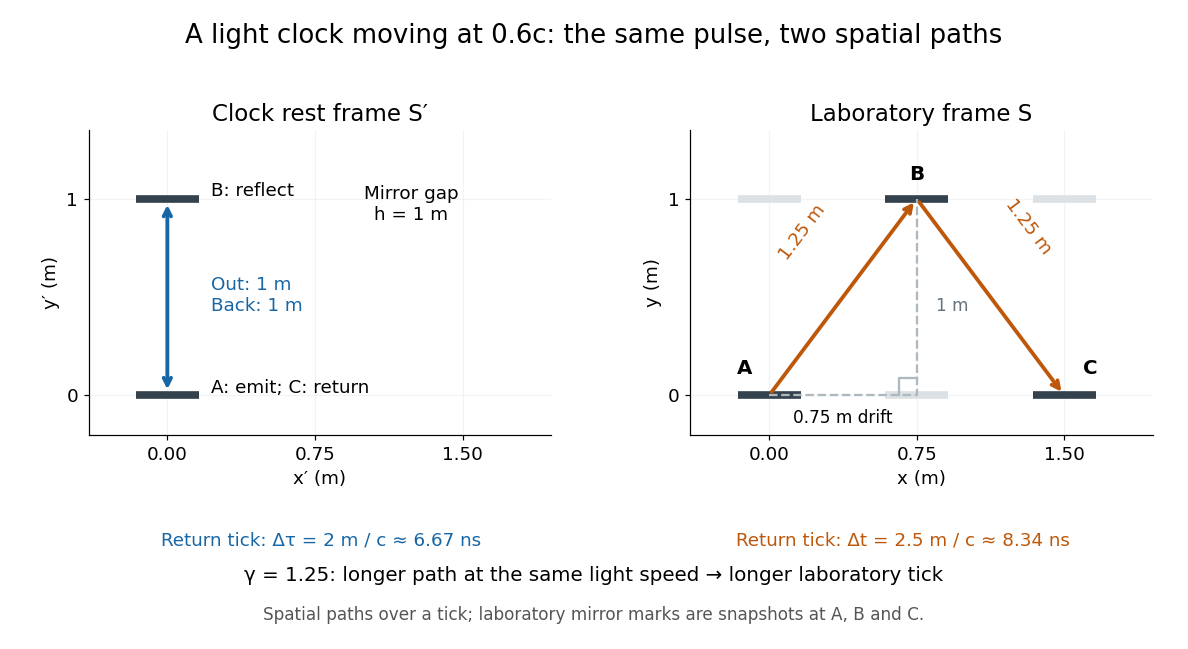
One return tick of a transverse light clock at rest and moving at 0.6c; the laboratory light path is longer
. Details. Reciprocal time dilation is consistent: each inertial frame times the other frame's single moving clock using its own synchronized clock network. These comparisons use different simultaneous spacetime events. Comparing reunited clocks instead requires their complete world lines, as in the twin paradox.

This is a section about Time dilation!
For example, this sentence. And then another one.

This is a section about Time dilation!
For example, this sentence. And then another one.

