
Past exam of the differential equations 1 course of the University of Oxford 2017 3 c Solution 2026-10-31
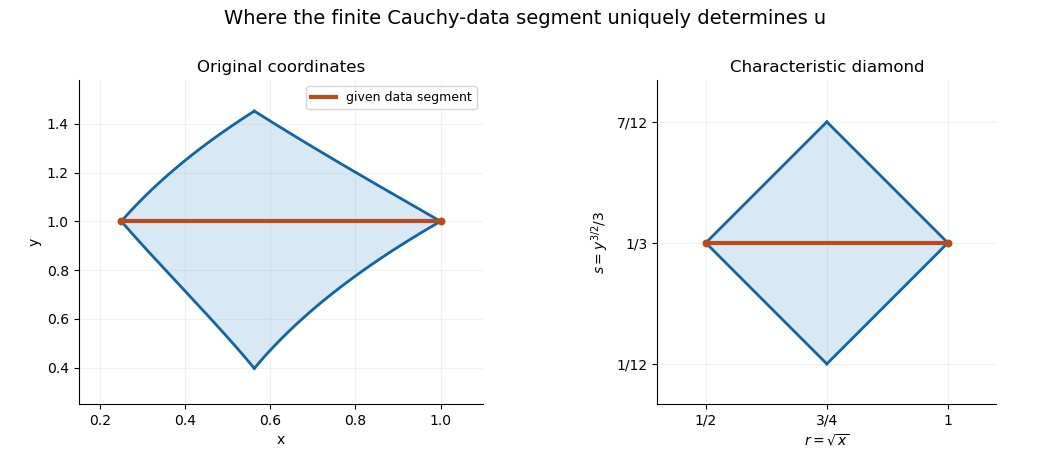
On , the transformed variables satisfy and . Differentiating the displacement data tangentially and using givesHence on , on , and the additive constants have sum . The uniquely determined solution is thereforeIt is fixed by the data exactly where both needed characteristic arguments belong to their known intervals:Equivalently, in the plane this is the diamond . In the original coordinates it is bounded by four curved characteristic curves. It lies wholly in . The displayed formula supplies one smooth extension beyond the diamond too, but the specified finite data segment does not determine that extension: one may change or outside its known argument interval. This is the characteristic-coordinate domain of dependence.

Past exam of the differential equations 1 course of the University of Oxford 2017 3 b Solution 2026-10-31
In , the characteristic equation of a partial differential equation gives . Integration yields the characteristic coordinatesTheir Jacobian determinant is , so they are valid independent coordinates. To see cancellation of the lower-order terms explicitly, first put , and . The chain rule givesSubstitution cancels the first-derivative terms, leaving . With , and , the characteristic normal form is . Integrating once in each variable giveswhere are arbitrary twice continuously differentiable functions on the relevant coordinate intervals. This is a curvilinear reduction to the one-dimensional wave equation.
Past exam of the differential equations 1 course of the University of Oxford 2017 3 a Solution 2026-10-31
The principal coefficients are , , , in the convention . Their discriminant is . Thus it is a hyperbolic partial differential equation where and an elliptic partial differential equation where . Its principal part has parabolic type where ; however the full equation contains and is undefined on . On its actual domain , the parabolic locus is .
The characteristic equation of a partial differential equation isIn a hyperbolic region this gives two distinct real characteristic directions. The singular lower-order coefficient should not be mistaken for an ordinary parabolic point of the full equation on .
Past exam of the continuous optimisation course of the University of Oxford 2011 3 v Solution 2026-10-31
For fixed , is fixed. The relaxed inequality and say preciselyThe objective strictly decreases with , so its best choice is always equality. Replacing any feasible relaxed point by that choice preserves feasibility and improves or leaves unchanged the objective. Conversely every point satisfying equality is feasible for the relaxed problem. Thus the two dual formulations have the same optimal value and the same optimal , with equality at any optimizer.
This algebraic equivalence in fact does not require Slater's condition. Under the stipulated condition, strong duality additionally identifies their attained optimum with the primal optimum. With as a linear coordinate, the relaxed constraint is , so the relaxed formulation is a second-order cone program.
Past exam of the continuous optimisation course of the University of Oxford 2011 3 iv Solution 2026-10-31
Reverse the order of the two optimizations to obtain the Lagrangian dualPut and . For , completing the square givesAt the infimum is finite precisely if , when it equals . For , the expression is minimized at , with value . The same optimized value holds when , choosing . Eliminating therefore gives . Introducing yieldsThe nonnegative square root is enforced by . Optimizers correspond by , including the zero case.
There are unlisted articles, also show them or only show them.