
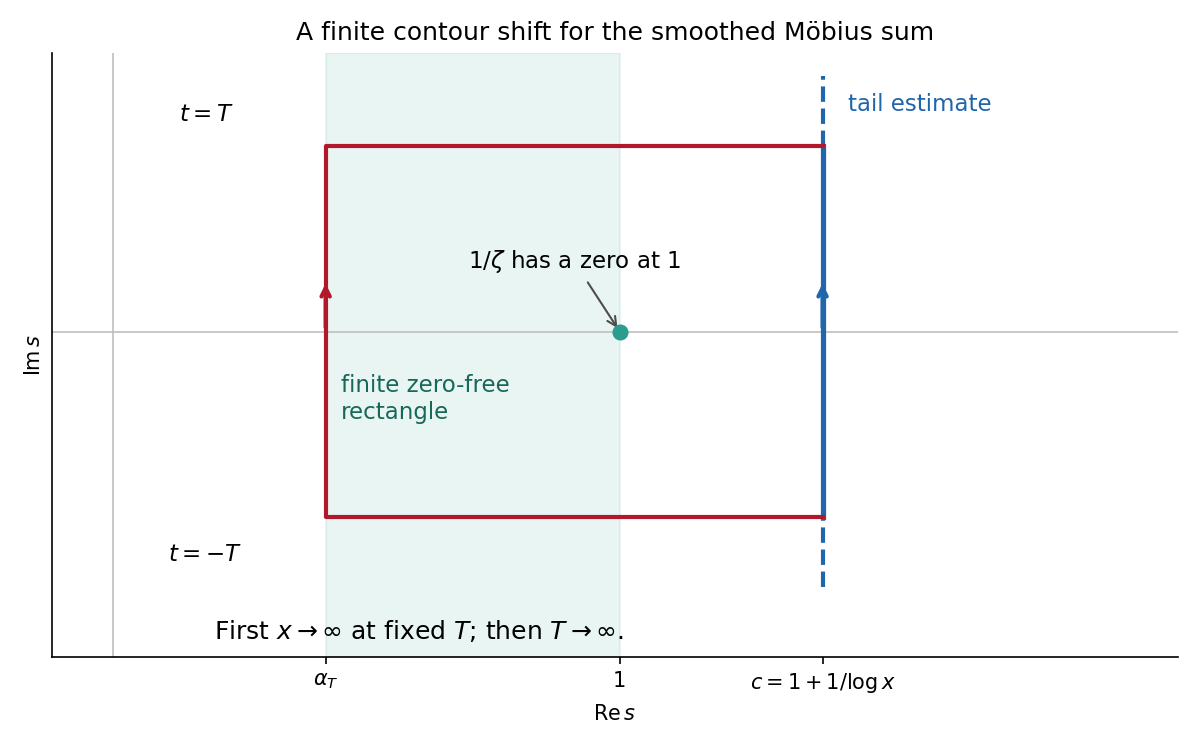
Write ; the source's rectangle notation is interpreted as the intended height restriction . We use the standard facts that has no zeros on , has a simple pole at one, and is meromorphic with no other pole. The function is holomorphic function and nonzero on the compact set , including its removable value one at . It remains nonzero in a neighborhood of this compact set. Together with nonvanishing to its right this gives some such that the whole closed rectangle , contains no zeta zero. The pole at one is harmless: extends holomorphically there with value zero.
The linearly smoothed Perron kernel, for and , isFor shift the contour left across the simple poles at zero and minus one, whose residues are and . For shift right, crossing no pole. At the integral is zero, also obtained by direct integration of . The quadratic denominator gives absolute integrability on the original vertical line.
For use the absolutely convergent Dirichlet series . Interchanging the sum and the contour integral is justified by and the integrable denominator. The term for is times the kernel at , hence when and zero otherwise. Consequently
Here is a contour argument that needs only the stated bound, with no unproved uniform estimate left of one. Take , , and first hold fixed. On the two tails , the given bound and giveShift the remaining segment to . The integrand is holomorphic function inside the rectangle: the zero of at one cancels the apparent zeta pole, and lie outside. On the fixed left side its integral is . On the two horizontal sides, is bounded by some finite constant depending on . Therefore their integrals are bounded byIt follows thatNow let ; the integrable tail tends to zero. ThusThe order of limits matters: first for each fixed rectangle, then . This is linearly smoothed Möbius cancellation from finite zero-free rectangles.

summation by parts, with , gives for an integer The boundary term tends to zero when because is bounded. In the original region of absolute convergence this provesFor a compact subset of , choose below all its real parts and bound there. The integral tail is bounded by a constant times , uniformly on that compact set. Its truncated integrals are holomorphic function in , so locally uniform convergence proves a analytic continuation throughout . This is holomorphy of a Dirichlet series from bounded partial sums.
The Euler product, valid for , isExpand the logarithms of these absolutely convergent Euler products. Writing , the logarithm of the product in the desired inequality isFor odd , is or . In the first case the numerator is the given nonnegative trigonometric polynomial. In the second replace by , which changes the sign of and leaves unchanged. At the numerator is . Every summand is nonnegative. Exponentiation provesThis is the three-four-one inequality for Euler products applied to the real character modulo four.
Suppose and . Holomorphy gives as . The only pole of the Riemann zeta function is at one, so remains bounded, while . The displayed product is then , contradicting its lower bound. Hence for .
At the last zeta factor also has a pole, so that contradiction no longer follows from the inequality. Instead evaluate the convergent alternating series:For rigor, integrate the finite geometric identity for ; the remainder has absolute integral at most and tends to zero. summation by parts above identifies this value with the analytic continuation at one.
absolute convergence depends only on , since . Let be the set of real for which converges. Comparison with a convergent member shows that is upward closed. The hypotheses give a member of and a real number outside , so its infimum is finite. If , some lies below , giving convergence by comparison; if , convergence would contradict the definition of the infimum. Thus is the abscissa of absolute convergence of a Dirichlet series. This argument leaves convergence on the boundary open.
Partition according to . Writing identifies the part indexed by with the integers coprime to . There are of them. Counting the entire partition proves the totient divisor-sum identity
We use the multiplication theorem for absolutely convergent Dirichlet series: their product is the Dirichlet series of the Dirichlet convolution of their coefficients. absolute convergence justifies rearrangement of the double sum. Here , so its series converges absolutely for , andThe Euler product implies for . Division gives
We finally use the simple pole of the Riemann zeta function at one, of residue one, and . The quotient therefore tends to as real . If converged, its nonnegative terms would dominate the series at every real , giving a uniform finite bound and a contradiction. Thus the series diverges at two; comparison then excludes absolute convergence at every . Combined with the convergence already proved, the abscissa is exactly two. This is the totient Dirichlet series and its absolute convergence boundary.
There are unlisted articles, also show them or only show them.