
Use a sufficiently high SEM acceleration voltage to transmit through the particle/support combination and provide useful diffracted intensity; operation near the high-voltage end of the SEM range is a reasonable starting point. The supplied wavelength is used directly for the camera-length calculation, rather than assigning a precise voltage from an approximate wavelength relation.
Choose the smallest beam current consistent with usable counting statistics, because the stated source-size contribution obeysHigher gun brightness permits more current at the same small probe. A relatively short working distance can give a larger convergence semiangle and reduce this term. In the specified fixed lens-to-detector geometry, shortening working distance also increases the specimen-to-detector camera length, reducing the detector's collection angles.
The objective aperture should be optimized, not made arbitrarily large: increasing reduces the source-size and diffraction contributions, but spherical/chromatic aberrations and angular broadening eventually worsen the probe or diffraction selectivity. A suitable aperture balances those effects while keeping the chosen diffraction rings within the annulus. Adjust specimen height to meet that angular condition, focus and align at the operating voltage, and control drift and contamination.
Low convergence favors angular discrimination of diffraction, whereas high convergence can favor probe size. The optimum therefore depends on whether spatial detail or sharply selected Bragg diffraction contrast is the limiting requirement.
Prepare a dilute dispersion of separated nanoparticles on an electron-transparent support, for example a thin carbon film on an electron-microscopy grid. A sparse deposited aliquot can be dried and the grid mounted over an open transmission aperture in the holder. The beam path must not be blocked by a bulk substrate.
Dilution and a thin, clean support reduce overlap, multiple scattering and background. Remove excess soluble residue where compatible with the particle surface chemistry, and ensure the support and mounting provide adequate electrical conduction. The desired object is an isolated, vacuum-compatible particle layer, rather than a thick dried droplet or an opaque slab.
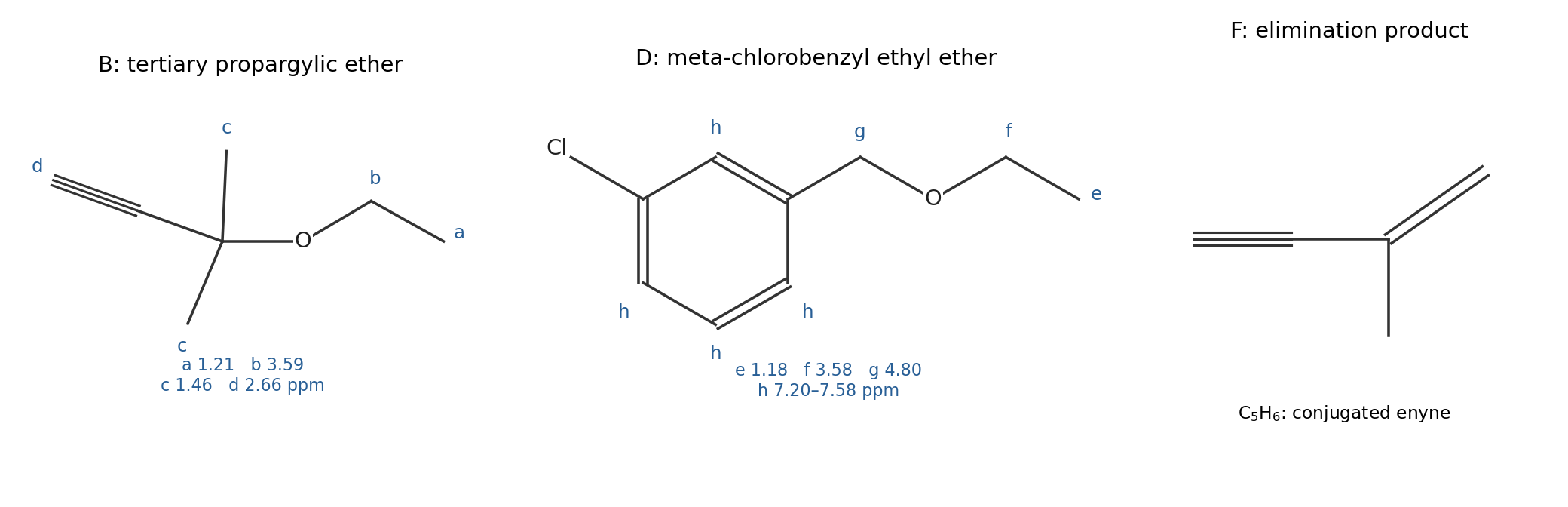
Elimination from A givesRemoving a beta hydrogen from either equivalent methyl group while losing chloride creates the same conjugated enyne. The strongly basic ethoxide, , promotes this E2 elimination from the tertiary substrate more strongly than neutral ethanol does. Ethanol instead favors the intended solvolytic capture, although some elimination can still compete.
The formula drawn and used in the rate table is ethoxide. The name “ethanoate” would mean acetate, , a different and resonance-stabilized anion; it should not be silently treated as the same base.
In Reaction 2 the primary benzylic carbon favors rapid substitution. The adjacent aromatic ipso carbon has no beta hydrogen for ordinary side-chain E2 elimination, so the analogous alkene-forming path is unavailable. This does not assert that all benzyl compounds are immune to every side reaction.
The drawn aryl dichloride is expected to undergo no analogous substitution under ordinary ethoxide conditions. Its chlorines are attached directly to sp2 aromatic carbons, rather than to the benzylic sp3 carbon of the previous substrate.
A normal SN2 reaction cannot follow the accessible backside geometry available at a primary benzylic carbon. A simple SN1 reaction would require a highly unfavorable aryl cation. Addition–elimination aromatic substitution would need suitable ring activation, such as a strong electron-withdrawing group in an appropriate position, which the drawing lacks. Forcing aryne chemistry cannot be inferred from ethoxide alone.
For Reaction 1, doubling substrate concentration doubles the rate, while doubling ethanol concentration leaves it unchanged. ThusRate-limiting ionization of the tertiary propargylic chloride gives a carbocation stabilized by substitution and propargylic/allenylic resonance. The crowded reaction center disfavors backside attack, while neutral ethanol is a weaker nucleophile than ethoxide. Ethanol capture and deprotonation occur after the rate-determining step.
For Reaction 2, independently doubling either reactant doubles the rate, and doubling both gives a fourfold increase:The benzylic carbon is primary and accessible, and the strong nucleophile can displace chloride in a concerted step. The reacting bond is benzylic C–Cl, not the ring C–Cl bond. These kinetic orders support the proposed mechanisms in the stated model; the rate table alone would not identify every intermediate in a more complicated reaction network.
The products areB retains the terminal alkyne and replaces the tertiary propargylic chlorine with ethoxy. D replaces the benzylic chlorine while retaining the aromatic chlorine; its meta arrangement follows from the drawn starting material, rather than from four aromatic protons alone.
| Product | Proton shift / ppm | Assignment |
|---|---|---|
| B | 1.21, 3H triplet | Ethoxy terminal methyl, coupled to the adjacent two protons. |
| B | 1.46, 6H singlet | Two equivalent methyl groups on the substituted carbon, with no neighboring proton to split them. |
| B | 2.66, 1H singlet | Terminal alkyne proton. |
| B | 3.59, 2H quartet | Ethoxy methylene next to oxygen, coupled to its methyl group. |
| D | 1.18, 3H triplet; 3.58, 2H quartet | The ethoxy group, with a common approximately 7 Hz coupling. |
| D | 4.80, 2H singlet | Benzylic methylene attached to oxygen, with no vicinal aliphatic proton. |
| D | Two aromatic multiplet regions, 4H total | The four remaining ring protons of the disubstituted aromatic ring. |
For B, the strong band is the terminal sp C–H stretch, the band is aliphatic C–H stretching, and the weak band is the alkyne stretch. The terminal proton and alkyne band together distinguish this from an alcohol interpretation of the high-frequency absorption.

Centrifuge the dispersion, separate the particle-rich sediment from the supernatant, wash the particles with a compatible solvent and repeat separation as necessary to remove soluble reagents and byproducts. Use conditions appropriate to the actual particle size and colloidal stability; the aim is particle separation rather than chemical decomposition.
A suitable membrane filtration process is another possibility if its pore size retains the particles. Simple solvent evaporation alone would leave soluble impurities together with the product, so it is not a selective isolation method.
The surface carboxylic acid is less reactive toward direct nucleophilic acyl substitution: hydroxide is a poor leaving group, and an amine initially tends to form an ammonium carboxylate salt. An alcohol also does not normally give rapid, quantitative ester formation merely by mixing with the acid.
Conversion to an acyl chloride activates the carbonyl and provides chloride as a substantially better leaving group. Amine or alcohol attack can then form a tetrahedral intermediate followed by elimination and proton transfer, giving the grafted amide or ester. Other coupling or esterification methods are possible; acid-chloride activation supplies the efficient route used in this scheme. Surface functionalization with the corresponding alkylamine and diol was demonstrated in the underlying carbon-material study.[ref]
Controlled dispersion of carbon nanospheres through surface functionalization by Margaret J. Sobkowicz and others. Carbon 47 (2009), pp. 622–628; covalent alkylamine and diol surface grafting
The expected order from most to least acidic isHI is stronger than HCl because the H–I bond is weaker and the larger iodide ion accommodates negative charge well. In water both strong acids are substantially leveled to hydronium; their intrinsic ordering should not be mistaken for a large difference in the acidity of equal-concentration fully dissociated aqueous solutions.
Removing the marked proton alpha to the nitro group in (3) gives a resonance-stabilized nitronate, with charge distributed onto oxygen. It is far more favorable than forming the unactivated carbon anions in (1) or (2).
The marked aromatic C–H in (1) is more acidic than the alkane C–H in (2). The resulting aryl carbon lone pair has greater s character than an alkyl carbanion's, and chlorine also exerts an inductive effect. The aryl anion's lone pair is not simply delocalized through the aromatic pi system in the same way as a phenoxide ion. The specified proton positions are essential: this is not an ordering of arbitrary hydrogens on the molecules.
The stabilizing outer groups should be compatible with the solvent, while the thiol-derived sulfur anchors the ligand shell to the gold nanoparticle.
| Solvent | Thiol number | Reason |
|---|---|---|
| Acidic water | 1 | The terminal amine is protonated, favoring hydration and electrostatic repulsion between similarly charged particles. |
| Basic water | 2 | The carboxylic acid becomes carboxylate, giving a hydrated negatively charged outer group. |
| Hexane | 4 | The long hydrocarbon tail is well solvated by a hydrocarbon solvent and can provide steric protection. |
| Perfluorohexane | 5 | The fluorinated tail is compatible with the fluorous solvent, unlike a conventional hydrocarbon shell. |
| Toluene | 3 | The aromatic-containing ligand is compatible with the aromatic organic solvent. |
These choices concern colloidal stability, not merely whether a free ligand dissolves. Coverage, chain packing and particle separation also matter. In the aqueous cases, high electrolyte concentrations can screen electrostatic repulsion, so ionization alone does not guarantee stability at every acid or base concentration.
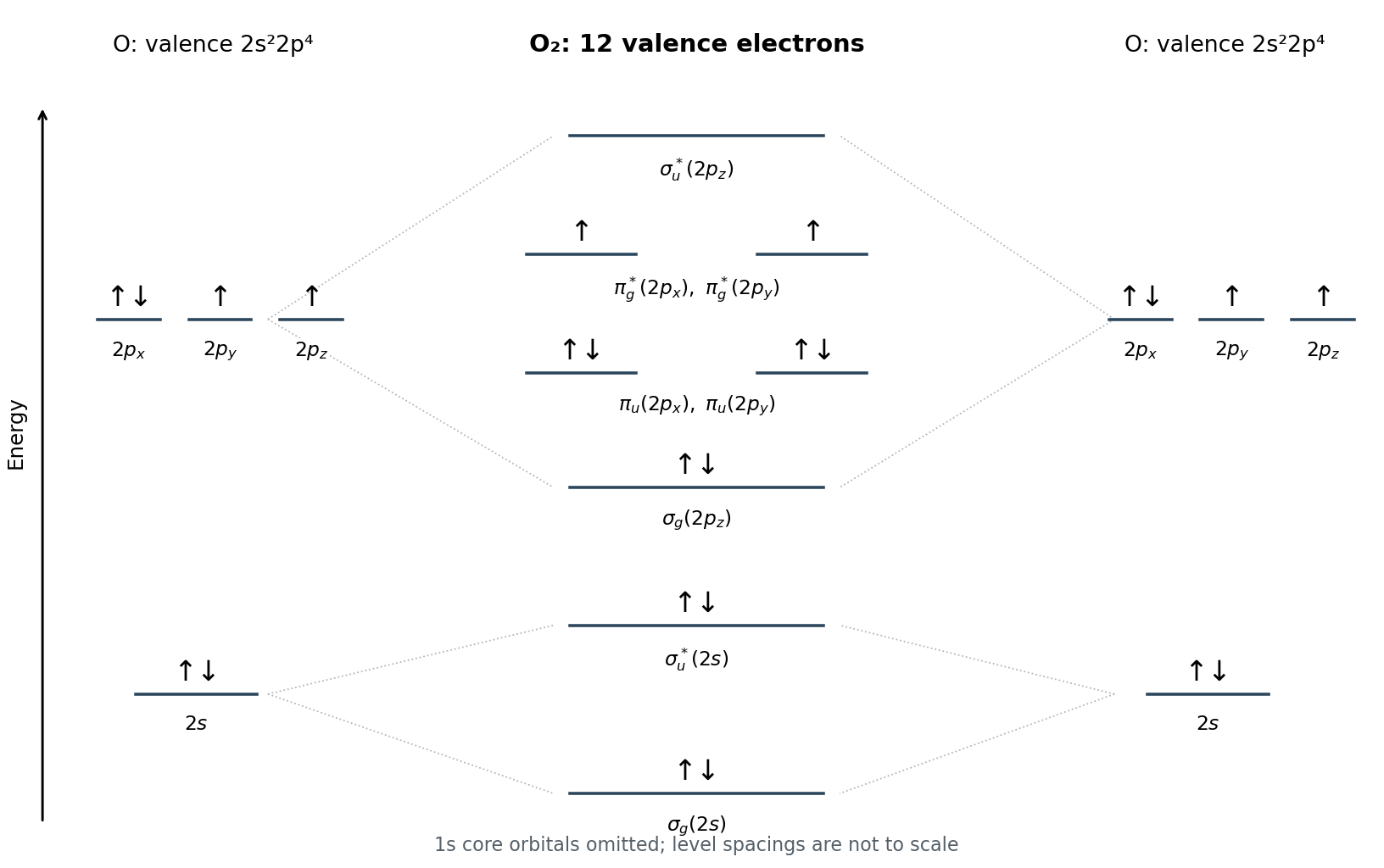
For oxygen, eight valence electrons occupy bonding orbitals and four occupy antibonding orbitals. Its bond order isThe additional electron in superoxide enters a antibonding orbital, givingReduced bond order weakens and lengthens the bond, consistent with the longer bond in superoxide. The diagram explains the direction of the change; it does not predict the two numerical bond lengths without a quantitative electronic-structure calculation.
The oxygen atom has . Each oxygen contributes six valence electrons, so the molecular diagram contains twelve. Taking the internuclear direction as , the relevant ordering for oxygen isThe valence occupation isThe final two electrons occupy the degenerate antibonding orbitals singly with parallel spin, following Hund's rules. Thus oxygen has two unpaired electrons and is paramagnetic. The core orbitals are deliberately omitted from the valence-only molecular orbital diagram.

Lateral oscillation or dithering is added to the vertical oscillation. It provides a tip-sidewall interaction signal that can drive lateral feedback while the vertical channel maintains height control. This is how a suitable flared tip can track steep or reentrant walls. Treating the additional signal as merely a larger vertical tapping amplitude would not supply the required sidewall sensing.[ref]
Effects of Lateral Tip Control in CD-AFM Width Metrology by Ronald G. Dixson and others. Lateral-dither contribution to the effective tip envelope
A conventional tapping tip tapers toward its apex, so its shank contacts an overhanging feature before its apex can probe underneath it. Critical-dimension atomic force microscopy instead uses a calibrated flared or laterally extended tip, with a relatively narrow neck and side-sensitive control. The lateral extension can contact a reentrant sidewall while the neck clears the upper edge. The measured profile still includes the tip's finite shape and must be interpreted with a tip calibration; changing the tip does not automatically eliminate all convolution errors.[ref]
Effects of Lateral Tip Control in CD-AFM Width Metrology by Ronald G. Dixson and others. Flared tips and bidirectional sidewall sensing
In tapping-mode atomic force microscopy, the cantilever is driven near a resonance and its oscillation amplitude is monitored. Tip-surface interaction changes that amplitude. A controller compares it with a chosen setpoint and moves the vertical piezoelectric actuator to reduce the error. The recorded actuator displacement supplies the topography channel. A smaller amplitude during approach commonly triggers withdrawal and an increased amplitude during separation triggers approach, with the actual feedback sign set by the instrument's operating convention. Correct tracking requires enough response bandwidth without destabilizing the loop.
Excessive feedback gain can make the closed loop underdamped or unstable. Edge transitions then produce overshoot, ringing or oscillatory streaks in the recorded height. The apparent structure is a controller response rather than a real series of surface ridges. The exact amplitude and frequency depend on the actuator, cantilever, loop delay and controller settings; without those data one can sketch the qualitative ringing but cannot predict a unique quantitative trace.
With gains too low for the scan speed, the vertical response lags the surface. On entering the depression during the left-to-right trace, the tip descends too slowly and the recorded edge rounds or extends into the trench. On climbing out, the tip can approach or contact the rising feature before the controller lifts it sufficiently, again distorting the edge. Thus the error depends on scan direction and can differ between trace and retrace. Slower scanning can reduce this bandwidth limitation, but it does not correct the geometrical inability to probe an overhang.
With suitable atomic force microscopy feedback gains, the trace follows the accessible surface while maintaining the chosen oscillation-amplitude setpoint. The measured trench is narrower than the accessible opening because the finite tip encounters an edge before its apex reaches that edge's true lateral position. For an ideal tip flank angle relative to the tip axis and height change , the geometrical setback is per side.
The conventional tapered tip cannot recover the underside of the overhang, even when feedback is perfect: the first contact with the upper edge or shank limits access. This geometrical envelope must be distinguished from errors caused by feedback dynamics. The stated tip height is sufficient for the vertical range; it does not remove the lateral-access problem.
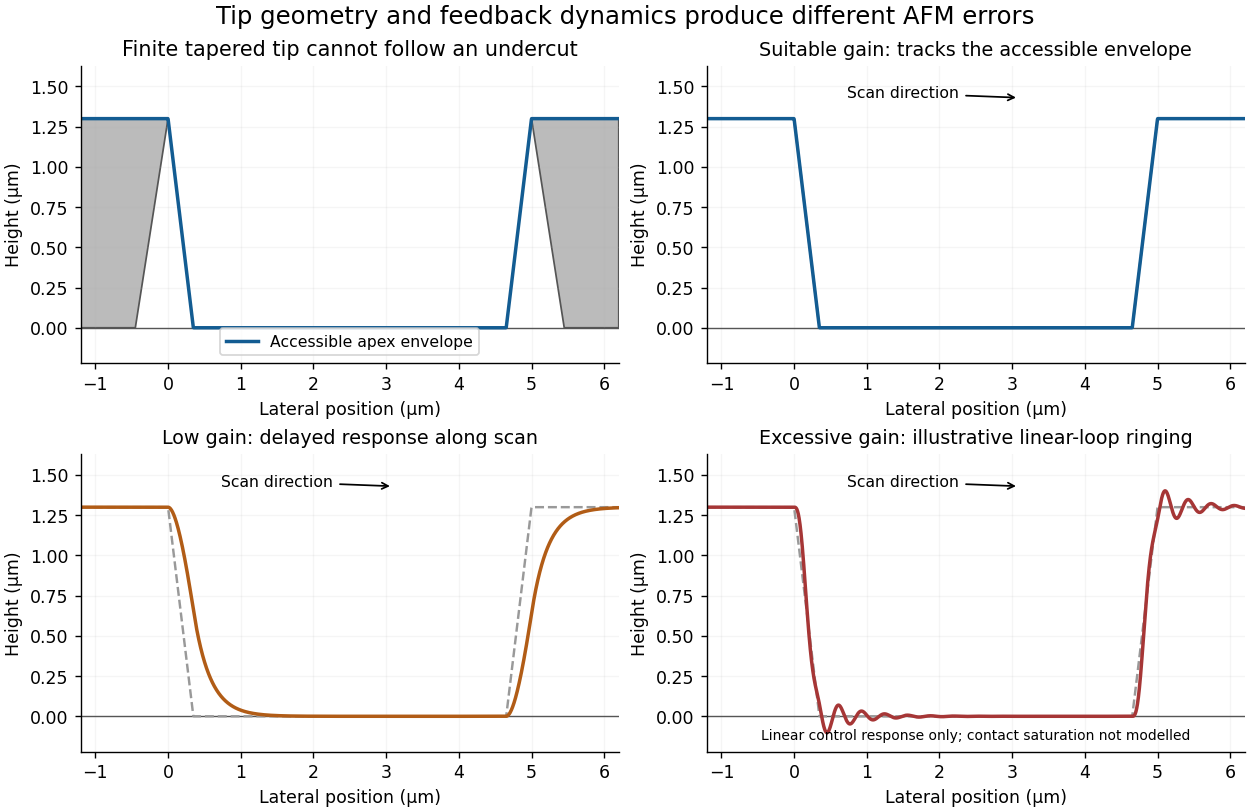
Illustrative AFM trace geometry and the effects of insufficient or excessive feedback gain
. Details. 
There are unlisted articles, also show them or only show them.