
Past exam of the quantum condensed matter course of the University of Cambridge 2021 Section A 2 Solution Created 2026-10-18 Updated 2026-10-20
In a simple metal, conduction electrons can move collectively in response to an incident electromagnetic wave. The Drude model gives, with time dependence ,In the low-loss range , the relative permittivity is approximately . The wavevector inside is predominantly imaginary, so the field is evanescent and penetrates only a short distance. Surface currents reradiate the field; little energy enters a good conductor. The normal-incidence Fresnel equations giveMany ordinary metals have their plasma frequency in the ultraviolet, placing visible light below this reflection edge. For the free-carrier contribution permits propagation; at , and . The electrons' inertial response becomes too small to screen the rapidly oscillating field.
Ultraviolet transparency is a simple-metal model prediction, not a universal property of real metals. Electronic transitions between bands and bound-electron absorption can remain strong, shift the plasma edge and prevent transparency; transmission also depends on thickness and attenuation. The robust explanation is the change from a reflective negative-permittivity range to a possible propagating range above the plasma edge.
Past exam of the quantum condensed matter course of the University of Cambridge 2021 Section A 1 Solution Created 2026-10-18 Updated 2026-10-20
For state counting in a Bloch band, take a primitive cubic lattice of spacing and impose periodic boundary conditions on lengths . The allowed wavevectors are . The first Brillouin zone has side , so it contains distinct values in each direction and hence wavevectors. Each orbital-derived energy band has one state per wavevector per spin orientation. ThereforeThe phrase “per atom” attached to in the PDF is a counting error: is the total, not the per-atom count.
By the Pauli exclusion principle, a monovalent crystal supplies valence electrons and half-fills a spin-degenerate band; its Fermi level lies within allowed states, giving a metal in the independent-electron picture. Two electrons per atom can fill one band. If a band gap separates it from all empty bands, the crystal is a band insulator. An even valence count only permits insulation: overlapping bands can still produce a metal. Conversely, electron interactions can produce a Mott insulator, and symmetry breaking can permit insulation outside this simple spin-degenerate electronic band structure criterion. The relevant count in a crystal with a basis is per primitive unit cell.
The Moiré pattern sets a superlattice periodFor the stipulated scalar one-dimensional model, right- and left-moving states have . The th Bragg crossing satisfies and hence . The Bragg gap ladder for a linear dispersion therefore has centresThis is the spacing of successive possible Bragg gaps. The corresponding atomic-lattice scale is , fifty times larger.
Shifting a linear branch by one full reciprocal period instead gives , twice the consecutive Bragg-threshold spacing; the first zone boundary is at . These scales should not be confused with the gap width, which depends on the weak potential's Fourier coefficients. The geometry alone does not guarantee equally wide or even observable gaps at every threshold, nor an exactly periodic full spectrum. The estimate neglects graphene's additional pseudospin selection rules and interlayer correlations, as required by the scalar-chain approximation.
Past exam of the quantum condensed matter course of the University of Cambridge 2019 Section A 2 Solution Created 2026-10-18 Updated 2026-10-20
Use Thomas-Fermi screening, treating a homogeneous three-dimensional conductor in static linear response. For a positive test charge the screened electric potential and bare Coulomb potential areHere is the background permittivity before the mobile carriers screen; it is in the simplest free-electron model. Both curves have the same leading divergence near the origin, while the screened curve lies below the bare one and decays much faster.
A positive potential attracts electrons. If is their total spin-summed density of states per volume and energy, and . Inserting this charge into Poisson equation gives the Thomas-Fermi screening lengthA larger density of states lets the conductor rearrange more charge for the same potential change and shortens the screening length. For a parabolic free electron model, , hence .
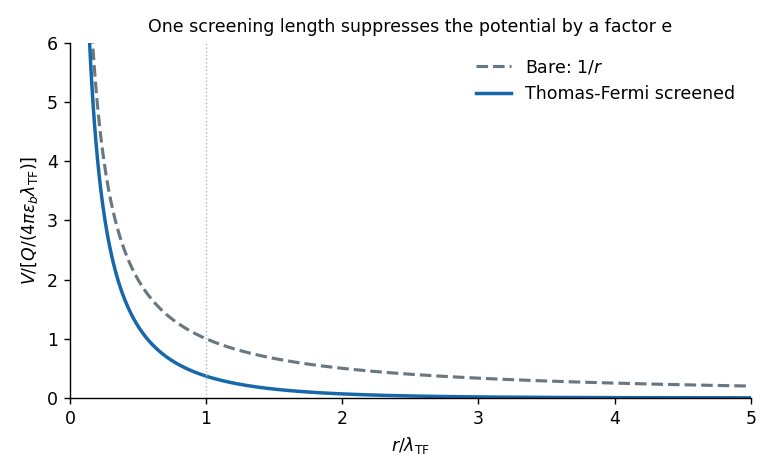

The exponential form is the intended local screening model. A microscopic zero-temperature metal also has Friedel oscillations, so the exponential alone is not an exact description at every length scale.
For a lattice-periodic one-electron Hamiltonian, Bloch's theorem givesHere is any lattice translation and labels an energy band. Under that translation the wavefunction gains phase . The crystal momentum labels this translation eigenvalue and is defined modulo for a reciprocal lattice vector .
The mechanical momentum is different. In zero magnetic field its operator is , which acts asA general Bloch state is therefore not a mechanical-momentum eigenstate. Expanding its periodic factor gives plane-wave components with momenta , with probabilities determined by their Fourier coefficients. For a local Hamiltonian , its mean momentum satisfiesnot generally . The lattice exchanges actual momentum with the electron; crystal-momentum conservation in scattering is instead modulo reciprocal-lattice vectors, as in Umklapp scattering.
There are unlisted articles, also show them or only show them.