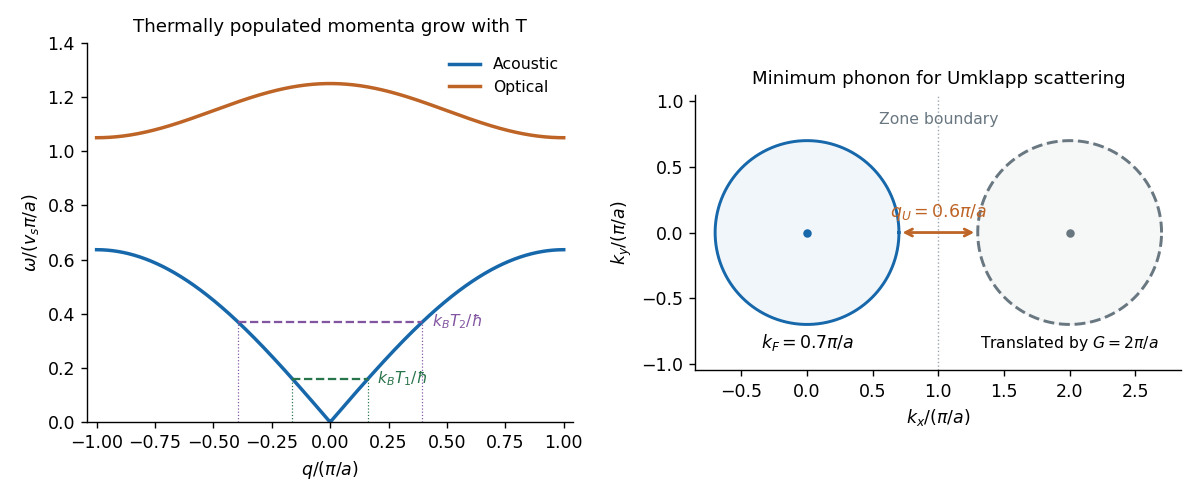
An acoustic phonon branch approaches zero frequency linearly, , because a long-wavelength translation has no restoring force. An optical phonon branch has nonzero frequency at and represents relative motion of atoms within a primitive unit cell. Such an optical branch requires more than one independent atom per primitive cell; a truly monatomic simple-cubic model has only the acoustic branches.
The Bose occupation is . At low temperature, appreciably populated acoustic modes haveAs temperature falls, the available phonon wavevectors concentrate near the zone centre and optical modes freeze out when . These are thermal-occupation restrictions, not a change in the allowed geometric Brillouin zone.

Articles by others on the same topic
There are currently no matching articles.