
Past exam of the mathematics course of the year 1 of the natural sciences course of the University of Cambridge 2003 Paper 2 2 Solution Created 2026-10-18 Updated 2026-10-20
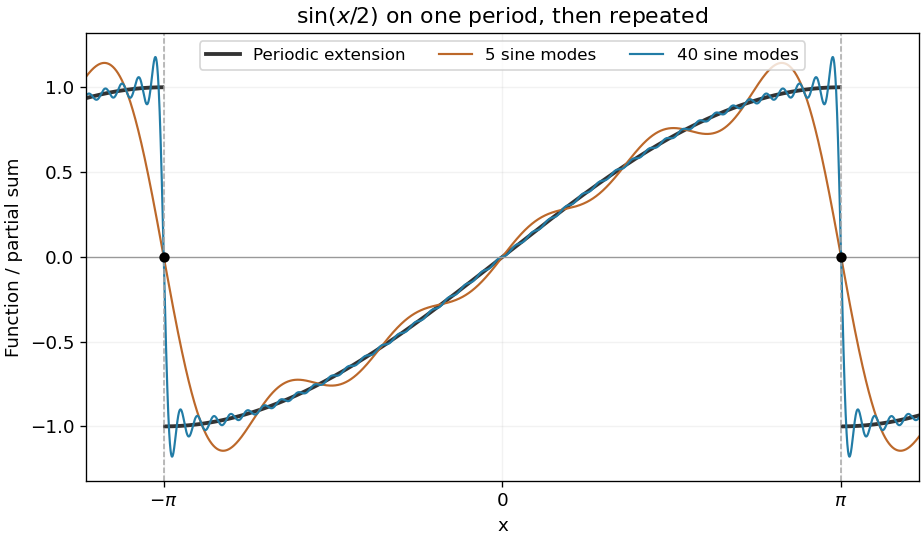
For an odd integrable function, both and are odd. Their integrals over therefore vanish, so the constant and cosine Fourier coefficients are zero. For , the remaining Fourier sine coefficients areThe product-to-sum identity in the first step reduces the integral to two cosines. Here is real and noninteger, so no denominator vanishes. Consequently the Fourier series of a noninteger-frequency sine isAt every term is zero. The Fourier series converges there to the average of the two limits of the periodic extension, namely zero, rather than to the nonzero endpoint values .

Past exam of the mathematics course of the year 1 of the natural sciences course of the University of Cambridge 2003 Paper 2 11 Solution Created 2026-10-18 Updated 2026-10-20
Use the method of undetermined coefficients. Substitution of givesEquating the coefficients of , , , and to the forcing gives , , , . ThusThe characteristic equation of the homogeneous equation is , with a repeated root. Its complementary function is . Since and , the initial conditions give and . ThereforeDirect differentiation verifies both zero initial data and the original forcing.
Past exam of the mathematics course of the year 1 of the natural sciences course of the University of Cambridge 2003 Paper 1 4 i Created 2026-10-18 Updated 2026-10-20
There are unlisted articles, also show them or only show them.