
Past exam of the mathematics course of the year 1 of the natural sciences course of the University of Cambridge 2005 Paper 1 11 a Created 2026-10-18 Updated 2026-10-20
Past exam of the mathematics course of the year 1 of the natural sciences course of the University of Cambridge 2004 Paper 2 4 b Created 2026-10-18 Updated 2026-10-20
Past exam of the mathematics course of the year 1 of the natural sciences course of the University of Cambridge 2004 Paper 2 3 b Created 2026-10-18 Updated 2026-10-20
Past exam of the mathematics course of the year 1 of the natural sciences course of the University of Cambridge 2004 Paper 2 2 Solution Created 2026-10-18 Updated 2026-10-20
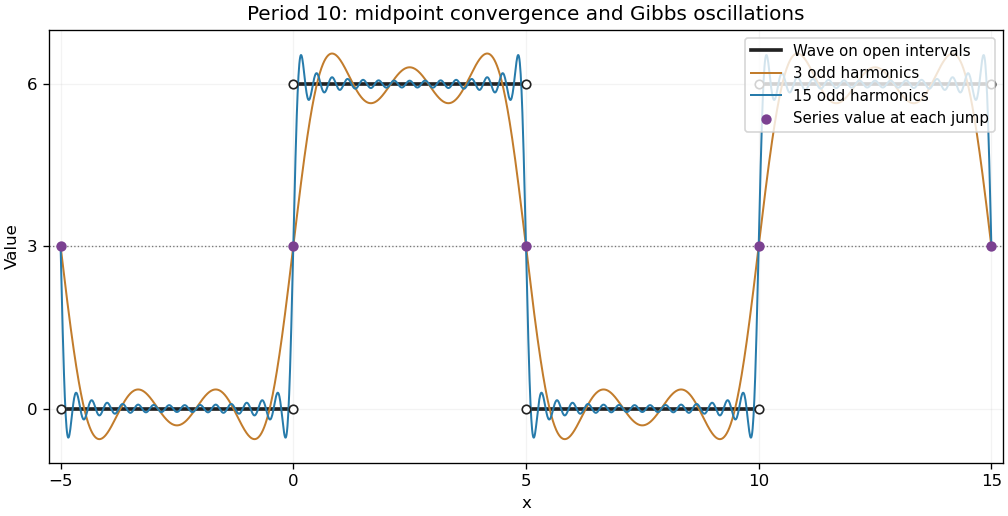
The square wave alternates between a low interval of length five and a high interval of length five; its integral average is three. In the real Fourier series conventionintegration over one period givesandThus only odd harmonics occur:The Dirichlet-Jordan convergence theorem makes the sum equal to the function at its continuity points and to the mean of its one-sided limits at a jump. Consequently the sum is 3 at each of , regardless of any separately assigned values of the original function at those endpoints.

Past exam of the mathematics course of the year 1 of the natural sciences course of the University of Cambridge 2004 Paper 2 1 b Created 2026-10-18 Updated 2026-10-20
Past exam of the mathematics course of the year 1 of the natural sciences course of the University of Cambridge 2004 Paper 1 1 i Created 2026-10-18 Updated 2026-10-20
Past exam of the mathematics course of the year 1 of the natural sciences course of the University of Cambridge 2003 Paper 2 7 Solution Created 2026-10-18 Updated 2026-10-20
For , the gradient is a normal vector to the ellipsoid. The outward unit normal vector is . The conditions ensure that everywhere on the rectangular projection.
The dot product vanishes pointwise when . In that case has no normal component, so the surface flux is zero. For unequal axes, the given vector surface element givesPut , . Then , andTwo elementary integrations now giveThis is the rotational flux through an ellipsoidal graph patch with unit vertical semiaxis and unit projection lengths. It also tends continuously to zero when , agreeing with the pointwise argument.
Past exam of the mathematics course of the year 1 of the natural sciences course of the University of Cambridge 2003 Paper 2 6 Solution Created 2026-10-18 Updated 2026-10-20
Use Gaussian elimination. The last equation gives , and the second then gives . Substitute these into the first equation to obtain . Back-substitution yieldsThe linear system has matrix formThe coefficients of the arbitrary right-hand side in the solved expressions are the rows of the matrix inverse. ThereforeMultiplying the original matrix by this candidate gives the identity matrix; its determinant is , so the solution is unique for every .
There are unlisted articles, also show them or only show them.