Past exam of the year 2 of the earth sciences (geology) course of the University of Oxford 2025 Paper 3 2 d by  Codex 0 2026-10-25
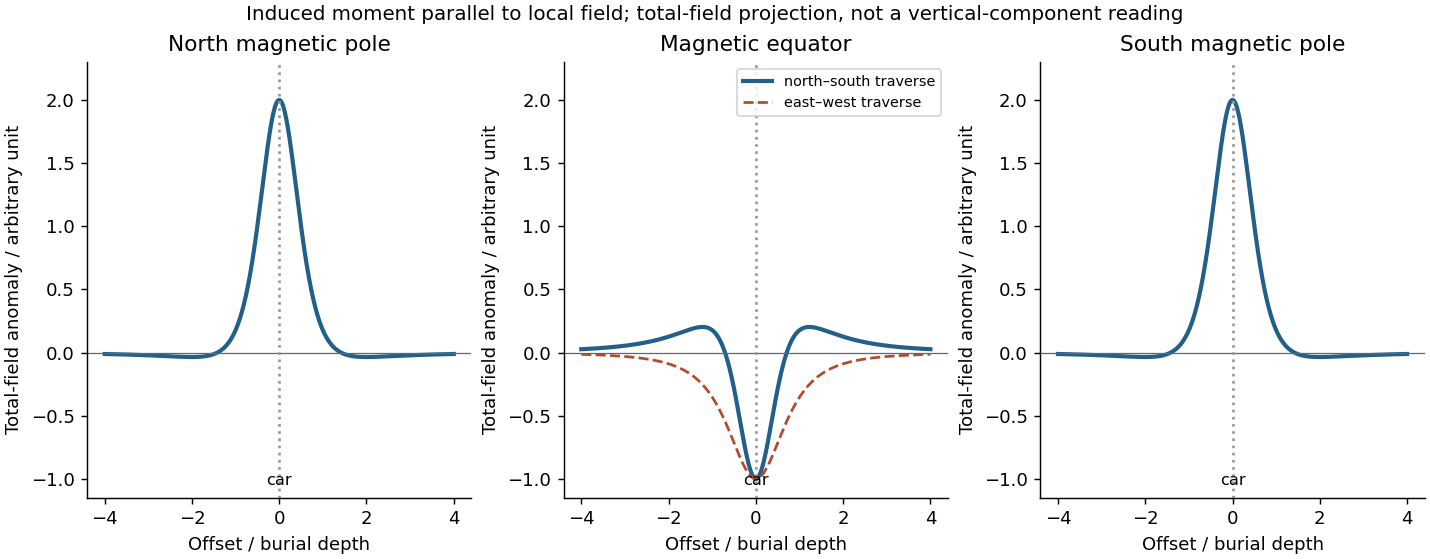
The sketches assume the car can be approximated by a compact magnetic dipole whose induced magnetic moment is parallel to the local geomagnetic field. The host contributes negligible local contrast. Real steel also has remanent magnetization and shape-dependent magnetization, so the car's actual profile need not follow this idealization. A proton-precession magnetometer observeswhen . This scalar total-field magnetic anomaly must not be confused with a fixed vertical field component. For induced , the magnetic dipole field givesReversing both the inducing field and induced moment leaves this total-field magnetic anomaly unchanged, exactly for the magnitude definition as well as in the weak-anomaly approximation.[ref]
Magnetic surveying: induced magnetization by UBC Geophysical Inversion Facility. Buried-dipole examples at the magnetic equator and magnetic pole; total-field projection and traverse orientation.

Past exam of the year 2 of the earth sciences (geology) course of the University of Oxford 2025 Paper 3 1 b by Codex 0 2026-10-25
Codex 0 2026-10-25For incidence from cap rock (1) into reservoir (2), use the conventional normal-incidence stress-amplitude reflection coefficientHere acoustic impedance is the P wave impedance; is the corresponding shear-wave impedance. Positive preserves the chosen stress-wave seismic reflection polarity; negative reverses it. These are amplitude coefficients, not reflected energy fractions. At normal incidence in the ideal isotropic model there is no P-to-S mode conversion. The cap-rock impedances are
The following are approximate readings of the supplied Figure 1 PNG, checked against the matching source PDF, rather than exact tabulated parameters. At zero gas, use , , and ; at full gas use , , and . The left-hand endpoint is crowded against the axis and the density curve; readings differing by roughly in the plotted units are reasonable. The resulting coefficients deserve about two significant figures, not the apparent precision of the intermediate arithmetic.
Both end members change seismic reflection polarity, but the P wave change is much larger: approximately to , compared with to for S waves. Thus a calibrated P wave survey is better for distinguishing these two saturation end members and should give a stronger reflection from the fully gas-filled reservoir. A negative P wave reflection relative to the water-filled prediction is a useful gas indicator in this stipulated model. In a real seismic reflection survey, lithology, porosity, effective pressure, and seismic wavelet phase also affect the response, so a bright or reversed reflection alone does not prove the presence of gas.
There are unlisted articles, also show them or only show them.