The sketches assume the car can be approximated by a compact magnetic dipole whose induced magnetic moment is parallel to the local geomagnetic field. The host contributes negligible local contrast. Real steel also has remanent magnetization and shape-dependent magnetization, so the car's actual profile need not follow this idealization. A proton-precession magnetometer observeswhen . This scalar total-field magnetic anomaly must not be confused with a fixed vertical field component. For induced , the magnetic dipole field givesReversing both the inducing field and induced moment leaves this total-field magnetic anomaly unchanged, exactly for the magnitude definition as well as in the weak-anomaly approximation.[ref]
Magnetic surveying: induced magnetization by UBC Geophysical Inversion Facility. Buried-dipole examples at the magnetic equator and magnetic pole; total-field projection and traverse orientation.
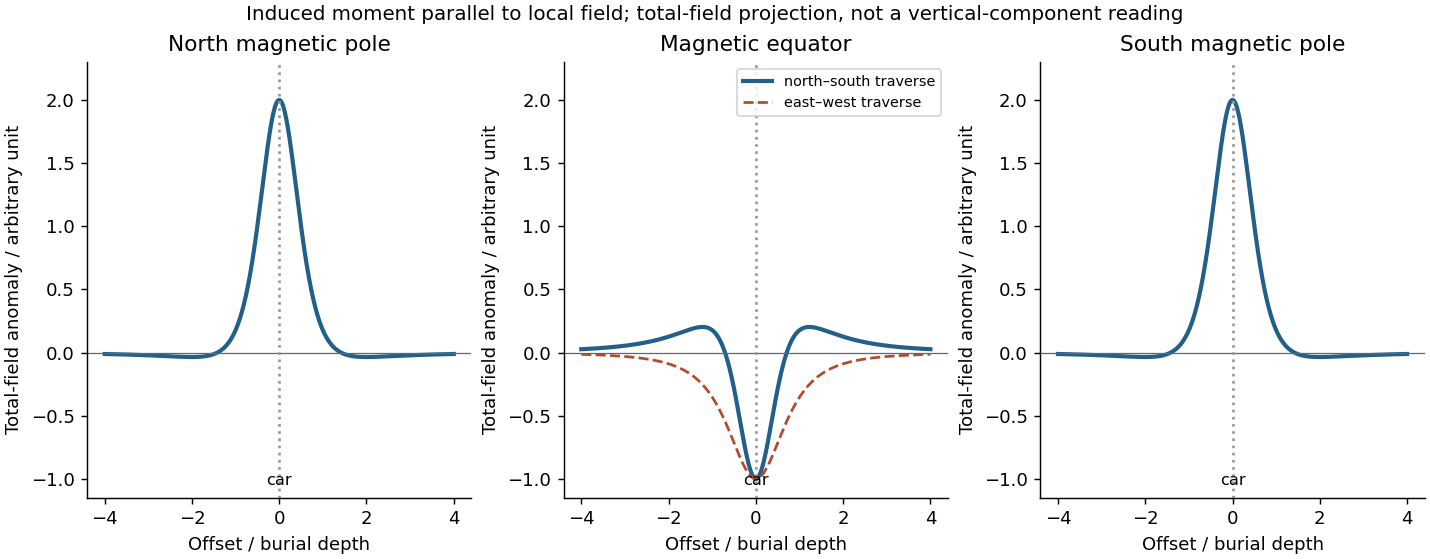

Near the north magnetic pole, take the inducing magnetic field and induced magnetic moment as vertically downward. Directly above the car, its anomalous field reinforces the main field: a positive central total-field magnetic anomaly results. Along a horizontal traverse, the vertical-dipole approximation gives a symmetric central high flanked by weaker negative side lobes:where is the depth from the sensor to the effective dipole centre. The anomaly width scales with ; no absolute amplitude can be calculated without the car's magnetic moment.
At the magnetic equator, the inducing magnetic field and induced magnetic moment are horizontal. Let point along this field, approximately magnetic north, and across it. Directly over the car, the dipole field opposes the main field, producing a negative central total-field magnetic anomaly. A north–south traverse through the car givesa symmetric central low with positive shoulders. An east–west traverse through the car instead has , a single negative trough. The equatorial anomaly therefore needs a stated traverse orientation; there is no universal single equatorial line profile.
Near the south magnetic pole, the inducing magnetic field and induced magnetic moment are vertically upward. Directly over the car its dipole field is also upward, again reinforcing the main field. The total-field magnetic anomaly is therefore the same positive central high and weak negative side lobes as at the north magnetic pole under the same induced-dipole assumptions. A fixed signed vertical field component would reverse, but the scalar field strength measured by the proton-precession magnetometer does not. If the car's remanent magnetization dominates, neither this symmetry nor these predicted signs is assured.
Articles by others on the same topic
There are currently no matching articles.