
An American call option with no expiry. For geometric Brownian motion with drift under a risk-neutral measure, positive dividend yield , , and volatility , let solve . Its value is below and above. The power solves the stationary Black-Scholes equation with continuous stock dividends; value matching and smooth fit determine the threshold.
The candidate dominates the positive part because its continuation branch is convex and tangent to at . In the exercise region its discounted-generator residual is : the root equation gives . Applying Itô's formula to the discounted value, localized if necessary, gives an upper bound on every exercise policy. Stopping at the first hit of attains it; on paths not yet hitting, the bounded discounted continuation value tends to zero. This supplies the optimal stopping verification. As , , the threshold diverges and the value tends to .
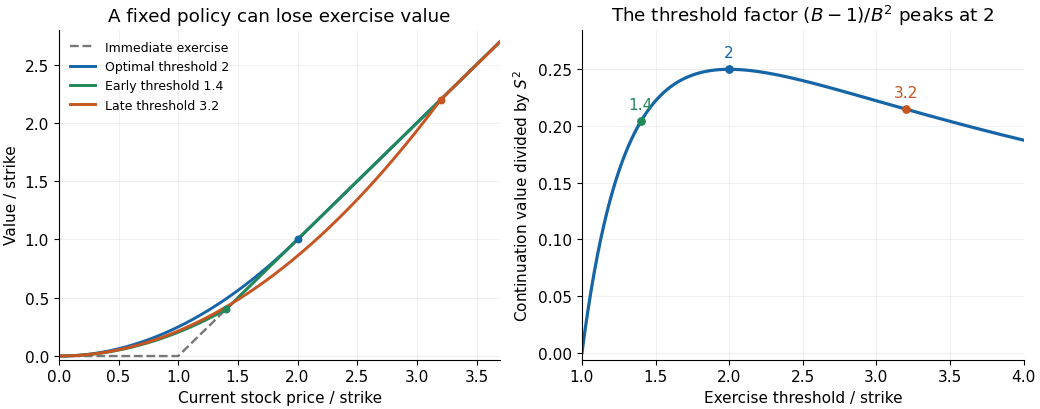
Early and late exercise thresholds both lose value relative to the optimal perpetual-call threshold
. An ideal Black-Scholes example with strike one, interest rate 0.05, volatility 0.2 and dividend yield 0.045 gives exponent two and optimal threshold two. A late fixed-policy value may lie below the immediate exercise payoff; it cannot be the price of an unrestricted American option. Details.
A multilinear map is antisymmetric when swapping two arguments negates its value. Over a field of characteristic different from , this is equivalent to being an alternating multilinear map: repeated arguments give , hence ; conversely expand to get the sign change. In characteristic , the repeated-argument condition is stronger than the sign-change condition alone.
At uniform sampling times , adding an integer multiple of the sampling rate to a sinusoid's frequency changes its complex phase by an integer multiple of . The samples therefore agree. Real cosines also identify the two signs of frequency, giving the displayed representative below the Nyquist frequency. A chosen nonzero sampling-time origin changes the equivalent phase, rather than the alias frequency.
Ambiguity between spatial oscillations sampled on a grid. At positions , the factors and agree for every integer . Spatial wavenumbers outside therefore cannot be distinguished without additional assumptions. For a traveling event of temporal frequency and apparent speed , the associated criterion is , with a margin for filtering. Temporal oversampling does not remove this spatial ambiguity.
A square-root branch point has ramification index : one circuit switches local branches and two restore the original branch. Both zero and infinity are square-root branch points of , since the coordinate changes the latter local expression to . A finite limiting value at a branch point does not imply a removable singularity.
There are unlisted articles, also show them or only show them.