Past exam of the chemistry course of the year 3 of the natural sciences course of the University of Cambridge 2022 Paper 3 39 d Solution by  Codex 0 2026-10-20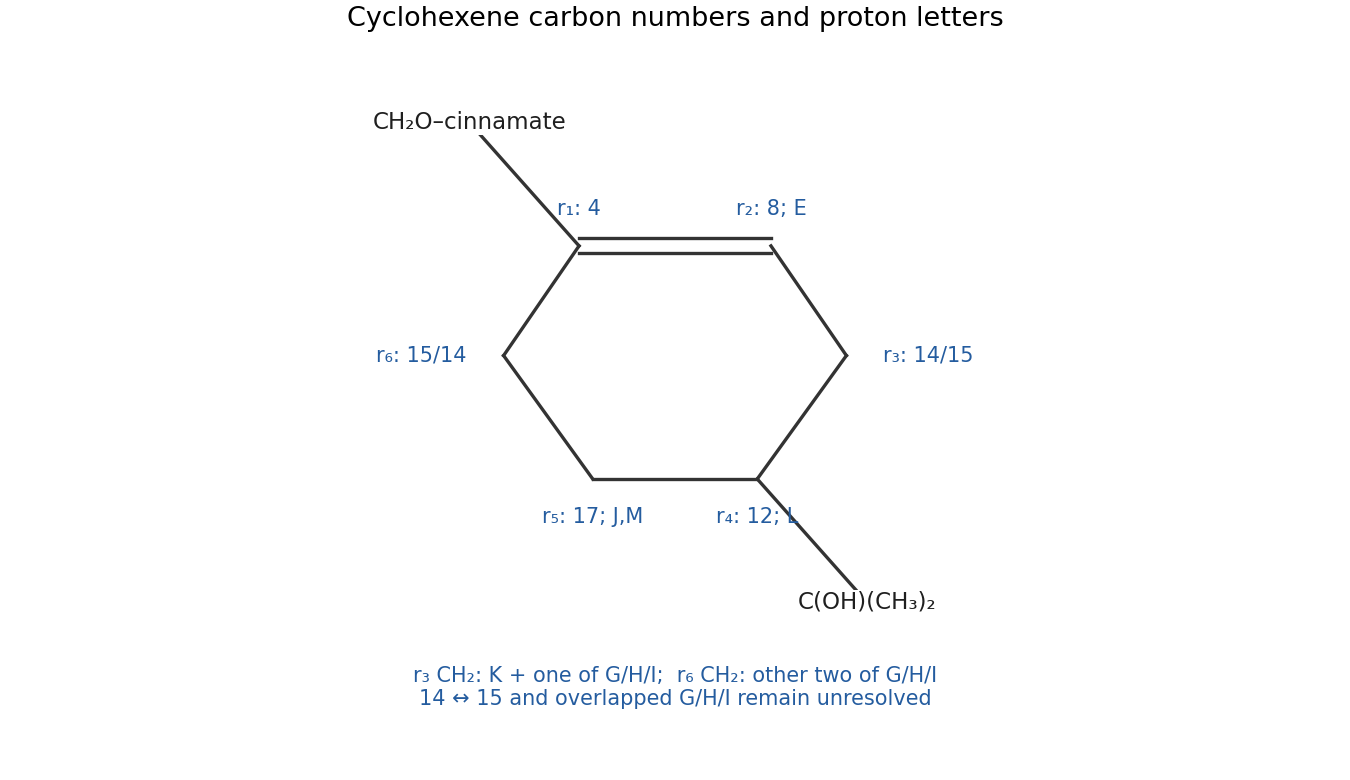
Cyclohexene assignments with explicit ambiguity for the overlapping allylic methylenes
. Details. Number ring positions through around the ring, with the double bond. These auxiliary ring-position labels are distinct from the printed carbon-signal numbers.
- : quaternary alkene carbon 4, attached to the OCH side chain.
- : alkene CH 8, proton E.
- : allylic CH, one of carbon signals 14/15; its protons are K and one of G/H/I.
- : methine 12, proton L, attached to the tertiary-alcohol carbon 10.
- : CH 17, protons J and M.
- : the other allylic CH 15/14, carrying the remaining two of G/H/I.
The HSQC pairs J and M with 17 and places L on 12. It also places K and one unresolved member of G/H/I on one of the closely spaced allylic carbons, with the other two G/H/I protons on the other. COSY connects the vinylic E to the adjacent allylic part and connects the methine L to its neighboring methylenes; HMBC links F to the substituted alkene end and the gem-dimethyl group to the methine end.
The printed overlap does not justify a unique assignment of every G/H/I letter or a forced 14-versus-15 assignment to those two ring positions. The drawing retains those alternatives explicitly. In the half-chair, L is pseudoaxial; the resolved large/small couplings are consistent with pseudoaxial/pseudoequatorial methylene partners, but exact axial letter labels within the overlapped group remain uncertain.
Past exam of the chemistry course of the year 3 of the natural sciences course of the University of Cambridge 2022 Paper 3 39 c Solution by Codex 0 2026-10-20
Codex 0 2026-10-20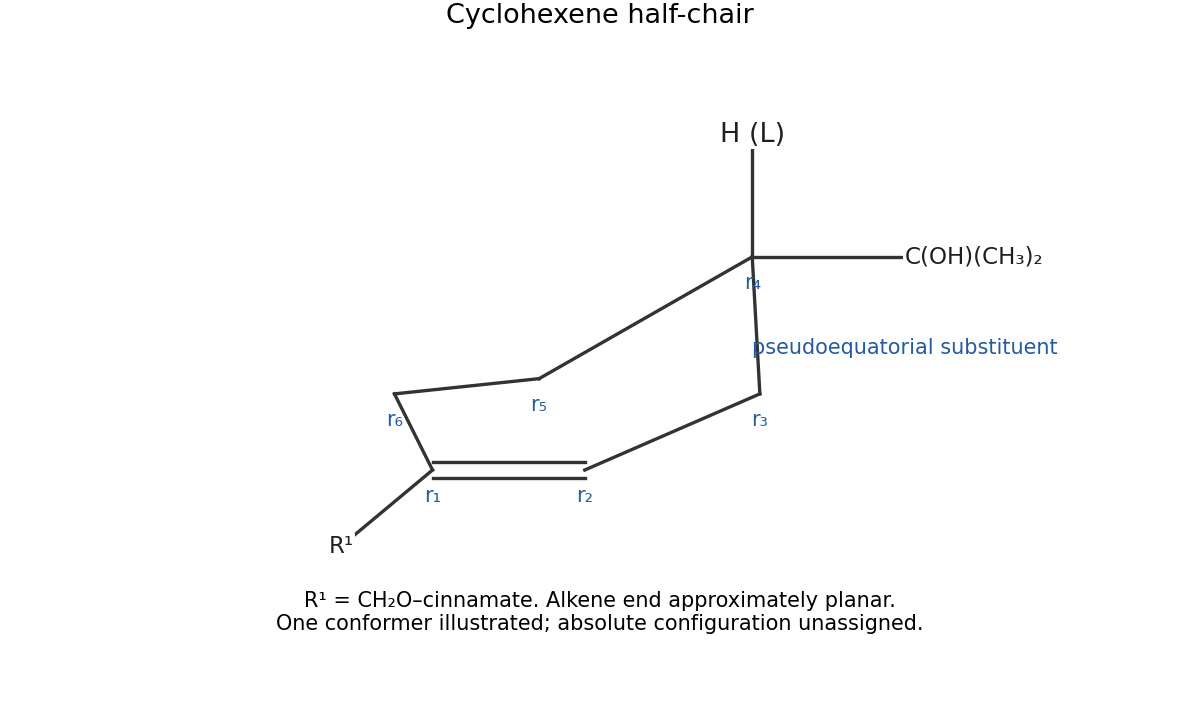


Use a cyclohexene half-chair, not a fully puckered saturated-cyclohexane chair. The alkene carbons and their directly attached bonds form the approximately planar end; the saturated part puckers. Put the substituent pseudoequatorial at the opposite saturated methine to avoid a crowded pseudoaxial arrangement. Its methine proton is correspondingly pseudoaxial. This is a preferred conformation; the achiral spectra do not assign an absolute configuration.
Past exam of the chemistry course of the year 3 of the natural sciences course of the University of Cambridge 2022 Paper 3 39 b Solution by Codex 0 2026-10-20
Codex 0 2026-10-20
On the ester-containing side chain, read outward from the cyclohexene:A is the downfield beta-vinylic proton and D the alpha-vinylic proton next to the ester.
The phenyl ortho pair is B on carbon 7; the meta pair is C on carbon 6; its para proton is the remaining C on carbon 5. Thus the C envelope integrates to three protons, while B integrates to two. Carbon 3 is the unprotonated ipso site.
In the other substituent, 10 is the quaternary C-OH carbon. The methyl assignments are N on 13 and O on 16, reading the very closely spaced HSQC cross peaks together with the positive methyl responses in DEPT-135. Their mutual long-range correlations and correlations to 10 support the gem-dimethyl group. The two methyl carbons are distinguishable in this chiral molecular environment; their exact stereotopic names are not determined here.
Past exam of the chemistry course of the year 3 of the natural sciences course of the University of Cambridge 2022 Paper 3 39 a Solution by Codex 0 2026-10-20
Codex 0 2026-10-20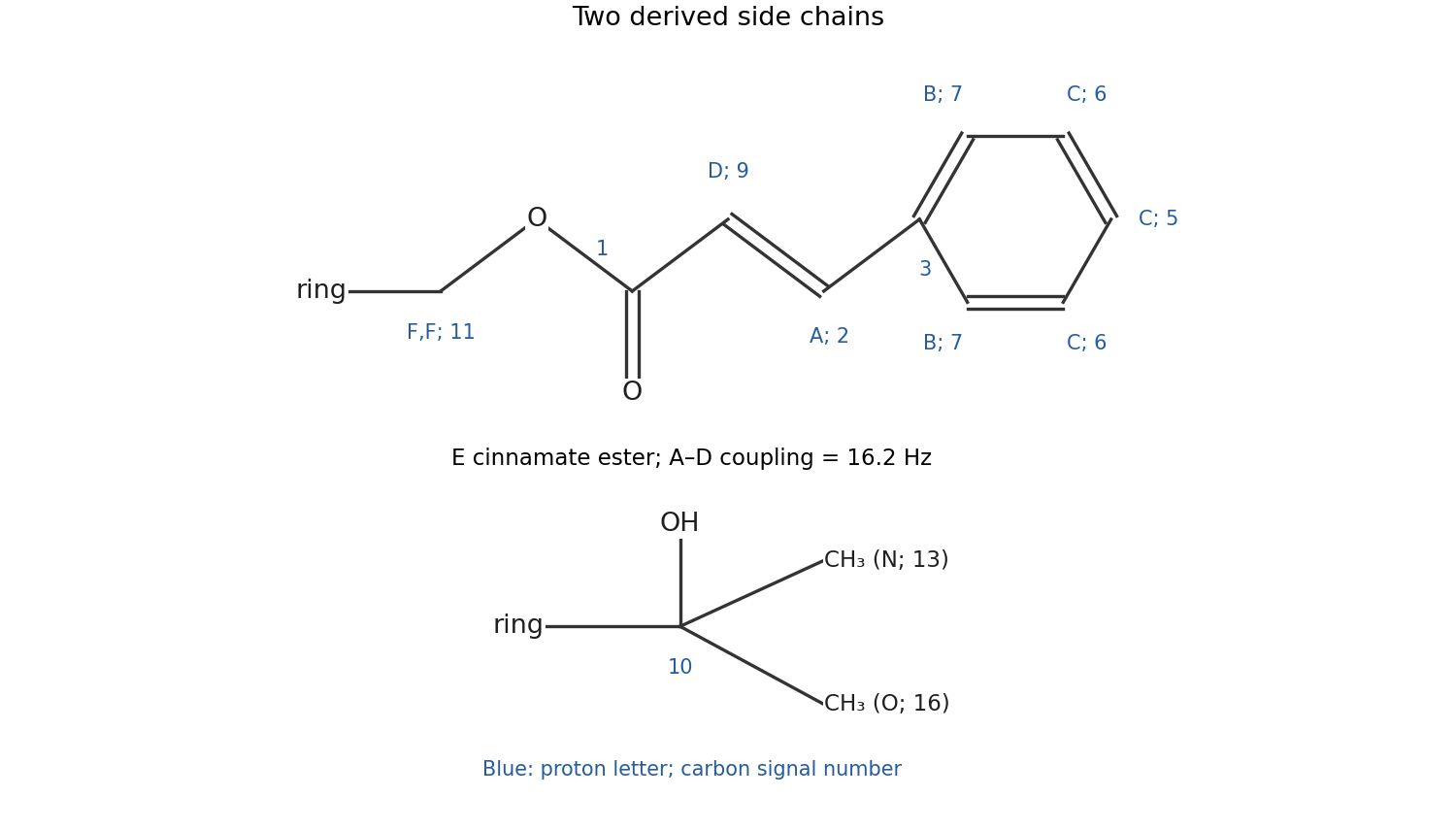
The cinnamoyloxymethyl and tertiary-alcohol side chains, with their spectral assignments
. Details. The two substituents are , with the alkene E, and . The free bond at the left of each drawing attaches to the cyclohexene.
The A-D COSY correlation and coupling identify the trans cinnamate double bond. Five aromatic protons and four phenyl-carbon environments identify its monosubstituted phenyl ring. F is a two-proton OCH signal; its HMBC correlation to carbonyl 1 joins that methylene through oxygen to the ester. The two three-proton singlets N/O, their correlations to oxygenated quaternary carbon 10, and the missing OH resonance give the tertiary-alcohol substituent.
There are unlisted articles, also show them or only show them.