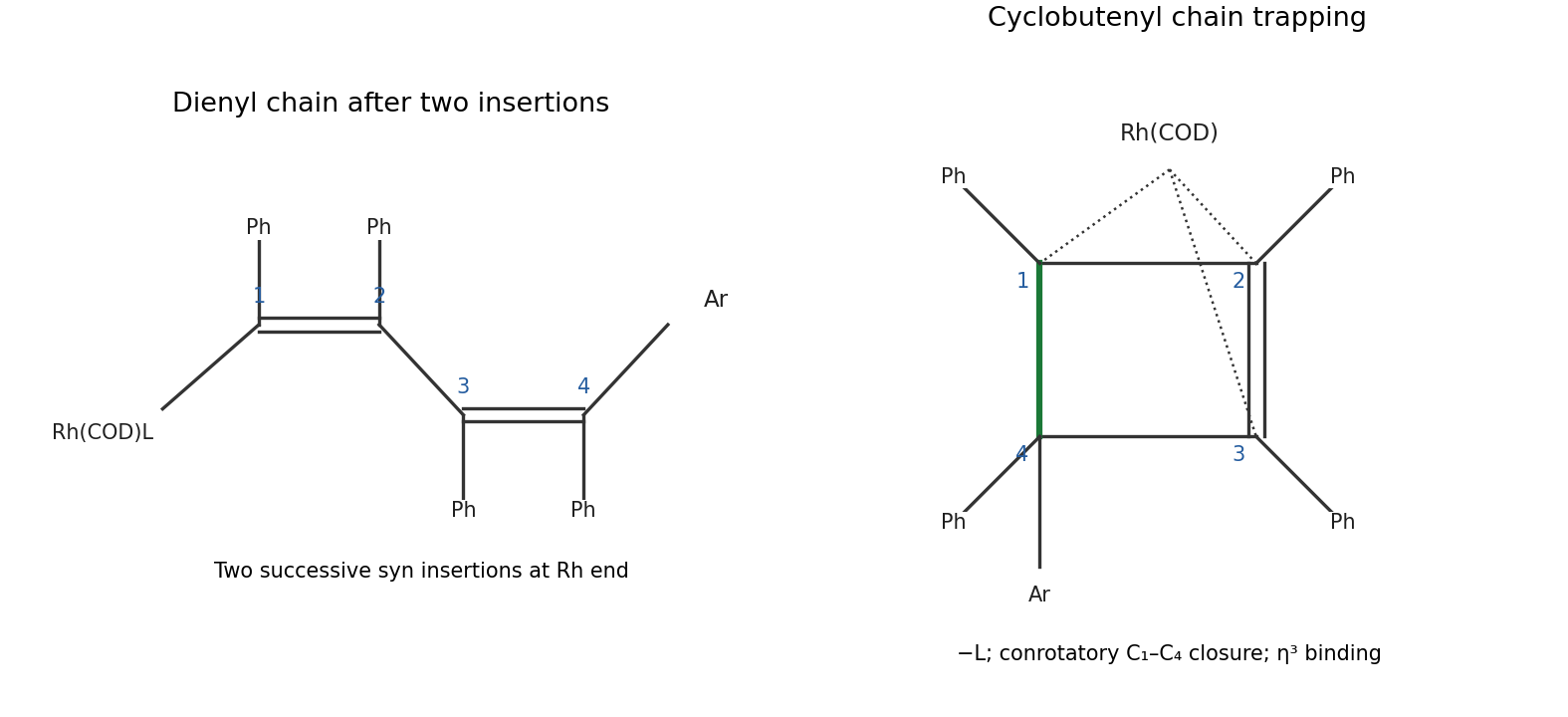
Coordinate one diphenylacetylene and insert it into Rh-Ar. Syn migration puts the new Rh-C and Ar-C bonds on the same face of the former alkyne. Repeat alkyne coordination/insertion into the resulting Rh-vinyl bond. The chain after two insertions isNumbering runs from the metal toward the initiating aryl group. Each insertion is syn: Rh and the continuing chain lie on the same side of the newly made double bond, giving the displayed cis relationship of the two Ph substituents at each inserted unit. The second alkyne inserts at the Rh end; it is not appended by coupling two free vinyl radicals.
To obtain F, promote PPh dissociation, allowing G's dienyl group to fold and form the new C-C bond. A four-pi-electron electrocyclic ring closure gives a cyclobutenyl ligand, stabilized by eta-three coordination of its allylic C-C-C fragment to Rh. The substituted C is the saturated ring carbon bearing Ar and Ph.
The thermal four-pi closure is conrotatory. Ring closure plus eta-three binding restores a 16-electron Rh(I) centre after phosphine loss; no net oxidation-state change is needed. F is an eta-three cyclobutenyl complex, not an eta-four cyclobutadiene with five substituents squeezed onto four unsaturated carbons.

Articles by others on the same topic
There are currently no matching articles.