Past exam of the chemistry course of the year 3 of the natural sciences course of the University of Cambridge 2022 Paper 3 43 c Solution by  Codex 0 2026-10-20
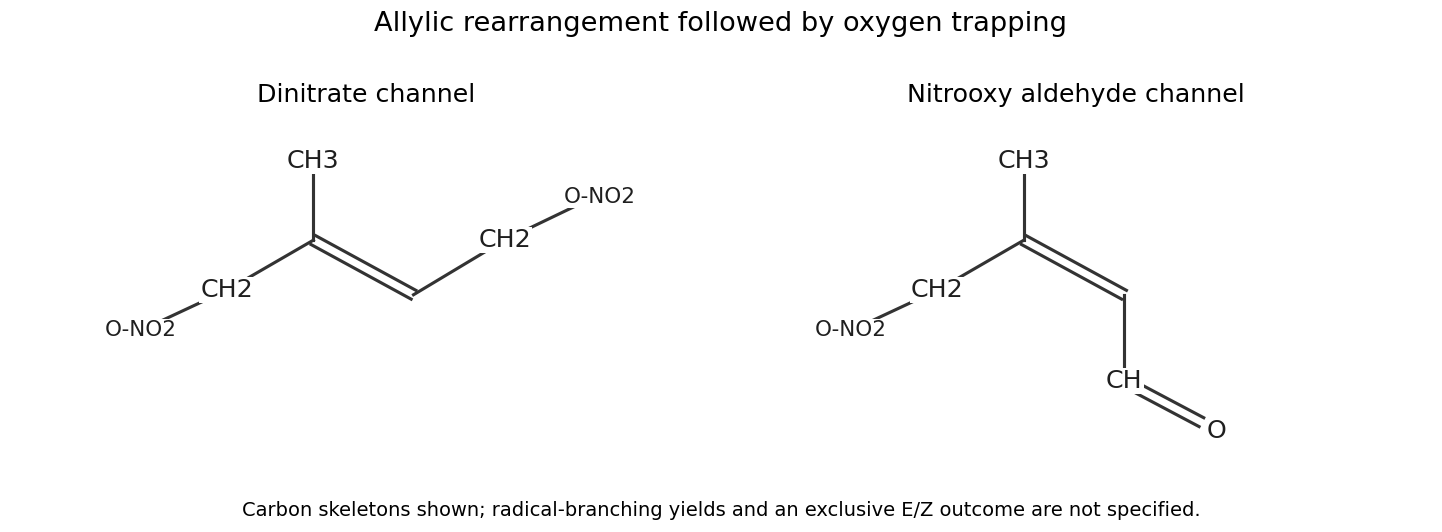
At night, nitrate radical addition and ozone attack are relevant oxidations of isoprene; direct daytime photochemistry is absent, though small OH sources can still exist. The nitrate-containing products identify the NO-addition route. Add NO to the terminal carbon next to the methyl-substituted alkene carbon, producing a nitrooxy substituent and an allylic radical. Resonance moves the radical to the far terminal carbon while shifting the double bond. Oxygen trapping gives a peroxy radical with the carbon skeletonA nitrate-forming termination branch, for example the organic-nitrate branch of reaction with NO, replaces the terminal peroxyl group by a nitrate ester, giving . An alternative branch forms an alkoxy radical, such as peroxy-radical reaction with NO producing RO, NO and O. Reaction of the terminal CHO group with O then gives an aldehyde plus HO, producing . These are covalent O–NO ester groups, not C–NO nitro groups. The delocalized radical can be trapped after conformational change, so this mechanism does not require one universal alkene geometry for both product channels. Product structures alone do not fix a unique branching ratio.

Past exam of the chemistry course of the year 3 of the natural sciences course of the University of Cambridge 2022 Paper 3 43 a Solution by Codex 0 2026-10-20
Codex 0 2026-10-20Peroxyacetyl nitrate forms reversibly from a peroxyacetyl radical and NO. It stores reactive nitrogen while intact, then thermal dissociation can release it again. It can therefore transport nitrogen through colder free-tropospheric air and recycle it more rapidly in a warmer planetary boundary layer. Deposition or further chemistry can compete, but reversible storage is its reservoir role.
Dinitrogen pentoxide is likewise a reservoir because can return reactive species. Conversion to nitric acid makes it a sink from the active nitrogen oxides family, especially through heterogeneous uptake on wet aerosol or cloud particles, followed by deposition or washout. Water vapour alone and wet-particle uptake are different mechanisms; they should not be assigned the same rate constant. Temperature, particle surface area and removal are often very different between the boundary layer and the free troposphere, so a reservoir can be transported in one environment and chemically removed in another.
Past exam of the chemistry course of the year 3 of the natural sciences course of the University of Cambridge 2022 Paper 3 42 d Solution by Codex 0 2026-10-20
Codex 0 2026-10-20With , a reaction of an electronically excited oxygen atom with hydrogen gives one OH and, after rapid H conversion, one HO. The radical source becomesThis is about 4.75 times the original source. Holding water, oxygen, NO and radiation fixed keeps the fast radical partition approximately unchanged, while bimolecular termination makes total radical abundance scale as . Thusabout 2.18 times the original catalytic loss. This predicts a stronger ozone-loss tendency within the specified stationary box model, not a numerically determined percentage change in the ozone layer. The latter requires coupled odd-oxygen production, changing ozone concentrations, transport and the longer-term water budget; those have been held fixed here.
Past exam of the chemistry course of the year 3 of the natural sciences course of the University of Cambridge 2022 Paper 3 42 b Solution by Codex 0 2026-10-20
Codex 0 2026-10-20For one specified channel, the photolysis rate coefficient isIt depends on spectral actinic flux, absorption cross section, and channel quantum yield. Solar zenith angle, season, overhead absorbers, clouds and aerosol scattering affect the photon field; branching and collisional quenching affect the chemical yield. Absorption alone does not guarantee the desired dissociation.
Curve A is oxygen photodissociation; curve B is ozone photodissociation. Molecular oxygen needs relatively short-wavelength ultraviolet photons, which are strongly screened at lower altitudes, so its rate increases steeply with height. Ozone can dissociate using longer wavelengths that penetrate much further, producing the much larger, less height-sensitive rate shown by B. The plotted quantity is a first-order coefficient with units , rather than a bimolecular rate constant.
Past exam of the chemistry course of the year 3 of the natural sciences course of the University of Cambridge 2022 Paper 3 42 a Solution by Codex 0 2026-10-20
Codex 0 2026-10-20A warmer troposphere does not imply a warmer stratosphere: increased carbon dioxide can cool the middle and upper stratosphere by enhancing infrared emission. One direct kinetic effect is slower temperature-dependent destruction in the Chapman cycle, tending to increase upper-stratospheric ozone. Two indirect chemical effects can have the opposite sign. If the entry atmospheric cold trap warms, it can admit more water; reaction with an electronically excited oxygen atom then supplies more of the HOx family, enhancing catalytic ozone loss. In cold polar air, changes in water and temperature can favour polar stratospheric clouds, whose surfaces activate halogen reservoirs and can enhance ozone destruction when sunlight returns. These are conditional pathways, not a universal sign for total ozone: cold-trap temperature and circulation, halogen abundance and altitude all matter. Methane oxidation can also supply stratospheric water.[ref]
Scientific Assessment of Ozone Depletion 2022 executive summary. Executive summary: Stratospheric Temperature, water-vapour influences, and temperature-dependent polar ozone loss
Past exam of the chemistry course of the year 3 of the natural sciences course of the University of Cambridge 2022 Paper 3 41 c Solution by Codex 0 2026-10-20
Codex 0 2026-10-20 Past exam of the chemistry course of the year 3 of the natural sciences course of the University of Cambridge 2022 Paper 3 41 b Solution by Codex 0 2026-10-20
Codex 0 2026-10-20 Past exam of the chemistry course of the year 3 of the natural sciences course of the University of Cambridge 2022 Paper 3 41 a Solution by Codex 0 2026-10-20
Codex 0 2026-10-20 Past exam of the chemistry course of the year 3 of the natural sciences course of the University of Cambridge 2022 Paper 3 39 e Solution by Codex 0 2026-10-20
Codex 0 2026-10-20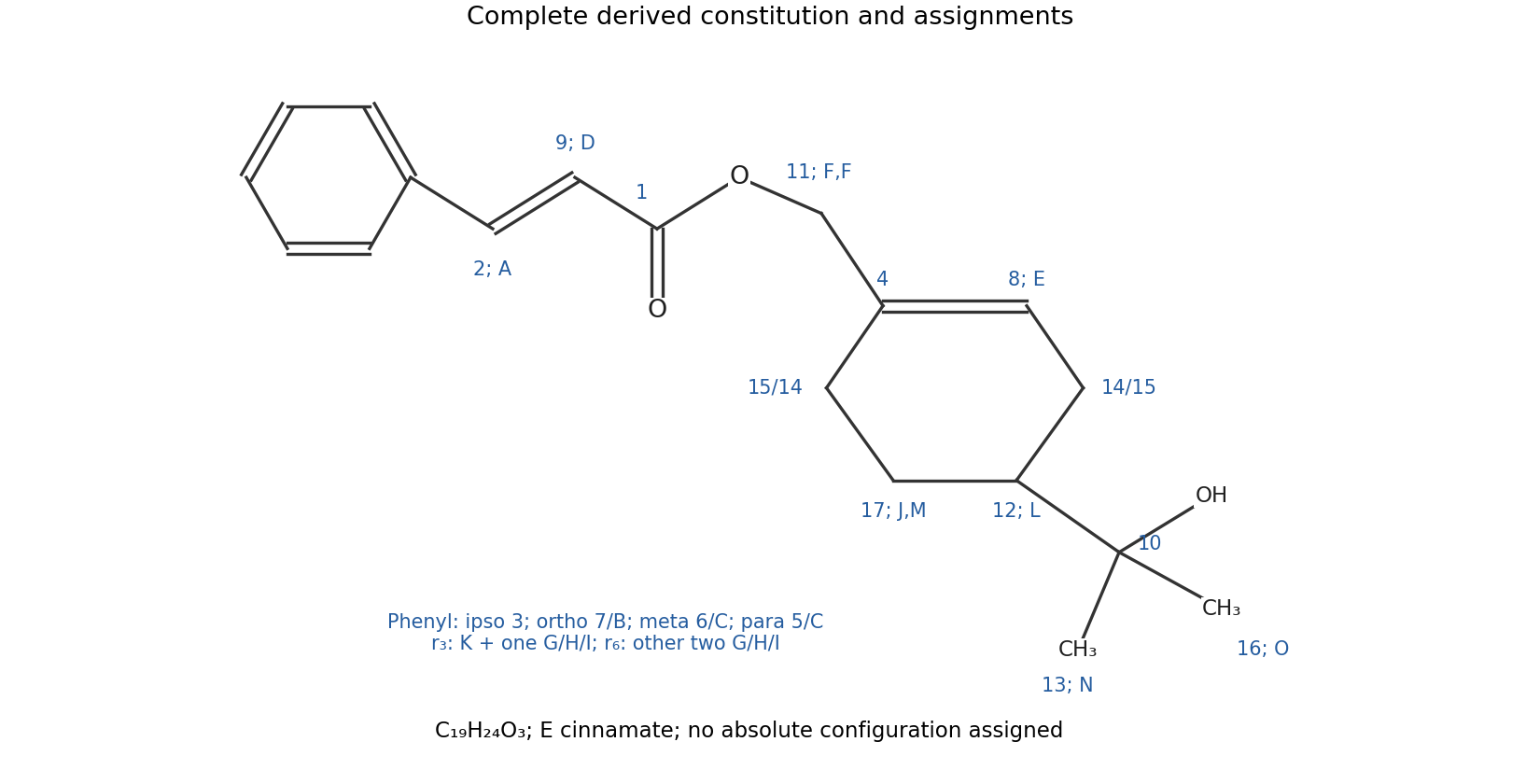
Complete constitution: cinnamoyloxymethyl at cyclohexene position 1 and a tertiary-alcohol substituent at position 4
. Details. 
The constitution is [4-(2-hydroxypropan-2-yl)cyclohex-1-en-1-yl]methyl (E)-3-phenylprop-2-enoate, with absolute configuration at the saturated substituted ring carbon unspecified.
The OCH side chain is attached to the unprotonated alkene carbon 4: F correlates through the ring junction to the alkene carbons and an allylic methylene, while its correlation to 1 fixes the ester linkage. The side chain is attached to methine carbon 12, as shown by the methyl-to-12 HMBC correlations and the contiguous ring COSY network.
The formula check gives 19 carbons and 24 hydrogens including OH. Its degree of unsaturation is eight: four from phenyl, one ester carbonyl, one cinnamate C=C, one cyclohexene C=C and one ring. No additional double bond or hidden second carbonyl is needed.
There are unlisted articles, also show them or only show them.