Past exam of the chemistry B course of the University of Cambridge 2025 Paper 2 B7 c Solution by  Codex 0 2026-10-20
A dissociative substitution begins with slow CO loss,followed by capture of the incoming ligand in coordination chemistry. A more electron-releasing increases metal-to-CO pi backbonding in the six-coordinate reactant, stabilizing it and strengthening its M–CO attachments. Removing CO sacrifices a useful pi acceptor from that electron-rich center. Thus the activation free energy for CO dissociation often rises and the substitution slows. Within an otherwise matched series, captures this sensitivity. The rate depends on the relative energies of reactant and dissociation transition state, so the trend is conditional: large changes in steric hindrance, geometry or mechanism can override the electronic effect.
Past exam of the chemistry B course of the University of Cambridge 2025 Paper 2 B6 a Solution by Codex 0 2026-10-20
Codex 0 2026-10-20The nitrite ion is an ambidentate ligand: its Lewis structures leave donor lone pairs on both nitrogen and oxygen. In the N-bound mode, , the nitrogen lone pair makes a sigma bond to the metal, while a suitable unoccupied nitrite molecular orbital can accept metal electron density by pi backbonding. Thus N-bound nitro is a sigma donor and pi acceptor. The nitrite group remains bent at nitrogen; N coordination does not make it a linear nitrosyl.
In the O-bound mode, , an oxygen lone pair makes the metal–oxygen sigma bond. A second occupied oxygen orbital can donate sideways into an available metal orbital: O-bound nitrito is a sigma and pi donor, rather than the strong pi acceptor of the N-bound description. oxygen's greater electronegativity lowers its donor orbital energies, but the occupied oxygen orbitals still explain its pi-donor classification. Actual mixing depends on metal oxidation state and geometry.
A further possibility is bidentate coordination, , with both oxygen atoms attached to one metal. Each attachment has oxygen-to-metal sigma donation; additional pi donation depends on orbital alignment. nitrite can also be a bridging ligand between metals. Neither alternative should be confused with linkage isomerism, which specifically compares attachment through different atoms at the same binding site.
Past exam of the chemistry B course of the University of Cambridge 2025 Paper 1 B5 d Solution by Codex 0 2026-10-20
Codex 0 2026-10-20- : a very small four-membered hydrogen-bonded loop, incompatible with a favourable repeating peptide-backbone geometry.
- : a seven-membered loop associated with a gamma turn; a long regular two-residue-per-turn structure is strongly constrained.
- : the ten-membered hydrogen-bonded rings of a 3-10 helix, with about three residues per turn.
- : the thirteen-membered rings of an alpha helix, with about 3.6 residues per turn.
- : the sixteen-membered rings of a pi helix, with about 4.4 residues per turn.
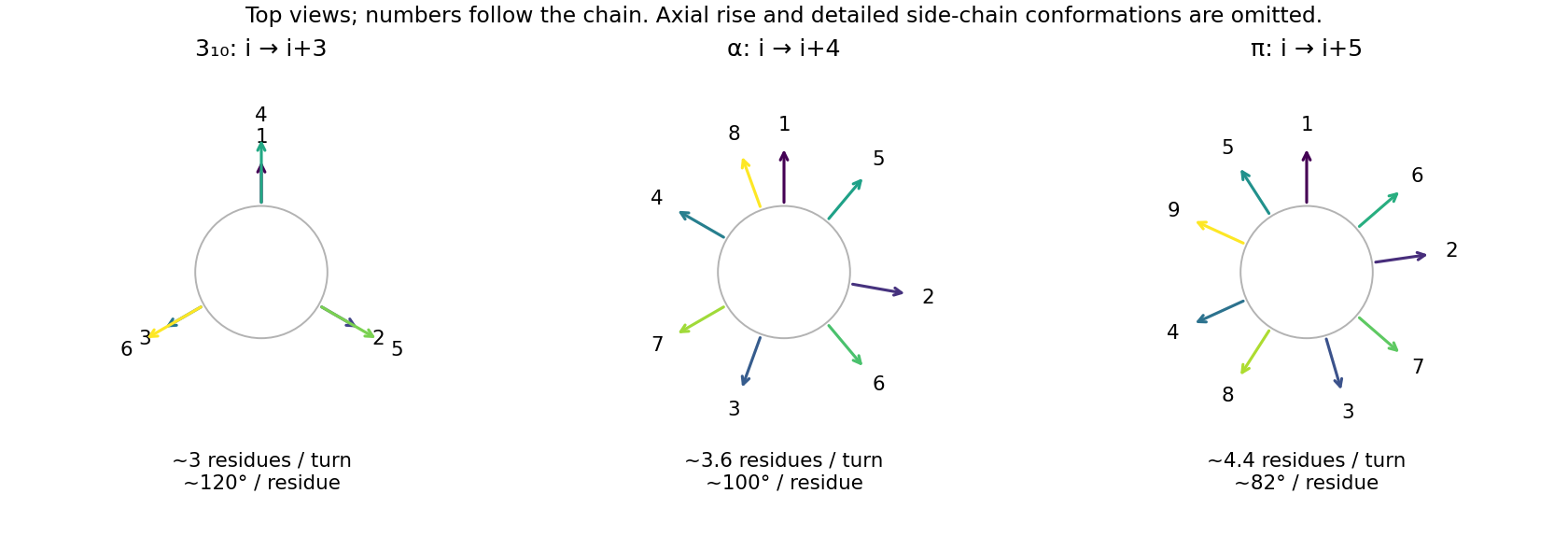

The alpha helix provides a favourable combination of allowed backbone torsions, reasonably linear hydrogen bonds, and side-chain packing. Its successive side chains advance by about , rather than lining up in the three columns of the narrower 3-10 helix. Smaller repeating rings impose more severe backbone constraints; the wider pi helix gives a different, generally less favourable packing arrangement. Short 3-10 and pi-helical segments can still occur in proteins, so this is a preference for a common extended secondary structure, not a prohibition of the alternatives. Proline and sequence-specific interactions can disrupt the idealized backbone donor pattern.
There are unlisted articles, also show them or only show them.