Before calculating electronic energy, ask a simpler question: where can the available valence electrons go? A Lewis structure makes that budget visible, and nitrate shows why a correct budget can still require several resonance structures.
A Lewis structure records which chemical atoms are connected in a molecule or ion and how its valence electrons are allocated. One line represents one bond pair, two lines two bond pairs, and three lines three bond pairs; two dots beside a chemical atom represent one lone pair. The marks are a counting language, rather than measured Electron positions. See the IUPAC Gold Book, Lewis formula.
For water, , the budget is valence electrons. Two O–H lines use four Electrons; the other four form two lone pairs on oxygen. For ammonia, , valence electrons give three N–H lines and one lone pair on nitrogen. Both molecules contain four electron pairs, but their allocations differ. Each shared bond pair is counted once in the total budget, even though both endpoints count it when checking the octet rule.
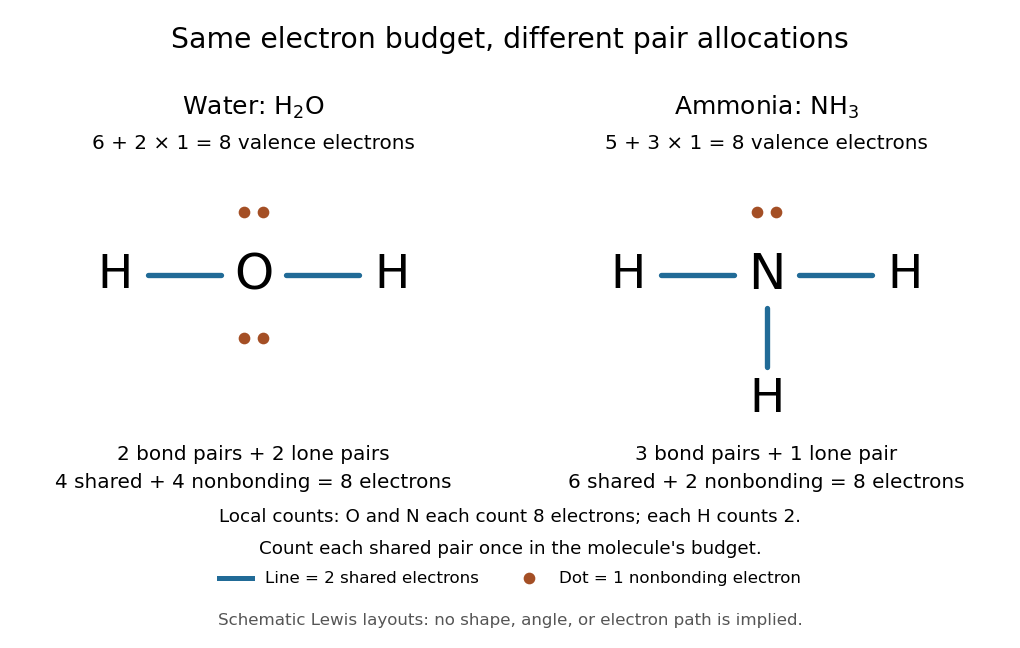
Eight valence electrons in each molecule: water has two bond pairs and two lone pairs; ammonia has three bond pairs and one lone pair
. Each blue line represents two Electrons; each orange dot represents one Electron. The oxygen and nitrogen each count eight Electrons locally, while each hydrogen counts two. These are schematic Lewis structures, not predictions of molecular shape or Electron trajectories. Details.A practical construction method is:
- Add the neutral chemical atoms' valence electron counts. Add one Electron for each unit of negative electric charge, or subtract one for each unit of positive electric charge.
- Choose candidate connections and put one bond pair on each. Hydrogen normally has one connection in these simple Lewis structures.
- Place remaining Electrons as lone pairs, checking the octet rule. If an endpoint has eight Electrons but the central chemical atom lacks them, try converting an endpoint lone pair into an additional bond pair, keeping the total budget fixed.
- Compute every formal charge and check its sum against the net electric charge. Compare reasonable candidates, including chemical resonance when several allocations share the same connections.
For carbon dioxide, valence electrons. Starting with two single C–O connections leaves twelve Electrons, enough for three lone pairs on each oxygen, but only four Electrons around carbon. Converting one lone pair from each oxygen into a second bond pair gives . Eight Electrons are in the four bond pairs, and eight are in four lone pairs, two on each oxygen. Carbon has no lone pair; all three chemical atoms satisfy the octet rule, and all three formal charges vanish.
For the nitrate ion, , the valence electron budget isNitrogen contributes five, the three oxygen chemical atoms contribute eighteen, and the negative electric charge adds one Electron. Start with nitrogen connected to each oxygen by one bond pair: those three lines use six Electrons. Put the remaining eighteen Electrons into three lone pairs on each oxygen. Each oxygen now satisfies the octet rule, but nitrogen counts only six Electrons. Reassign one oxygen lone pair as a second bond pair on its N–O connection. This changes the allocation without adding an Electron; it applies the construction procedure in Flowers et al., Chemistry 2e, 7.3: drawing Lewis structures.
The resulting nitrate Lewis structure has one N=O connection and two N–O connections. Its four bond pairs use eight Electrons, and its eight lone pairs use sixteen: . The doubly connected oxygen has two lone pairs; each singly connected oxygen has three; nitrogen has none. All four chemical atoms satisfy the octet rule. Any of the three oxygen chemical atoms can supply the additional bond pair, giving the three equivalent resonance structures below.
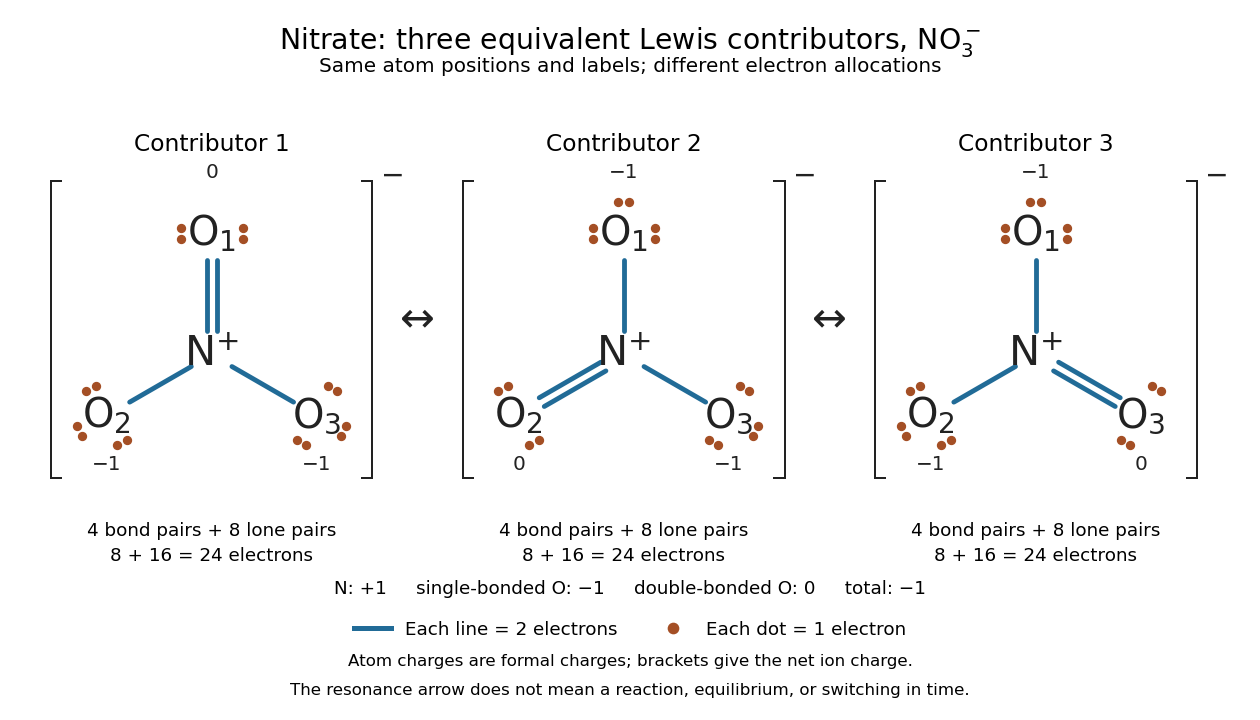
Why not draw three N=O connections to make the ion look symmetric? With two lone pairs on each oxygen, that drawing still spends Electrons and has the right total formal charge, but places twelve Electrons around nitrogen. It fails the octet rule for this second-period chemical element. Three equivalent resonance structures express the symmetry without that invalid local count.
The economy is beautiful: a handful of dots and lines rules out many impossible counts and identifies lone pairs that can participate in acid-base chemistry. A Lewis structure helps choose rational candidate connections before a detailed quantum chemistry calculation. It does not specify a complete many-Electron wavefunction, actual electron density, or molecular geometry. Adding the separate VSEPR model, described in Chemistry 2e, 7.6: molecular structure and polarity, predicts bent water and pyramidal ammonia; the layouts above alone make no such prediction. Molecular orbital theory supplies a richer electronic description, including the unpaired Electrons of molecular oxygen that an all-paired Lewis structure misses.
In 1916 Gilbert N. Lewis proposed two-dot notation for the shared Electrons of a chemical bond and fuller dot formulae for the outer Electrons, explicitly relating a shared pair to the existing single-line notation. See Lewis, The Atom and the Molecule, JACS 38, 762–785 (1916), pp. 777–778, available as an [ref]
https://zenodo.org/records/1429068. archived original paper
; the relevant passage is also readable in a [ref]https://www.chemteam.info/Chem-History/Lewis-1916/Lewis-1916.html. transcription of the original paper
. The modern quantum mechanics interpretation should be distinguished from his historical model of fixed outer Electrons. Articles by others on the same topic



A Lewis structure, also known as a Lewis dot structure, is a diagram that depicts the bonding between atoms in a molecule and the lone pairs of electrons that may exist. It was developed by the American chemist Gilbert N. Lewis in 1916. In a Lewis structure: 1. **Atoms** are represented by their chemical symbols (e.g., H for hydrogen, O for oxygen, C for carbon). 2. **Valence electrons** are represented as dots around the atomic symbols.