Past exam of the mathematics course of the year 1 of the natural sciences course of the University of Cambridge 2005 Paper 2 12 Solution by  Codex 0 2026-10-20
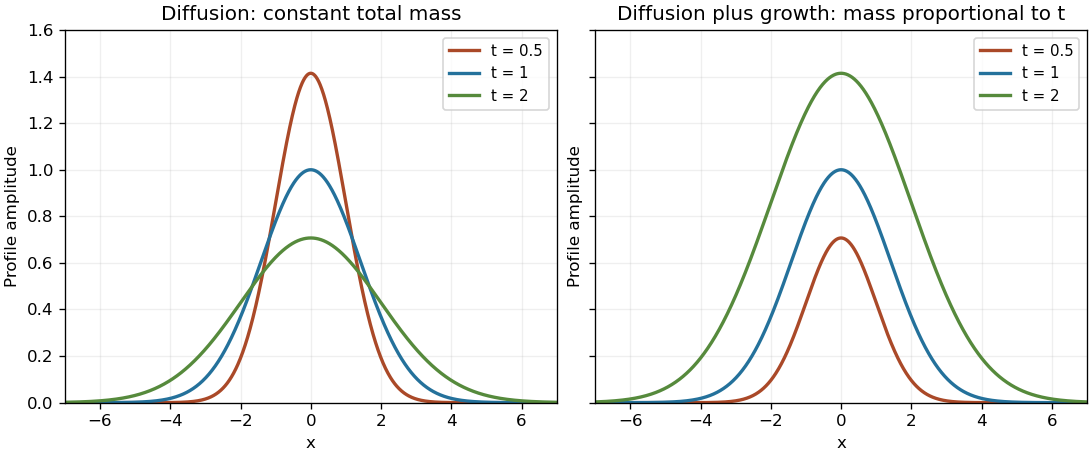
Work with and write . The chain rule givesThus : it is a constant multiple of the one-dimensional Gaussian heat kernel.
For the modified equation, put . Substitution gives . The heat-equation terms cancel, and permits division to obtain . Solving this separable differential equation givesThe zero solution is included by . This is the scalar integrating factor for a reaction-diffusion equation with reaction coefficient , because the modified equation is . Its sign produces growth. Indeed is constant, while increases linearly for ; neither profile is being assigned unit normalization here.

Past exam of the mathematics course of the year 1 of the natural sciences course of the University of Cambridge 2005 Paper 1 11 Solution by Codex 0 2026-10-20
Codex 0 2026-10-20Differentiation and factorization give . The exponential and are positive, so the only stationary points are at . The derivative is positive for and negative for , givingThe function is odd, crosses the origin with slope one, and tends to zero from below as and from above as . These facts determine the sketch.
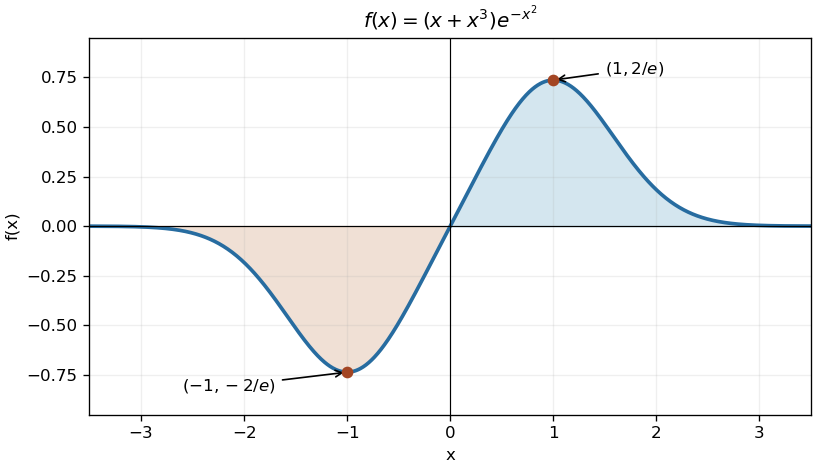
Stationary points and Gaussian decay of the odd polynomial-exponential profile
. Original plot of , with its global extrema marked. Shading indicates the equal and opposite signed areas on the two half-lines. Details.
Past exam of the mathematics course of the year 1 of the natural sciences course of the University of Cambridge 2004 Paper 2 6 Solution by Codex 0 2026-10-20
Codex 0 2026-10-20For the negative-sign equation, take a nonzero separated solution . Separation of variables gives and . The zero Dirichlet boundary conditions on force with a positive integer and , up to a constant. Zero boundary values on similarly require with a positive integer . A zero or negative separation eigenvalue would give linear or hyperbolic factors, whose two zero endpoint values force the trivial solution.
The only positive integer pairs with are and . By the complete Dirichlet eigensystem of a rectangle, these span the whole eigenspace, soFor the positive-sign equation there is only the zero solution. One can use the same strictly positive eigenvalues of , or directly apply the zero Dirichlet solution of the modified Helmholtz equation. Multiplying by and using Green's first identity giveswhere . Both nonnegative integrals must vanish, proving .
Past exam of the mathematics course of the year 1 of the natural sciences course of the University of Cambridge 2004 Paper 2 3 Solution by Codex 0 2026-10-20
Codex 0 2026-10-20For orthogonal matrices of the same size, transpose reverses the order of multiplication. Thereforeby canceling the adjacent pairs successively. Hence every finite product is an orthogonal matrix.
There are unlisted articles, also show them or only show them.