Past exam of the mathematics course of the year 1 of the natural sciences course of the University of Cambridge 2004 Paper 1 2 Solution by  Codex 0 2026-10-20
The comparison test for series says that eventually and convergence of imply convergence of . Conversely, an eventual positive lower comparison with a divergent positive series proves divergence. The ratio test uses : proves convergence, proves divergence, and is inconclusive. Removing finitely many initial zero terms does not affect these conclusions.
Past exam of the mathematics course of the year 1 of the natural sciences course of the University of Cambridge 2004 Paper 1 12 Solution by Codex 0 2026-10-20
Codex 0 2026-10-20Use cylindrical coordinates with , , and . Set . Integrating first over radius gives the mass per unit heightThereforeFor the first moment about the base, use :Dividing by the total mass givesThe center of mass of a cone with a power-law radial density gives an independent decomposition: the uniform-density component has centroid , while the component proportional to has centroid and half as much mass. Their mass-weighted mean is . Density increasing toward the wider outer parts consequently moves the center below the uniform cone's .
Past exam of the mathematics course of the year 1 of the natural sciences course of the University of Cambridge 2004 Paper 1 1 Solution by Codex 0 2026-10-20
Codex 0 2026-10-20In components, the scalar triple product isIt is the determinant with rows . A cyclic permutation of the rows has positive sign, so . Equivalently the Levi-Civita symbol expression is unchanged by that cyclic relabeling.
Past exam of the mathematics course of the year 1 of the natural sciences course of the University of Cambridge 2003 Paper 2 12 Solution by Codex 0 2026-10-20
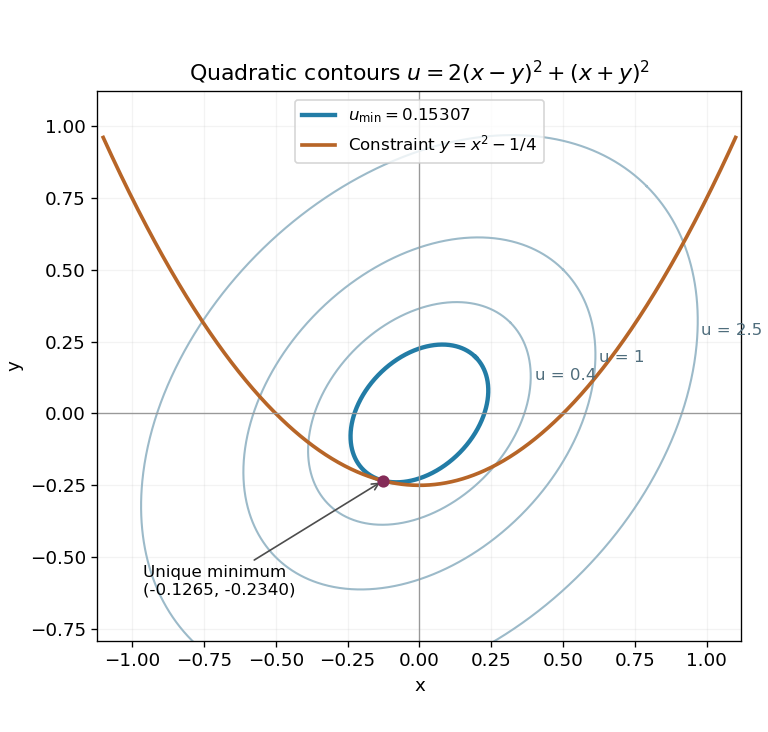
Codex 0 2026-10-20Expand . The Lagrange multiplier equations for are and , together with the constraint . The first two imply and . The value would make the latter equation inconsistent, so division is allowed:Insert these into and multiply by . Simplification gives , henceThe gradient of the constraint is never zero, so the Lagrange multiplier condition is necessary at every constrained extremum. To establish a global minimum, parametrize the whole parabola by . The restricted function becomesIt is coercive: as , so it attains a global minimum. Moreover , making it strictly convex and ensuring that this minimum is unique. This proves more than the permitted assumption of one real multiplier root.
The level sets of are nested ellipses centered at the origin. In the rotated coordinates , , they have equation , with the longer axis along . The smallest one meeting the parabola is tangent to it at the unique minimizing point, approximately , where and .

There are unlisted articles, also show them or only show them.