Past exam of the mathematics course of the year 2 of the natural sciences course of the University of Cambridge 2003 Paper 2 10 Solution by  Codex 0 2026-10-20
Write the symmetry group of a square as , with a counterclockwise quarter-turn and reflection across the horizontal axis. The conjugacy classes of the symmetry group of a square areHere is the half-turn and the clockwise quarter-turn. The two members of the fourth class reflect across the horizontal and vertical axes. Those of the fifth reflect across and . The identity and half-turn are central elements, giving singleton classes. The relations , , and show that each displayed pair consists of conjugate elements. More generally, conjugating by changes to , and conjugating by changes to ; parity is preserved, so the two reflection pairs cannot merge.
In a one-dimensional representation, the relation forces the image of to equal its inverse. Thus and can be assigned independent signs . These four choices give four irreducible characters. The ordinary two-dimensional action on the plane gives one more character: a rotation through has trace , and a reflection has trace zero. Therefore the character table of the symmetry group of a square isFor instance the last row has squared character norm , so the planar representation is irreducible; its inner product with each one-dimensional row is zero. All five rows obey character orthogonality. Their squared dimensions sum to , so they exhaust the irreducible representations of this order-eight group.
Past exam of the mathematics course of the year 2 of the natural sciences course of the University of Cambridge 2003 Paper 1 5 Solution by Codex 0 2026-10-20
Codex 0 2026-10-20If for a Hermitian matrix and a nonzero eigenvector, then . The scalar on the left equals its complex conjugate because , while . Thus is real. If also , thenConsequently distinct eigenvalues force , proving orthogonality of their eigenvectors.
For a unitary matrix, preserves the norm induced by the standard Hermitian inner product. If with , then , so .
Past exam of the mathematics course of the year 2 of the natural sciences course of the University of Cambridge 2002 Paper 2 7 Solution by Codex 0 2026-10-20
Codex 0 2026-10-20A normal mode is a fixed displacement pattern whose components share a common harmonic time dependence in the equations for small oscillations. Its normal frequency is the associated oscillation frequency; below, denotes the angular frequency, so the frequency in cycles per unit time is . A normal coordinate is the amplitude of one such pattern, chosen so that the linear equations decouple. For mass matrix and stiffness matrix , the patterns solve . Zero eigenvalues describe free rigid motions rather than periodic restoring oscillations.
Past exam of the mathematics course of the year 2 of the natural sciences course of the University of Cambridge 2002 Paper 2 5 Solution by Codex 0 2026-10-20
Codex 0 2026-10-20For a piecewise continuous function of exponential order on , its unilateral Laplace transform isThe Bromwich inversion formula, at a point of continuity, isThe Bromwich contour is a straight vertical line, traversed upwards, with to the right of the abscissa of convergence and hence of all singularities of the transform. Under the usual piecewise smoothness assumptions, at a jump the symmetric inversion limit gives the mean of the two one-sided values.
In the transform in the question, put . Then andThus the restricted Mellin transform on the unit interval is the Laplace transform of . Apply the Bromwich inversion formula with , where , to obtainHere lies in the convergence half-plane of . At a discontinuity this formula has the same mean-value interpretation. The real natural logarithm defines unambiguously.
Past exam of the mathematics course of the year 2 of the natural sciences course of the University of Cambridge 2001 Paper 1 5 Solution by Codex 0 2026-10-20
Codex 0 2026-10-20Commuting inverse. Assume is invertible, as required by the displayed inverse. Multiplication givesMultiply on both sides by to obtainMore generally, a matrix commuting with an invertible matrix also commutes with its inverse.
Orthogonality. For a real skew-symmetric matrix , . If for a real vector , multiply by to obtain . Thus is invertible; the same argument applies to . For the Cayley transform of a real skew-symmetric matrix,The factors commute by the first result, soTherefore
Eigenvector mapping. If , then . ConsequentlyThe denominator cannot vanish. In fact the eigenvalues of a real skew-symmetric matrix are purely imaginary: is the negative of its complex conjugate, so . For the corresponding eigenvalue of is , consistent with orthogonality.
Spectrum in three dimensions. Let be any real three-by-three orthogonal matrix. For a complex eigenvector , implies . A real cubic characteristic polynomial has a real root, necessarily or . Any nonreal roots form a complex-conjugate pair of unit modulus. If all three roots are real, two of the three signs agree and can be grouped as a pair with angle zero or . Thus in every case the eigenvalues can be writtenTheir product is .
Determinant and fixed axis for the Cayley transform. Since ,so . This determinant argument works in every dimension. In dimension three the preceding spectrum result then guarantees an eigenvector with . Set . The fixed-vector equation says , so and . HenceThis is the axis fixed by the three-dimensional rotation. Equivalently, a real odd-dimensional skew-symmetric matrix has zero determinant, because .
Past exam of the mathematics course of the year 2 of the natural sciences course of the University of Cambridge 2001 Paper 1 11 Solution by Codex 0 2026-10-20
Codex 0 2026-10-20Local errors of the Euler schemes. Let , and evaluate and its partial derivatives at an exact starting point . DefineThe exact Taylor expansion is . The forward Euler method retains only , so its one-step defect, exact minus computed value, isFor the Backward Euler method, substitution of the exact solution into the scheme gives the residualbecause . Under local smoothness, solving the implicit step changes this residual by a factor , so the one-step defect has the same leading term:These are unnormalized local truncation errors, as in the question. A convention dividing by instead gives . Both schemes have first-order global error under the usual smoothness and stability hypotheses.
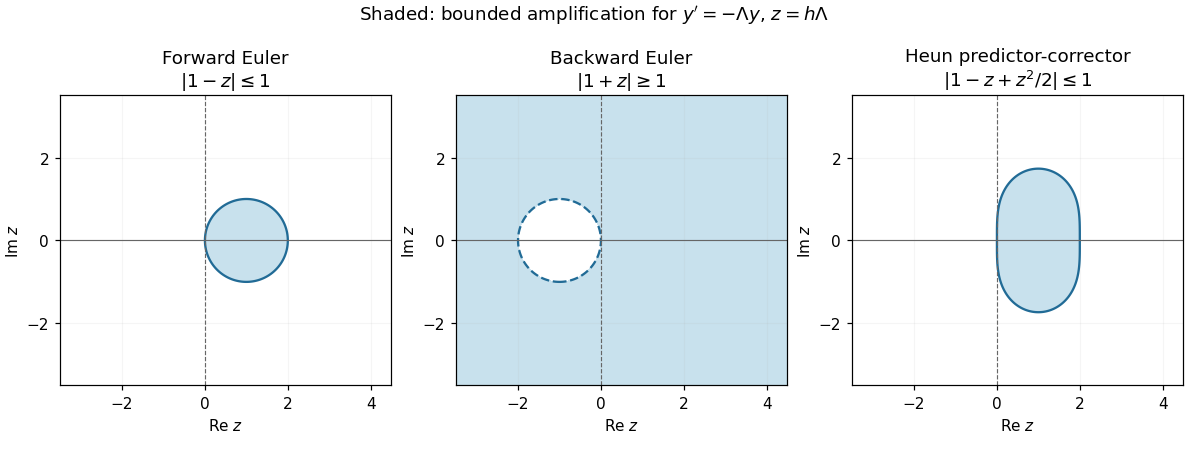
Euler stability. For the Dahlquist test equation , put , with . The numerical amplification factors areStrict decay requires ; the boundary gives bounded but generally nondecaying values. For Forward Euler method,For positive real , this reduces to . The absolute stability region in the plane is the disk . For Backward Euler method, whenever , so it decays for every step size. It is A-stable and also L-stable, since for large in this half-plane. Here has the opposite sign from the alternative convention for .
Predictor-corrector accuracy. The printed two-stage construction is Heun's method, equivalentlyAlthough the second stage resembles a Backward Euler method evaluation, it uses the predicted value, so the combined method is explicit. Expand that stage around the exact starting point, puttingThenand the numerical step is . Along the exact solution, , so comparison with the exact Taylor expansion givesThus the local defect improves by one power of , giving second-order global error under the usual hypotheses. For the linear test equation the defect reduces to .
Predictor-corrector stability. Applied to the test equation, the predictor is and the second value is . Their average givesFor real positive , , so strict decay holds exactly for , the same real-axis step bound as Forward Euler method. For complex the precise condition isThe region is bounded and does not contain the full right half-plane: for example gives . It is therefore not A-stable. Its imaginary-axis values satisfy for . Better accuracy has not inherited the unconditional stability of an actual implicit Backward Euler method step.

There are unlisted articles, also show them or only show them.