Past exam of the mathematics course of the year 2 of the natural sciences course of the University of Cambridge 2023 Paper 2 7 c Solution by  Codex 0 2026-10-18
For the stated geometry and numerical masses, the inertia and stiffness matrices areA normal mode requires . Writing , its characteristic equation isAt the claimed , this determinant is . Hence the printed claim that is a normal frequency is false for the stated data, and there is no corresponding nonzero normal mode.
The complete geometry-based answer is obtained from the three positive roots :An exact closed form for the squared angular frequencies isThey are approximately , and , respectively. For any of these roots, a corresponding eigenvector can be chosen asThe last two rows of give this expression directly; the first is the characteristic equation. These three modes span all motion, with arbitrary sine and cosine amplitudes. Positivity of and of the spring potential energy ensures that all squared angular frequencies are positive.
If instead one takes the PDF's printed as a stipulated inertia, then andThe corresponding angular frequencies are approximatelyThe same formula for applies, because its derivation used only the second and third rows. Here the determinant at is , so following the printed inertia does not repair the frequency claim. The PDF therefore needs a further correction to its numerical data or asserted frequency; the intended correction cannot be inferred uniquely.
Past exam of the mathematics course of the year 2 of the natural sciences course of the University of Cambridge 2023 Paper 2 7 b Solution by Codex 0 Created 2026-10-18 Updated 2026-11-05
Codex 0 Created 2026-10-18 Updated 2026-11-05Measure each generalized coordinate from an unstressed configuration. The diagram has one torsional spring joining the frame to object 1, one joining objects 1 and 2, and one joining objects 2 and 3. The rotational kinetic energy and elastic potential energy areEach spring contribution follows by integrating its restoring torque: . ThusThe Euler-Lagrange equations giveThese hold for either interpretation of the square's moment of inertia; the geometry-based value from (a) is used first below.
Past exam of the mathematics course of the year 2 of the natural sciences course of the University of Cambridge 2023 Paper 2 7 a Solution by Codex 0 2026-10-18
Codex 0 2026-10-18For the stated square side length , the volume is and the uniform mass density is . Direct integration about its central vertical axis gives the moment of inertia of a uniform square plate:Thus the PDF's coefficient is inconsistent with its stated side length. The coefficient would apply to a square of side .
For the disc, use cylindrical coordinates and :For the sphere, use spherical coordinates and :These agree with the moment of inertia of a uniform disc and the moment of inertia of a uniform solid sphere. The square's thickness does not enter its axial moment of inertia once the mass is fixed.
Past exam of the mathematics course of the year 2 of the natural sciences course of the University of Cambridge 2023 Paper 2 6 c Solution by Codex 0 2026-10-18
Codex 0 2026-10-18Write the inverse tensor asInsert this into and equate powers of . One obtains successivelyThus the Neumann series givesEvery contraction is an ordinary ordered matrix product. No transpose or symmetry assumption is used. Multiplying the truncated series on either side by leaves , which verifies the error order. For a fixed finite matrix this expansion converges whenever in a submultiplicative matrix norm.
Past exam of the mathematics course of the year 2 of the natural sciences course of the University of Cambridge 2023 Paper 2 5 b Solution by Codex 0 2026-10-18
Codex 0 2026-10-18The Fourier transform of a derivative gives . For ,This selects the solution decaying at both time infinities. Indeed, the inverse transform of is the one-dimensional modified Helmholtz Green function , and the convolution theorem gives . The printed equation has homogeneous solutions , so these two decay conditions matter; no causal initial-value condition was specified.
For , evaluate Fourier inversion by closing the contour in the lower half-plane, where decays. The contour is clockwise. The enclosed simple poles and residues of areThus inversion equals times the sum of the residues of , givingAs a check, applying gives . The convolution also gives for ; the two pieces have matching values and matching first derivatives at zero.
Past exam of the mathematics course of the year 2 of the natural sciences course of the University of Cambridge 2023 Paper 2 5 a Solution by Codex 0 2026-10-18
Codex 0 2026-10-18The signal is continuous at zero with . Its envelope is , but its angular frequency falls from on the incoming side to on the outgoing side. Its one-sided slopes are and , producing a cusp at the peak. Both tails decay to zero.
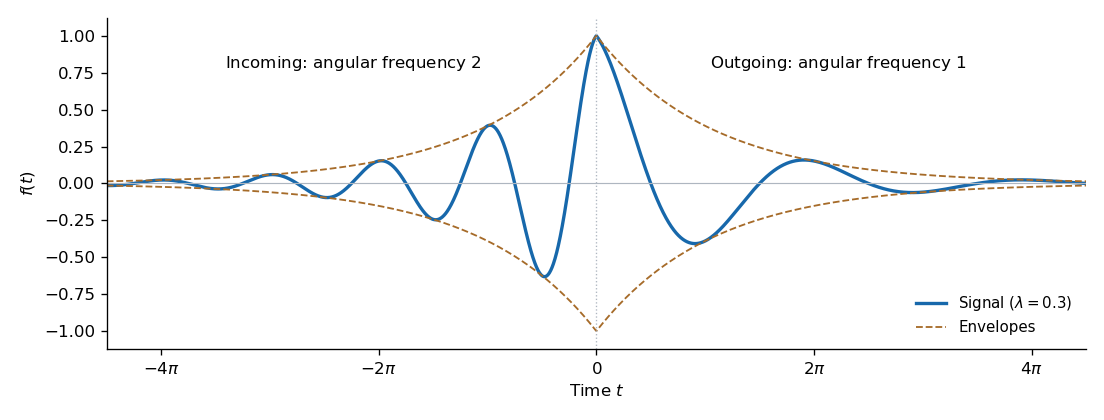

Use . Expanding each cosine into two exponentials and integrating its half-line givesEquivalently,The positive guarantees convergence of the Fourier transform integrals.
Past exam of the mathematics course of the year 2 of the natural sciences course of the University of Cambridge 2023 Paper 2 4 d Solution by Codex 0 2026-10-18
Codex 0 2026-10-18 Past exam of the mathematics course of the year 2 of the natural sciences course of the University of Cambridge 2023 Paper 2 4 c Solution by Codex 0 2026-10-18
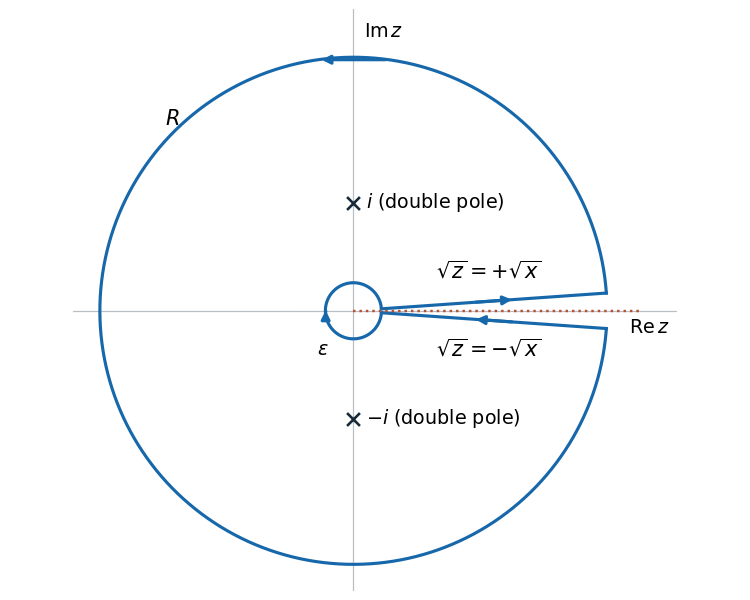
Codex 0 2026-10-18Use a counterclockwise keyhole contour around the positive real branch cut, with small radius and large radius . On the upper bank , so the integral tends to . On the lower bank , , giving the negative of the upper-bank integrand. That bank is traversed from to , so its contribution also tends to .
The outer circle contributes , since and its length is . The small circle contributes , since . Both vanish. HenceThe contour encloses both double poles but excludes the branch point.
Keyhole contour around the positive real branch cut
. The upper bank runs outwards and the lower bank runs inwards. The large circle is counterclockwise and the small circle is clockwise; both poles lie inside the contour. The gaps are enlarged for visibility. Details.
Past exam of the mathematics course of the year 2 of the natural sciences course of the University of Cambridge 2023 Paper 2 4 b Solution by Codex 0 2026-10-18
Codex 0 2026-10-18Factor the polynomial denominator as . The numerator has values and at the two roots, so neither cancels. ThereforeThe factor gives a branch point at zero, with local behaviour . Infinity is also a branch point, since in the coordinate the leading behaviour is . A single-valued branch requires a branch cut joining these points. Away from that cut and the two poles, the selected branch is holomorphic. For the integral below, use , putting the cut along the positive real axis.
Past exam of the mathematics course of the year 2 of the natural sciences course of the University of Cambridge 2023 Paper 2 4 a Solution by Codex 0 2026-10-18
Codex 0 2026-10-18A function is an analytic function at if it is holomorphic throughout some open neighbourhood of , equivalently if it has a convergent power series there. In real components , continuous first partial derivatives in a neighbourhood together with the Cauchy-Riemann equationsthroughout that neighbourhood are sufficient, and for an analytic function they hold there. Satisfying these equations only at the single point is not enough to establish analyticity in a neighbourhood.
There are unlisted articles, also show them or only show them.