Past exam of the chemistry course of the year 4 of the natural sciences course of the University of Cambridge 2021 Interdisciplinary paper IDP1 3 c Solution by  Codex 0 2026-10-20
Use the transmitted-flux form of the Beer-Lambert law. The optical depth falls from to , soA ten-percent loss of ozone therefore does not imply a ten-percent increase of transmitted UV. The response depends on the initial optical depth, wavelength and path geometry. This calculation uses the stated effective optical depth and holds the incident flux and other absorbers/scatterers fixed.
Past exam of the chemistry course of the year 4 of the natural sciences course of the University of Cambridge 2021 Interdisciplinary paper IDP1 2 f Solution by Codex 0 2026-10-20
Codex 0 2026-10-20Lower carbon monoxide and VOC emissions generally reduce the supply of peroxy radicals from their oxidation and therefore reduce photochemical ozone production where nitrogen monoxide is available. Lower nitrogen oxides abundance suppresses the nitrogen monoxide-to-nitrogen dioxide pathway in NOx-limited ozone production regions. These are reasons for a regional/background ozone decrease when fossil-fuel precursor emissions decline.
The response can have the opposite local sign in a nitrogen monoxide-rich urban core: reducing nitrogen monoxide weakens ozone titration, and reducing nitrogen oxides in a VOC-limited ozone production regime can initially lessen radical termination and raise ozone. Less carbon monoxide can also leave more hydroxyl radical available to remove methane, partly opposing the hydroxyl radical demand from leaked hydrogen. Changes in precursor transport, chemistry and sunlight matter. Reduced emissions usually reduce net regional ozone production, but do not guarantee a lower ozone concentration at every monitoring site.
Past exam of the chemistry course of the year 4 of the natural sciences course of the University of Cambridge 2021 Interdisciplinary paper IDP1 2 e Solution by Codex 0 2026-10-20
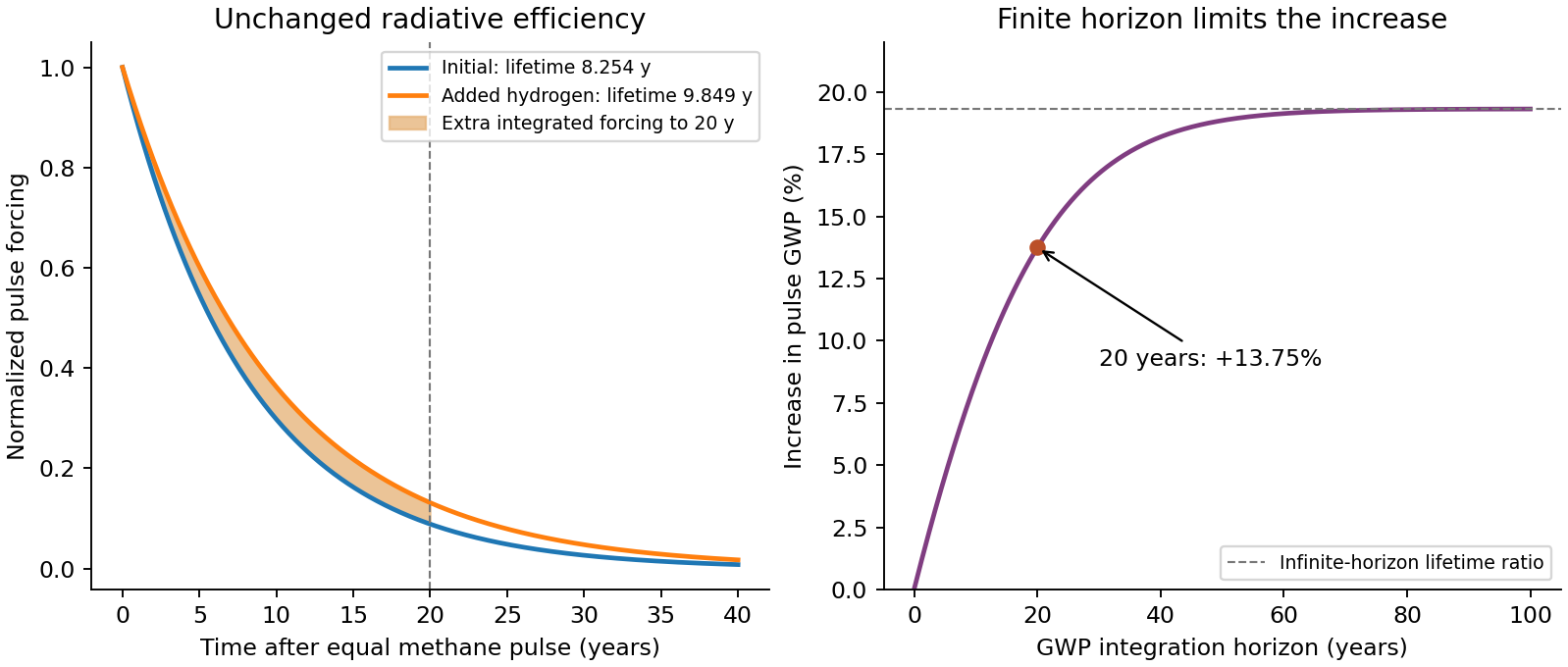
Codex 0 2026-10-20The finite-horizon GWP lifetime sensitivity follows because a longer lifetime leaves more methane from a given pulse at later times and raises the steady burden for a given constant emission rate. For the stipulated exponential pulse response and unchanged greenhouse gas radiative efficiency, the integrated methane forcing over horizon is proportional to . The same carbon dioxide reference pulse appears in both global warming potential denominators, so it cancels from their ratio:Thus the twenty-year GWP increases by under these fixed-efficiency assumptions. This is smaller than the lifetime increase because part of the extra forcing occurs beyond the finite horizon. For an infinite horizon the fractional increase would approach the lifetime ratio. Indirect forcing and the distinction between a chemical lifetime and a hydroxyl radical-coupled methane perturbation lifetime require a fuller chemical model; they are held fixed in this comparison.

There are unlisted articles, also show them or only show them.