An oxidation increases an oxidation state, recording loss from the formal electron assignment. For , the increase is . Oxidation need not involve oxygen.[ref]
In the electrochemistry examples here, oxidation is loss of electrons by a chemical species; it occurs at the anode. That electrode definition holds in both a galvanic cell and an electrolytic cell; it does not fix terminal polarity. The oxidized chemical species serves as the reducing agent in the coupled redox.
Historical term for slow oxidation, used in discussions of cellular respiration.
Reaction of zirconium with steam to form zirconium oxide and hydrogen. Its rate increases strongly with temperature; oxide formation and oxygen uptake alter heat transfer and mechanical behavior.
Oxidation of an alcohol functional group. Primary and secondary alcohols have different accessible oxidation products, and overoxidation must be controlled.
Oxidation with a Dess–Martin periodinane reagent, commonly converting primary alcohols to aldehydes and secondary alcohols to ketones under mild conditions.
Conversion of an alkene to an epoxide. Concerted oxygen transfer from a peracid preserves the relative stereochemical information of the alkene.
Transfer of an oxidant oxygen atom to an unsaturated substrate, including controlled formation of an epoxide.
Enantioselective oxygen transfer to an allylic alcohol using a titanium–tartrate complex and a hydroperoxide. With the alkene horizontal and its hydroxymethyl substituent at lower right, L-(+)-tartrate directs delivery from the back face and D-(−)-tartrate from the front face. Rotate a structure in its plane to apply the mnemonic; reflecting it changes its stereochemistry.
In hydroxyl-directed epoxidation, hydrogen bonding between an allylic hydroxyl and the oxidant favors oxygen delivery from a particular alkene face. This influences diastereoselectivity without requiring an unchanged preference under every solvent or protecting-group condition.
An oxidation state is an electron-bookkeeping assignment to a chemical atom: its electric charge number after the ionic approximation of bonds. It helps identify oxidation and reduction and determine stoichiometry, even for covalent bonds without separate charged ions. In water, each hydrogen has oxidation state and oxygen has ; this does not assert that a water molecule contains two free protons and a free oxide ion.[ref]
Comprehensive definition of oxidation state (IUPAC Recommendations 2016) by Pavel Karen and others. Karen, McArdle and Takats, Comprehensive definition of oxidation state (IUPAC Recommendations 2016), §2, pp. 832–833: definition and equal splitting of same-element bonds
Three conventions answer different questions. Formal charge divides each bonding electron pair equally in a chosen Lewis structure. Oxidation state uses the ionic approximation of bonds. Partial atomic charge instead partitions the actual electron density and depends on that partition. In the ordinary water Lewis structure, every formal charge is zero although the oxidation states are not. Neither bookkeeping convention supplies numerical partial atomic charges.
For the routine examples here, assign all bonding electrons between different chemical elements to the more electronegative partner; divide bonding electrons between identical chemical elements equally. Retain each lone pair on its original chemical atom. Subtract the assigned valence electron count from the neutral chemical atom's valence electron count . The IUPAC convention uses Allen electronegativity, based on free-chemical atom valence electron energies. Close electronegativity comparisons and some reversibly bound chemical compounds require care beyond this simple rule.[ref]
Comprehensive definition of oxidation state (IUPAC Recommendations 2016) by Pavel Karen and others. §3 and §4.1, pp. 833–834: Allen electronegativity, electron allegiance and the reversible Lewis-acid-ligand caveat; §5.5, pp. 836–837: ambiguous assignments
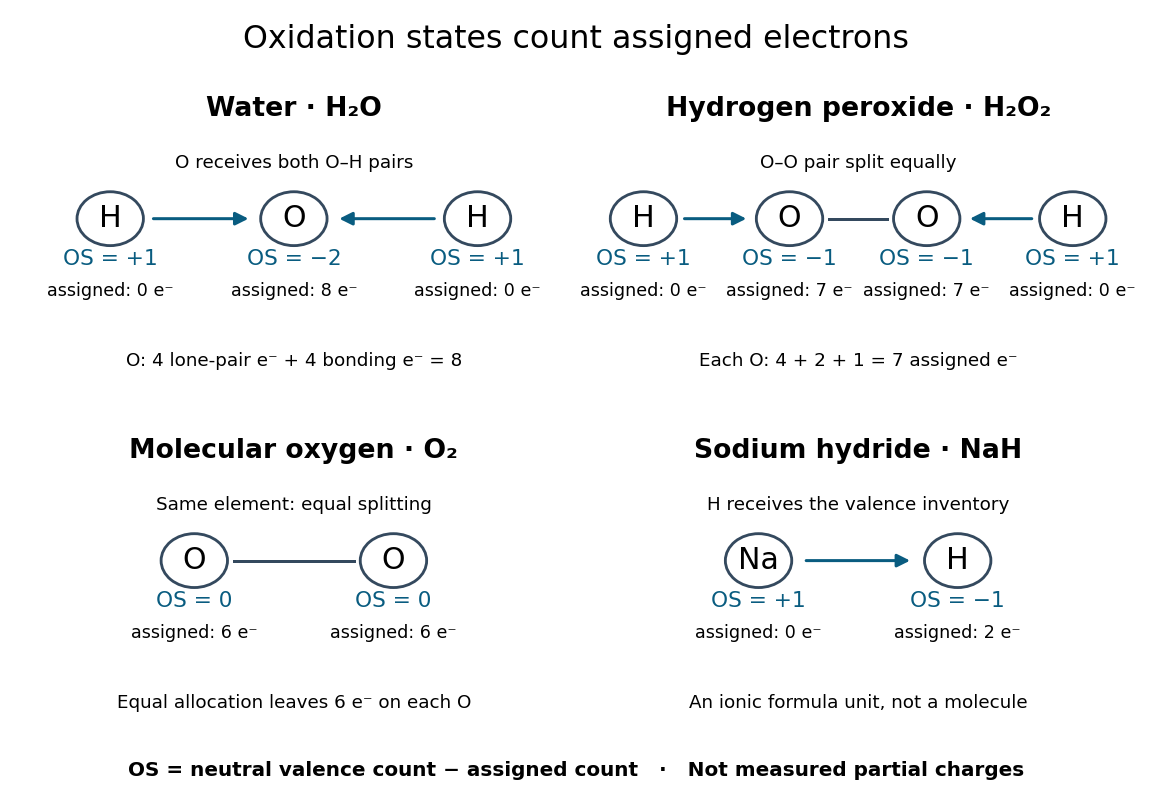

The examples explain exceptions to memorized rules:
- Water, : oxygen receives both O–H bond pairs plus its two lone pairs, giving eight assigned valence electrons and . Each hydrogen receives none, giving .
- Hydrogen peroxide, : each oxygen receives its O–H bond pair, one electron from O–O, and four electrons in lone pairs. Thus each has , while each hydrogen remains . The O–O connection is why the usual oxygen shortcut fails.
- Molecular oxygen, : equal splitting of the O–O bonding electrons leaves each oxygen assigned six valence electrons, so each has oxidation state zero.
- Sodium hydride, : hydrogen is more electronegative than sodium. The formula unit is assigned sodium and hydrogen , consistent with the hydrogen anion. The usual hydrogen shortcut fails here.
These drawings record allocations, not molecular geometry or a physical process of breaking the chemical bonds. In particular, the O–O line in the molecular oxygen panel only marks the connection; it does not assert a complete Lewis structure or spin state.
Sum oxidation states over all chemical atoms of the specified molecule, ion or formula unit, including multiplicities:Here is the net electric charge and the positive elementary charge. For a neutral entity the sum is zero; for an ion it equals its signed electric charge number . The reason is simple: the allocation assigns every valence electron exactly once, so the sum is the neutral electron budget minus the actual electron count.
For water, ; for hydrogen peroxide, . In permanganate, , assigning each oxygen gives , so manganese has oxidation state . This is not a free ion: the entire permanganate anion has net electric charge . The sum rule supplies a constraint; without additional assignments it cannot determine every individual oxidation state.
An increase in oxidation state records oxidation; a decrease records reduction. Thus raises the iron oxidation state by one, while lowers the manganese oxidation state from to . Five iron ions supply the five-electron inventory required per permanganate ion.
In an acidic chemical solution, the complete half-reactions areFirst balance oxygen with four water molecules, then hydrogen with eight protons, and finally electric charge with five electrons. Multiply the iron half-reaction by five and add; the exchanged electrons cancel:Both sides contain one manganese, four oxygen, eight hydrogen and five iron chemical atoms, with net electric charge . The notation represents the acidic aqueous proton inventory; it does not imply bare protons moving independently of water. These half-reactions and their sum are the acidic balance used in the documented permanganate-iron titration.[ref]
Iron Tablet Determination Analytical Competition (Royal Society of Chemistry resource). Iron Tablet Determination Analytical Competition, “Setting the Scene”: both half-reactions and the overall equation
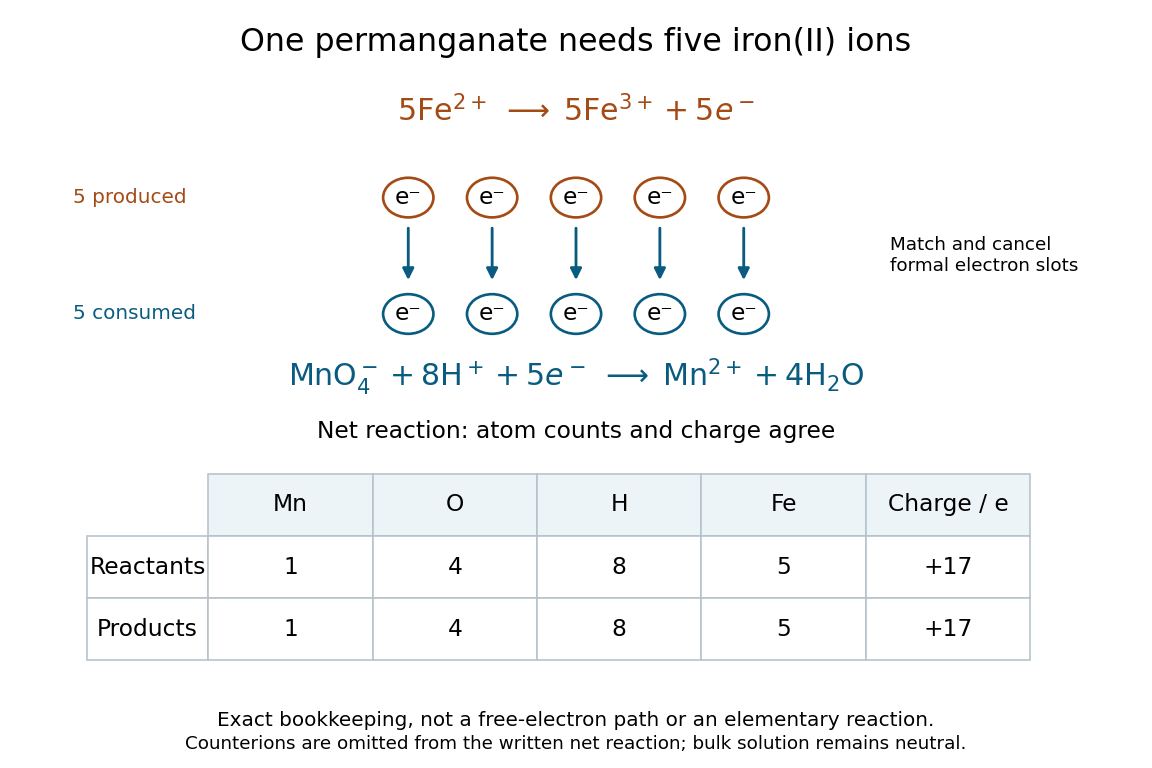
Acidic permanganate-iron balance: five exchanged electrons and conserved chemical atom and electric charge inventories
. Original exact stoichiometry diagram. Matching five formal electron slots is a bookkeeping operation, not a picture of free electrons in the chemical solution. The lower table verifies the net chemical equation; its is the net electric charge number of the written reacting species, not the bulk chemical solution. Details.
The coefficients predict amounts consumed, not a collision of five ions or an elementary reaction. Bulk chemical solution also contains compensating counterions, which are omitted from this net chemical equation. The hydrogen and oxygen oxidation states are unchanged; balancing their inventories remains essential even though they do not account for the exchanged electrons.
Articles by others on the same topic
There are currently no matching articles.