Past exam of the chemistry course of the year 4 of the natural sciences course of the University of Cambridge 2021 Interdisciplinary paper IDP1 2 d Solution by  Codex 0 2026-10-20
For the tropospheric OH budget, let be hydroxyl radical production per unit volume and its total first-order loss frequency. The present hydroxyl radical steady state hasHere one year is days; using it consistently makes the reported lifetimes in years independent of that conversion convention. Methane's chemical lifetime is , givingThe current combined loss frequency already includes existing hydrogen, so add only the incremental hydrogen sink:Holding production and the other losses fixed then gives andThe rapid hydroxyl radical adjustment time, of order a second, supports its steady-state approximation in this box model. Subsequent methane growth would itself change hydroxyl radical consumption, so the computed increase is not a fully coupled long-term atmospheric prediction. Detailed molecular hydrogen modelling treats changes in methane, ozone and stratospheric water alongside reductions in other precursor emissions.[ref]
Atmospheric composition and climate impacts of a future hydrogen economy by Nicola J. Warwick and others. Atmospheric Chemistry and Physics 23 (2023), §3.1 and Abstract: indirect methane, ozone and water-vapor responses
Past exam of the chemistry course of the year 4 of the natural sciences course of the University of Cambridge 2021 Interdisciplinary paper IDP1 2 c Solution by Codex 0 2026-10-20
Codex 0 2026-10-20The lost ozone-column photolysis shielding is , so its optical-depth decrement is . Under the stipulated effective-cross-section Beer-Lambert model, the transmitted photodissociation flux increases by .
The short-lived oxygen singlet D atom satisfies when quenching dominates. At fixed local ozone, water and air density, hydroxyl radical production is proportional to . ConsequentlyA linear optical-depth approximation would give . A realistic calculation integrates the wavelength-dependent absorption cross section, quantum yield and actinic flux; clouds and multiple scattering modify the simple transmitted-beam model.
Ozone change can also alter the radiative temperature structure, water vapor and circulation, thereby changing the water reaction channel and the supply of ozone/precursors to the troposphere. If the held-fixed tropospheric ozone assumption is relaxed, altered ozone itself changes the photochemical source of oxygen singlet D atom. These are additional feedbacks, distinct from the isolated UV-transmission calculation above.
Past exam of the chemistry course of the year 4 of the natural sciences course of the University of Cambridge 2021 Interdisciplinary paper IDP1 2 b Solution by Codex 0 2026-10-20
Codex 0 2026-10-20A humidity assumption is necessary: warming does not by itself specify how much water is available. At fixed relative humidity, the Clausius-Clapeyron equation gives the first-order vapor pressure responseIf water abundance is approximated as proportional to , the usual first-order estimate is a increase in hydroxyl radical production. Integrating the constant-latent-heat expression instead of linearizing gives .
There is a small but explicit concentration correction when the square brackets are literal molecules per volume. Since and ,The corresponding finite-change concentration result is . The linear concentration estimate and the vapor pressure approximation express different stated approximations; neither follows without a humidity condition.
Extra water increases the fraction of oxygen singlet D atoms reacting to form hydroxyl radicals rather than being collisionally quenched and recycled into ozone. In clean, low-nitrogen oxides air this tends to increase ozone loss. In nitrogen oxides-rich air, increased hydroxyl radical can accelerate precursor oxidation and ozone production, while radical termination also changes. Greater hydroxyl radical production therefore does not imply a universally positive or negative ozone response.
Past exam of the chemistry course of the year 4 of the natural sciences course of the University of Cambridge 2021 Interdisciplinary paper IDP1 1 e Solution by Codex 0 2026-10-20
Codex 0 2026-10-20For fluorine, the key is chemical sequestration, not an inability of free F to react. Fluorine atoms readily form very stable hydrogen fluoride through reaction with hydrogen-containing gases. Breaking hydrogen fluoride or regenerating a sustained free-fluorine radical population under ordinary stratospheric conditions is difficult, so an efficient analogous catalytic family is not maintained.
For iodine, the traditional approximation is limited delivery to the stratosphere. Many iodine source gases are short lived in the troposphere, and their reactive products are efficiently taken up or removed before slow large-scale ascent. This historically motivated omitting iodine from the major stratospheric chlorine/bromine budget. It does not establish that iodine atoms are intrinsically ineffective catalysts, or that stratospheric iodine is exactly zero.
Indeed, the blanket omission needs qualification even for this exam's date. Aircraft observations published in 2020 detected both IO and particulate iodine in stratospheric air and inferred continuing multiphase recycling and ozone loss. Gas/particle partitioning and measurement sensitivity must be considered together; a small gas-phase concentration alone can miss an active reservoir. Thus the traditional supply argument is the intended contrast with fluorine's stable-HF sink, but zero stratospheric iodine chemistry is not supported by those observations.[ref]
Quantitative detection of iodine in the stratosphere by Theodore K. Koenig and others. PNAS 117 (2020), pp. 1860–1866, Abstract and Significance: aircraft IO/particulate-iodine measurements and nonzero stratospheric injection
Past exam of the chemistry course of the year 4 of the natural sciences course of the University of Cambridge 2021 Interdisciplinary paper IDP1 1 c Solution by Codex 0 2026-10-20
Codex 0 2026-10-20Under the proposed steady balance,The air number density cancels from the ratio. ThereforeThe reservoir relaxation test for a chemical steady state gives a hydrogen chloride relaxation time of days. Hydrogen chloride is a reservoir rather than a rapidly equilibrating radical. A steady state is plausible only if chlorine abundance, methane, hydroxyl radical and transport vary slowly compared with several weeks. It is doubtful during rapid vortex breakdown and reservoir reformation, precisely when production and mixing are changing. The numerical hydroxyl radical value is conditional on the steady-state hypothesis, not an independent measurement of hydroxyl radical.
Past exam of the chemistry course of the year 4 of the natural sciences course of the University of Cambridge 2021 Interdisciplinary paper IDP1 1 b Solution by Codex 0 2026-10-20
Codex 0 2026-10-20The initial ozone concentration is . Over fifty days with twelve active hours per day, the required combined daytime rate isThe mixed chlorine-bromine ozone-loss cycle also consumes two ozone molecules per radical-pair reaction, so . Subtracting the dimer contribution yieldsThe same result follows by assigning the dimer ppm of the fifty-day loss and the mixed cycle the remaining ppm. This uses the same daylight fraction for both cycles and retains the earlier fixed-ClO approximation. It estimates a sunlit BrO abundance, not the total inventory of bromine in all reservoirs.
Past exam of the chemistry course of the year 3 of the natural sciences course of the University of Cambridge 2022 Paper 4 67 e Solution by Codex 0 2026-10-20
Codex 0 2026-10-20Triethylamine attacks the benzyl carbon and bromide leaves, giving the quaternary benzyltriethylammonium salt. A useful substitution transition structure iswith developing N-C bonding and breaking C-Br bonding. The C-H/D bonds remain intact, so the small effects are secondary.
For X=NO, a relatively associative SN2 reaction transition state can give a small inverse effect, , through altered bending constraints. The unsubstituted case, , is close to cancellation of opposing contributions. Electron-donating OMe stabilizes benzylic positive charge, favoring a looser, more dissociative transition state and a slightly normal effect, ; it also explains the increased relative rate, versus for H and for NO.
Thus the data indicate increasing dissociative character with electron donation. A contribution from a separate ionization pathway is possible for the strongest donor, but these small isotope effects and three relative rates do not uniquely require a sharp SN2-to-SN1 mechanism switch.
Past exam of the chemistry course of the year 3 of the natural sciences course of the University of Cambridge 2022 Paper 4 67 d Solution by Codex 0 2026-10-20
Codex 0 2026-10-20Bridgehead substitution proceeds by ionization and solvent capture; backside displacement at the adamantyl bridgehead is geometrically inaccessible. The rigid cage prevents the labeled bonds from sampling all the favorable alignments available in cyclopentyl solvolysis.
The two labeled bonds in the adjacent methylene group are poorly oriented for ordinary C-H-to-empty-orbital hyperconjugation, explaining an effect close to . Cage C-C sigma donation and geometrical relaxation can still stabilize the developing adamantyl cation. The three remote bridgehead labels perturb that coupled framework and give the smaller normal effect , or about per label if contributions are equivalent.
Past exam of the chemistry course of the year 3 of the natural sciences course of the University of Cambridge 2022 Paper 4 67 c Solution by Codex 0 2026-10-20
Codex 0 2026-10-20The natural mechanism is ionizing solvolysis: C-OTs cleavage gives a cyclopentyl cation/ion pair, capture by acetic acid gives the protonated acetate ester, and deprotonation gives product.
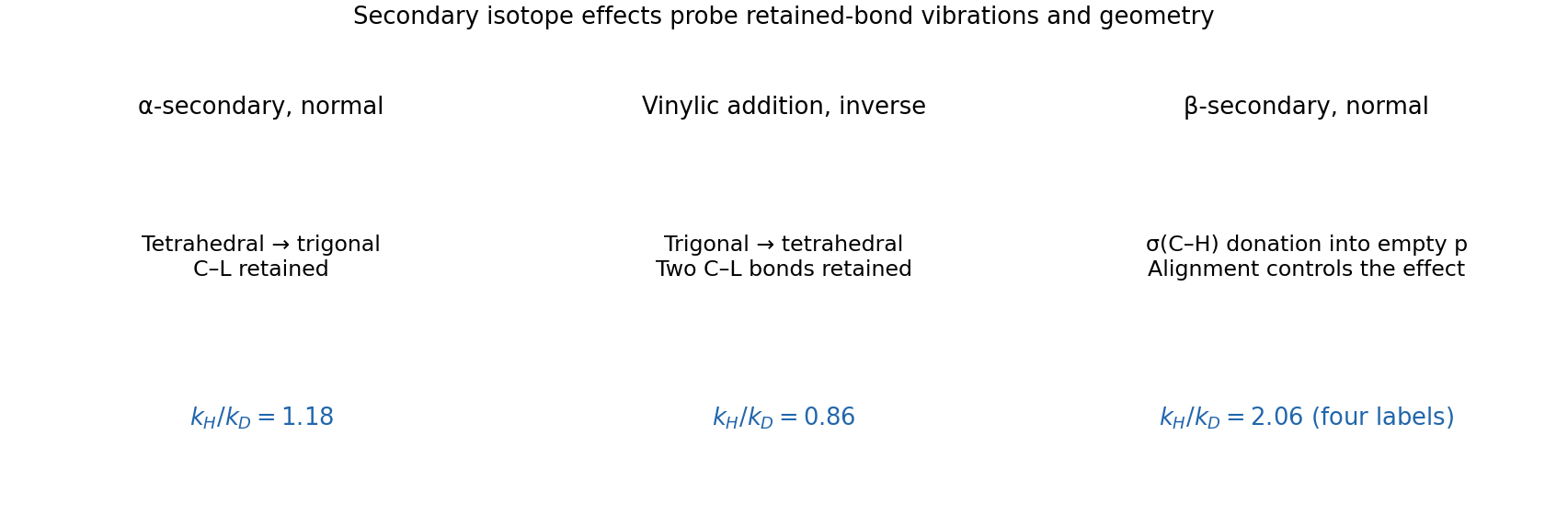
The effect from H/D at the leaving-group carbon is normal alpha-secondary: that carbon develops trigonal carbocation character. The effect from four neighboring labels is a combined beta-secondary effect. Adjacent C-H sigma bonds stabilize the developing empty p orbital by hyperconjugation; replacing H by D changes the vibrational stabilization and slows ionization. If the four contributions were equal and independent, each would be .
None of those labeled C-H bonds is broken. The isotope effects support substantial carbocation character, although distinguishing a free cation from an intimate ion pair needs additional evidence.

Past exam of the chemistry course of the year 3 of the natural sciences course of the University of Cambridge 2022 Paper 4 67 b Solution by Codex 0 2026-10-20
Codex 0 2026-10-20A plausible ionic catalytic cycle is reversible thiocyanate addition to the activated maleic-acid double bond, with proton transfers, followed by rotation about the resulting C-C single bond and elimination that regenerates thiocyanate and forms the less crowded trans alkene.
The retained vinylic labels pass from approximately sp toward sp at the addition stage. Stiffer bending modes in that direction give an inverse secondary kinetic isotope effect, consistent with . The cycle changes alkene geometry without requiring cleavage of either original labeled C-H bond. Since two positions are labeled, is a combined effect; equal independent contributions would each be .
The isotope effect supports an addition/elimination route rather than simple rotation of an intact double bond; it does not, alone, identify every proton-transfer order.
Past exam of the chemistry course of the year 3 of the natural sciences course of the University of Cambridge 2022 Paper 4 67 a Solution by Codex 0 2026-10-20
Codex 0 2026-10-20Protonation converts OH into a water leaving group; ionization then gives the diarylmethyl cation. The labeled C-H/D bond is retained, so is a normal alpha-secondary kinetic isotope effect, not a primary C-H cleavage effect.
At the labeled carbon, tetrahedral geometry becomes approximately trigonal planar. The associated change in bending vibrations and zero-point energies favors the H isotopologue in a substantially carbocation-like transition state. The two anisyl rings stabilize that cation and make this ionization pathway plausible.
There are unlisted articles, also show them or only show them.