Let denote the dihedral group of group order eight acting on a square. Here the subscript specifies group order; the same group is called in the convention that counts vertices of a polygon, as in the group action example. Let be a counterclockwise quarter-turn rotation and a reflection in a diagonal. ThenProducts act rightmost first. The group commutator of the generators of a group isIt is a half-turn rotation, so forcing and to commute must identify a half-turn with .
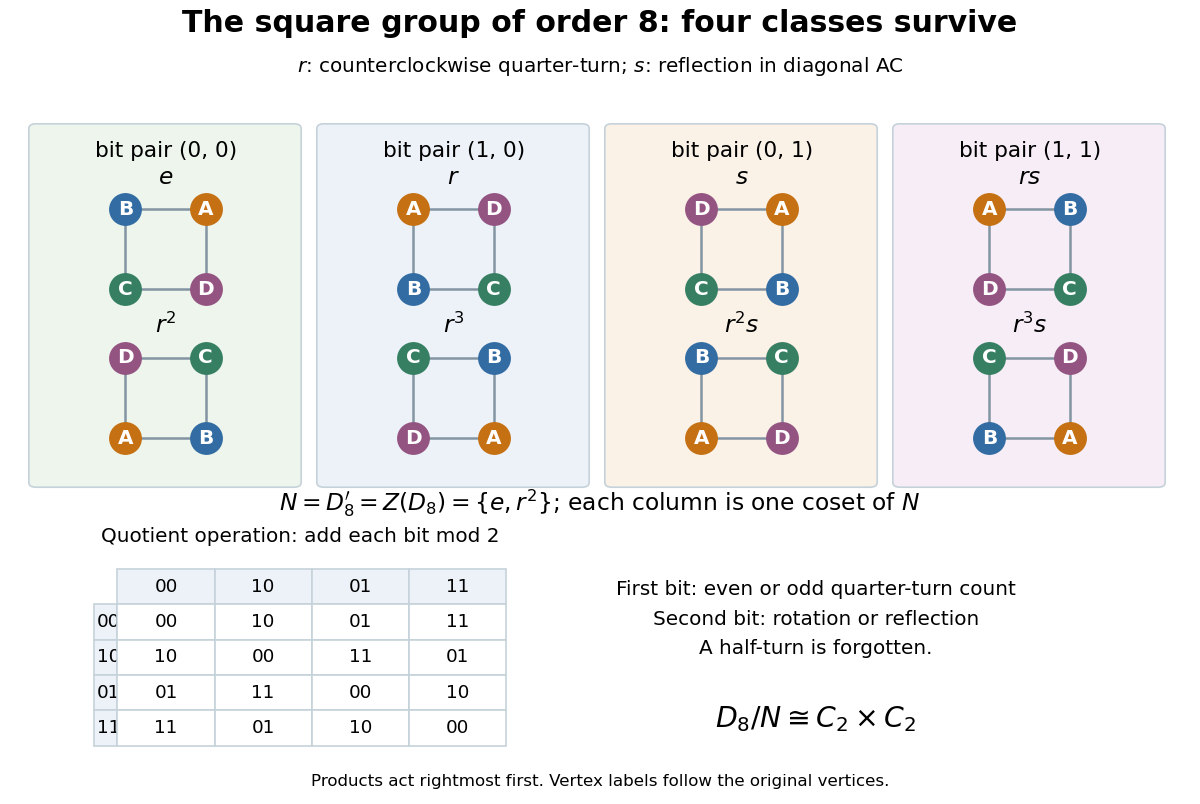

More concretely, write each element uniquely as , with and . The functionis a surjective group homomorphism. Indeed, giveswhere the exponents are reduced modulo four and two. Modulo two, and agree, so adds the two coordinates separately. Its group kernel is . Since the target is an abelian group, ; since , also . ThusThe four cosets are , , , and . Each coset forgets the difference of a half-turn. The quotient group still distinguishes rotations from reflections, and even from odd numbers of quarter-turns; the two surviving choices are independent. This is the Klein four-group, rather than the cyclic group , because each nonidentity element squares to the identity element. For the general dihedral group calculation, see Conrad, Dihedral groups I, theorem A.1; that source uses the vertex-count convention and for individual group commutators.
Articles by others on the same topic
There are currently no matching articles.